
S Series Tool Steel
El acero para herramientas de la serie S pertenece al grupo de aceros resistentes a los impactos del sistema de clasificación AISI. La designación "S" indica su resistencia a los impactos, lo que hace que estos aceros sean adecuados para herramientas expuestas a impactos repetidos, cargas repentinas, astillamiento, agrietamiento o rotura.
Aceros para herramientas de la serie S disponibles en Aobo Steel.
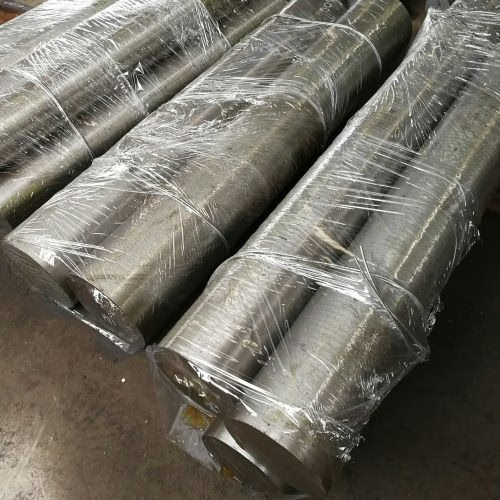
Aobo Steel suministra acero para herramientas de la serie S, resistente a los impactos, en forma de barras redondas y planas a granel para compradores de herramientas industriales, distribuidores, almacenistas y empresas de mecanizado.
S1 | 1.2550
Acero para herramientas resistente a los golpes, para aplicaciones que puedan requerir resistencia al impacto, dureza en caliente moderada u opciones de endurecimiento superficial.

S7 | 1.2355
Acero para herramientas resistente a los impactos, ampliamente utilizado, con comportamiento de endurecimiento al aire, buena templabilidad y mejor estabilidad dimensional.
El acero para herramientas de la serie S pertenece al grupo de aceros resistentes a los impactos del sistema de clasificación AISI. La designación "S" indica su resistencia a los impactos, lo que hace que estos aceros sean adecuados para herramientas expuestas a impactos repetidos, cargas repentinas, astillamiento, agrietamiento o rotura.
A diferencia de los aceros para herramientas de trabajo en frío con alto contenido de carbono, los aceros de la serie S no están diseñados principalmente para ofrecer la máxima resistencia al desgaste abrasivo. Suelen utilizar un menor contenido de carbono y una matriz más resistente y tratada térmicamente, lo que permite que la herramienta absorba la energía del impacto en lugar de fallar repentinamente.
La mayoría de los aceros de la serie S contienen combinaciones de silicio, manganeso, cromo, molibdeno, tungsteno o vanadio. Estos elementos de aleación controlan la templabilidad, la respuesta al revenido, la resistencia, la tenacidad y la resistencia al calor. Debido a que la composición de la aleación varía según el grado, los aceros S1, S2, S5 y S7 pueden comportarse de forma muy diferente durante el tratamiento térmico y su uso.
Entre los grados comunes de la serie S, el S7 es el más utilizado debido a su alta resistencia al impacto, su comportamiento de endurecimiento al aire y su mayor estabilidad dimensional. El S5 se usa frecuentemente para herramientas de alto impacto. El S1 se puede seleccionar cuando se requiere resistencia al impacto y una dureza en caliente moderada. El S2 es más adecuado para herramientas específicas que necesitan una capa superficial dura y un núcleo resistente.
Entre las aplicaciones típicas se incluyen cinceles, punzones, cuchillas de corte, remachadoras, rompedoras de hormigón, herramientas de conformado y determinadas herramientas para trabajos en caliente de intensidad moderada.
¿Por qué se utiliza el acero para herramientas de la serie S para la resistencia a los golpes?
La resistencia al impacto del acero para herramientas de la serie S se debe a su composición química y a su microestructura tratada térmicamente.
El contenido de carbono suele estar entre 0,40% y 0,65%. Este rango permite que el acero desarrolle una alta resistencia tras el endurecimiento y el revenido, limitando al mismo tiempo la formación de carburos grandes y frágiles. Los carburos grandes mejoran la resistencia a la abrasión, pero también pueden convertirse en puntos de inicio de grietas bajo cargas de impacto.
Los elementos de aleación ajustan la respuesta del acero. El silicio mejora la resistencia al revenido. El cromo, el molibdeno, el manganeso, el tungsteno y el vanadio pueden mejorar la templabilidad, la resistencia, la dureza en caliente o la resistencia al desgaste, según el grado del acero.
Tras un tratamiento térmico adecuado, los aceros de la serie S forman una estructura martensítica resistente con finos carburos. Esta estructura absorbe mejor los impactos repetidos que una estructura con alto contenido de carburos. Por esta razón metalúrgica, los aceros de la serie S se utilizan en herramientas sometidas a cargas de impacto.
Propiedades clave del acero para herramientas de la serie S
| Propiedad | Características del acero para herramientas de la serie S |
|---|---|
| Toughness | De alto a muy alto. Esta es la propiedad que define al grupo. |
| Hardness | Seleccionado según la carga de la herramienta, el grado y las condiciones del tratamiento térmico. |
| Resistencia al desgaste | Bajo a medio contenido de carbono en comparación con los aceros para herramientas de trabajo en frío con alto contenido de carbono. |
| templabilidad | Varía según el grado. El S2 tiene un endurecimiento superficial; el S7 tiene una templabilidad mucho mayor. |
| estabilidad dimensional | Se ve muy afectado por el método de temple. Los grados de endurecimiento al aire suelen ser más estables. |
| Resistencia al calor | Algunos grados pueden funcionar en condiciones de trabajo moderadamente calurosas, hasta aproximadamente 1000 °F a 1050 °F, o 540 °C a 565 °C. |
| Maquinabilidad | Generalmente moderado en estado recocido. |
Acero para herramientas de la serie S vs. Acero para herramientas serie D
La principal diferencia en la selección radica en el modo de fallo.
| Elemento de comparación | S Series Tool Steel | Acero para herramientas serie D |
|---|---|---|
| tipo de acero para herramientas | acero para herramientas resistente a impactos | Acero para herramientas de trabajo en frío con alto contenido de carbono y cromo. |
| Propósito principal | Resistencia al impacto | Resistencia al desgaste y retención de bordes |
| Dirección del carbono | Menor contenido de carbono que la serie D. | Alto contenido de carbono |
| Estructura de carburo | Menos carburos gruesos | Alto volumen de carburos duros ricos en cromo. |
| Toughness | Más alto | Más bajo |
| Resistencia al desgaste abrasivo | Más bajo | Más alto |
| Comportamiento ante el tratamiento térmico | Depende en gran medida del grado: endurecimiento por agua, aceite o aire. | Muchos grados son de endurecimiento al aire, excepto grados como el D3. |
| Uso típico | Cinceles, punzones, cuchillas de corte, herramientas de impacto | Troqueles de troquelado, cuchillas de corte, troqueles de conformado, herramientas de desgaste |
| Mejor opción cuando | La herramienta se rompe, se astilla o se agrieta. | La herramienta se desgasta principalmente |
Tratamiento térmico del acero para herramientas de la serie S.
El tratamiento térmico del acero para herramientas de la serie S debe controlar cuatro riesgos: descarburación superficial, grafitización, agrietamiento por temple y fragilidad excesiva.
Muchos aceros de la serie S contienen silicio. Durante el calentamiento, una atmósfera deficiente en el horno puede provocar la descarburación de la superficie. Una superficie descarburada pierde carbono y se vuelve más débil que el núcleo. Esto puede reducir la resistencia a la fatiga, la resistencia de los bordes y la vida útil.
Los aceros con alto contenido de silicio también pueden grafitizarse si se sobrecalientan o se mantienen a altas temperaturas durante demasiado tiempo. Esto daña la estructura de acero y reduce la fiabilidad. Se prefiere el calentamiento en atmósfera controlada, al vacío o en baño de sales neutras cuando la calidad de la superficie es importante.
A continuación se muestra el procedimiento habitual de tratamiento térmico.
| Etapa de tratamiento térmico | Objetivo |
|---|---|
| Recocido | Produce una estructura suave y uniforme para el mecanizado. |
| Precalentamiento | Reduce el choque térmico antes de la austenización. |
| Austenización | Prepara el acero para el endurecimiento. |
| Temple | Endurece el acero según su grado y tamaño de sección. |
| Templado | Reduce la fragilidad y establece el equilibrio final entre dureza y tenacidad. |
| Doble templado | Se utiliza con frecuencia en grados como S5 y S7 para mejorar la estabilidad y la resistencia. |
El método de temple es una de las mayores diferencias entre los grados S.
| Método de enfriamiento | Significado típico |
|---|---|
| enfriamiento del agua | Enfriamiento rápido, alto efecto de endurecimiento, mayor riesgo de agrietamiento y deformación. |
| enfriamiento con aceite | Más seguro que el temple en agua y habitual para grados de templabilidad media. |
| endurecimiento por aire | Mayor estabilidad dimensional y menor riesgo de agrietamiento por temple en secciones de dimensiones adecuadas. |
Los siguientes rangos deben considerarse valores de referencia típicos, no un sustituto de la ficha técnica de tratamiento térmico del fabricante de acero. En la práctica final, se deben tener en cuenta el tamaño de la herramienta, el tipo de horno, la protección de la superficie, el espesor de la sección y la dureza de trabajo requerida.
| Grado | Precalentamiento típico | Gama austenizante | Método de enfriamiento | Dirección típica de revenido/dureza |
|---|---|---|---|---|
| S1 | ~1200 °F / 650 °C | 1650–1750 °F / 900–955 °C | enfriamiento con aceite | Templado a 205–650 °C (400–1200 °F). La dureza de trabajo puede variar entre 58 HRC y 40 HRC, dependiendo de la temperatura de templado. |
| S5 | ~1400 °F / 760 °C | 1600–1695 °F / 870–925 °C | enfriamiento con aceite | Se recomienda un doble templado. Para aplicaciones de máxima resistencia al impacto, lo típico es una dureza de entre 40 y 44 HRC. |
| S7 | 1200–1300 °F / 650–705 °C | 1695–1750 °F / 925–955 °C | Enfriamiento por aire en secciones adecuadas | Es común utilizar un doble revenido a 900–960 °F / 482–516 °C. La dureza final es de aproximadamente 58–60 HRC en este rango. |
El acero S7 se suele considerar un acero para herramientas resistente a los golpes y al aire. Se prefiere para herramientas que requieren mayor estabilidad dimensional o que presentan formas más complejas. El acero S5 se suele templar en aceite. El acero S2 generalmente conlleva un mayor riesgo de tratamiento térmico debido a que se asocia con un temple más rápido.
El revenido debe realizarse inmediatamente después del temple. Los aceros para herramientas resistentes a los golpes no deben permanecer en estado templado. En todas las series S y aplicaciones, la dureza final de trabajo suele oscilar entre 40 y 60 HRC.
Aplicaciones del acero para herramientas de la serie S
| Área de aplicación | Herramientas típicas | Riesgo principal de fallo | Dirección adecuada de la serie S |
|---|---|---|---|
| Herramientas de percusión y golpeo | Cinceles manuales, cinceles neumáticos, remachadoras, martillos rompedores de hormigón | fractura por impacto, deformación en forma de hongo, rotura | S5, S7, S2 |
| Perforación de alta resistencia | Punzones fríos, punzones de cabeza, bolos de nocaut | Agrietamiento del punzón, astillamiento del borde, carga repentina | S7, S5 |
| Herramientas de corte | Cuchillas de corte, cortadoras en frío, cortatubos | Desconchado de bordes y carga de impacto | S7, S5 |
| Herramientas de conformado y prensado | Troqueles de doblado, troqueles de acuñación, troqueles de conformado | Estrés local, agrietamiento, carga repetida | S7, S5 |
| Trabajo en caliente moderado | Punzones calientes, cuchillas de corte en caliente, insertos de forja | Ablandamiento, agrietamiento, tensión termomecánica | S1, S7 |
| Soporte para moldeo y utillaje de plástico | Componentes de moldes, fresas maestras, insertos de herramientas | Resistencia, pulido y estabilidad dimensional | S7 |
Cómo elegir acero para herramientas de la serie S
Tras decidir que un acero de la serie S es adecuado, el siguiente paso es elegir la dirección de grado correcta. La elección depende de la estabilidad dimensional, el método de temple, el tamaño de la sección, la temperatura de trabajo y el rendimiento superficial requerido.
| Necesidad de selección | Mejor dirección de grado | Razón |
|---|---|---|
| Óptima estabilidad dimensional | S7 | El comportamiento de endurecimiento al aire reduce el riesgo de deformación en las secciones adecuadas. |
| Forma compleja de la herramienta o esquinas afiladas | S7 | Endurecimiento más seguro que el de los grados templados en agua. |
| Herramientas de impacto pesado en general | S5 o S7 | Ambos se utilizan para herramientas sometidas a cargas de impacto; el S7 ofrece una mayor seguridad de endurecimiento. |
| Herramientas de impacto endurecibles con aceite | S5 | Adecuado para aplicaciones donde el enfriamiento con aceite y la economía son importantes. |
| Aplicaciones de choque por trabajo en caliente moderado | S1 o S7 | Estos grados ofrecen una mayor resistencia al ablandamiento a temperaturas elevadas. |
| Mayor resistencia al desgaste de la superficie gracias a su núcleo resistente. | S1 | Se puede considerar el tratamiento S1 cuando la carburación o el endurecimiento superficial resulten útiles. |
| Herramientas sencillas que necesitan una carcasa resistente y un núcleo robusto. | S2 | Más adecuado para formas simples, ya que un enfriamiento rápido aumenta el riesgo de daños durante el tratamiento térmico. |
| Herramientas de gran sección transversal | S7 o grados de temple profundo | La templabilidad debe ser suficiente a través de la sección. |
Para la mayoría de las herramientas generales resistentes a impactos, el S7 suele ser el primer grado a evaluar porque combina tenacidad, templabilidad y estabilidad dimensional. El S5 sigue siendo útil para herramientas de impacto de servicio pesado donde el temple en aceite es aceptable. El S1 es adecuado para aplicaciones que requieren resistencia al impacto, con opciones de dureza en caliente moderada o endurecimiento superficial. El S2 debe utilizarse con más cuidado porque sus requisitos de temple limitan la complejidad de los diseños de herramientas.
¿Necesita suministro al por mayor de acero para herramientas de la serie S?
Aobo Steel suministra barras redondas y barras planas de acero para herramientas resistente a impactos S1, S7 y otros grados para pedidos industriales al por mayor. Envíe el grado, tamaño, cantidad y aplicación requeridos.