

Acero para herramientas de trabajo en caliente 4Cr5MoSiV
AOBO STEEL – Proveedor mundial de confianza de aceros para herramientas
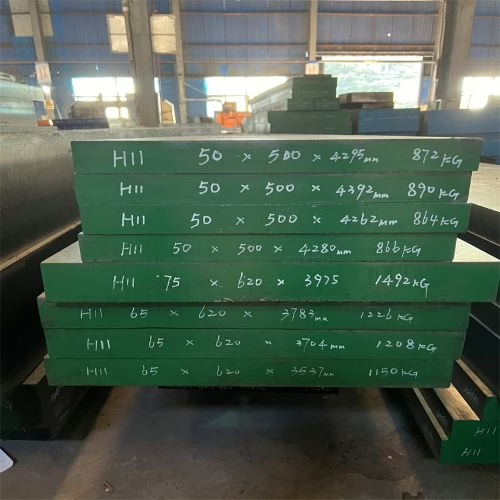
4Cr5MoSiV es un grado de la norma nacional china, equivalente a AISI H11 en los Estados Unidos. En comparación con 4Cr5MoSiV1(AISI H13/DIN 1.2343), el contenido de vanadio en la composición del 4Cr5MoSiV es menor. El 4Cr5MoSiV1 generalmente tiene mayor resistencia en caliente y dureza, y es más ampliamente utilizado, pero el 4Cr5MoSiV sigue siendo preferido para matrices de forja por martillo de alta velocidad debido a su excelente resistencia a la fatiga térmica.
1. Composición química (GB / T 1299—2000)
| C | Si | Mn | Cr | Mo | V | P | S |
| 0.33 – 0.43% | 0.80 – 1.20% | 0.20 – 0.50% | 4,75 – 5,50% | 1.10 – 1.60% | 0,30 – 0,60% | ≤0,030% | ≤0,030% |
2. Propiedades físicas del 4Cr5MoSiV
2.1 Temperaturas críticas
| Punto crítico | Ac₁ | Ac₃ | Ar₁ | Ar₃ | Ms | Mf |
| Temperatura (aprox.) / °C | 853 | 912 | 720 | 773 | 310 | 103 |
2.2 Coeficiente de expansión lineal
| Temperatura / °C | 20 ~ 100 | 20 ~ 200 | 20 ~ 300 | 20 ~ 400 | 20 ~ 500 | 20 ~ 600 | 20 ~ 700 |
| Coef. de expansión lineal α / 10⁻⁶ °C⁻¹ | 10.0 | 10.9 | 11.4 | 12.2 | 12.8 | 13.3 | 13.6 |
2.3 Conductividad térmica
| Temperatura / °C | 100 | 200 | 300 | 400 | 500 | 600 | 700 |
| Conductividad térmica λ / [W/(m·K)] | 25.9 | 27.6 | 28.4 | 28.0 | 27.6 | 26.7 | 25.9 |
2.4 Módulo de elasticidad
| Temperatura / °C | 20 | 100 | 200 | 300 | 400 | 500 |
| Módulo de elasticidad E / MPa | 227,000 | 221,000 | 216,000 | 208,000 | 200,000 | 192,000 |
2.5 Densidad y capacidad calorífica específica
| Densidad / (g/cm³) | Capacidad calorífica específica cₚ (20°C) / [J/(kg·K)] |
| 7.69 | 459.8 |
3. Caliente Especificación del proceso de forja para el acero 4Cr5MoSiV
| Artículo | Temperatura de calentamiento / °C | Temperatura inicial de forjado / °C | Temperatura final de forjado / °C | Método de enfriamiento |
| Lingote de acero | 1140 ~ 1180 | 1100 ~ 1150 | ≥900 | Enfriamiento en arena o enfriamiento en foso |
| Palancón de acero | 1120 ~ 1150 | 1070 ~ 1100 | 850 ~ 900 | Enfriamiento en arena o enfriamiento en foso |
Complete el siguiente formulario de contacto para obtener la cotización más reciente del 4Cr5MoSiV.
4. Tratamiento térmico del 4Cr5MoSiV
4.1 Precalentamiento
| Plan preliminar de tratamiento térmico | Parámetros del proceso |
| Recocido posterior al forjado | Temperatura de calentamiento 860 ~ 890 °C, mantener durante 2 ~ 4 h; enfriar en horno hasta por debajo de 500 °C y luego enfriar al aire. Dureza después del recocido ≤229HBW. |
| Recocido para aliviar el estrés | Temperatura de calentamiento 730 ~ 760 °C, mantener durante 3 ~ 4 h, enfriar en horno o enfriar al aire. |
4.2 Enfriamiento
① Especificación del proceso de temple recomendado
| Temperatura de temple / °C | Medio de temple | Temperatura del medio de temple / °C | Paso posterior | Dureza HRC |
| 1000 ~ 1030 | Aceite o aire | 20 ~ 60 | Enfriar hasta la temperatura del aceite | 53 ~ 55 |
② Relación entre la temperatura de temple y la dureza
| Temperatura de temple / °C | 950 | 975 | 1000 | 1025 | 1050 | 1075 | 1100 |
| Dureza HRC | 51 | 53 | 54.5 | 56 | 58 | 58.5 | 57.5 |
4.3 Templado
① Especificación del proceso de templado recomendado
| Propósito del templado | Temperatura / °C | Equipo | Enfriamiento | Número de temperamentos | Dureza HRC |
|---|---|---|---|---|---|
| Eliminar tensiones y reducir la dureza | 530 ~ 580 | Horno de baño de sales fundidas o horno de aire | Enfriar al aire | 2 | 47 ~ 49 |
Nota: La segunda temperatura de revenido suele ser 20 ~ 30 °C menor que la primera.
② Propiedades mecánicas después del revenido a diferentes temperaturas
| Temperatura de revenido / °C | 500 | 550 | 600 | 650 |
|---|---|---|---|---|
| Dureza HRC | 57 | 54.5 | 46.5 | 37 |
| aᴋ / (J/cm²) | 20 | 45 | 60 | 66 |
Nota: 1000 °C enfriar al aire, 580 °C revenir.
4.4 Especificación del proceso de tratamiento de endurecimiento superficial recomendado
| Proceso | Temperatura / °C | Tiempo / h | Medio | Espesor de capa / mm | Dureza superficial HV |
|---|---|---|---|---|---|
| Nitruración | 560 | 2 | KNO₃ 50% + NaNO₃ 50% (fracción de masa) | 0.04 | 640 ~ 690 |
| Nitruración | 580 | 8 | Gas natural + amoníaco | 0.25 ~ 0.30 | 830 ~ 860 |
| Nitruración | 540 | 12 ~ 20 | Tasa de descomposición del amoníaco 30% ~ 60% | 0.15 ~ 0.20 | 550 ~ 750 |
5. Propiedades mecánicas
El acero 4Cr5MoSiV (H11) es un acero para herramientas de trabajo en caliente del tipo de endurecimiento por enfriamiento al aire. Tiene buena tenacidad y, después del endurecimiento por tratamiento térmico, su resistencia puede alcanzar más de 2070 MPa. Debido a que puede endurecerse al aire, la deformación por temple y las tensiones residuales son pequeñas, y la tendencia a la oxidación superficial también es pequeña. Puede producir un fenómeno de endurecimiento secundario y puede alcanzar un rendimiento óptimo cuando se reviene por encima de 510 °C. Después del revenido a alta temperatura, se puede eliminar la mayor parte de la tensión interna. Tiene buena estabilidad térmica y puede resistir la erosión de la aleación de aluminio fundido. Por debajo de 650 °C, tiene alta ductilidad, tenacidad al impacto, resistencia a la oxidación, resistencia a la fatiga térmica, así como alta resistencia a la fluencia y resistencia a la tracción.
5.1 Propiedades mecánicas a alta temperatura
| Temperatura de ensayo / °C | Rₘ / MPa | Rₑₗ / MPa | A (%) | Z (%) |
| 300 | 1504 | 1311 | 12.0 | 39.1 |
| 600 | 895 | 794 | 21.9 | 72.9 |
| 650 | 471 | 402 | 33.1 | 85.5 |
| 700 | 226 | 179 | 55.0 | 94.5 |
5.2 Dureza a alta temperatura
| Temperatura de ensayo / °C | 300 | 450 | 600 | 650 | 700 | 750 |
|---|---|---|---|---|---|---|
| Dureza HV | 491.5 | 448.5 | 384.0 | 302.5 | 227.5 | 178.5 |
Nota: Dureza original de la probeta 49~50HRC.
5.3 Tenacidad al impacto a alta temperatura
| Temperatura de ensayo / °C | 300 | 600 | 650 | 700 |
|---|---|---|---|---|
| Energía de absorción de impacto K / J | 28.8 | 31.0 | 36.5 | 70.0 |
5.4 Rendimiento de fatiga térmica
| Grado | |
|---|---|
| 20 ~ 650 °C repetido 1000 veces | 8.2 |
| 20 ~ 750 °C repetido 1000 veces | 14.6 |
5.5 Resistencia al desgaste térmico
Resistencia al desgaste térmico del acero 4Cr5MoSiV (I)
| Rotaciones/veces | 300 | 600 | 900 | 1200 | 1500 | 2500 |
|---|---|---|---|---|---|---|
| Pérdida de peso / mg | 0.67 | 0.80 | 1.4 | 1.63 | 1.97 | 2.62 |
Nota: Temperatura de ensayo 800 ~ 850 °C, presión 784 ~ 882N, dureza de la probeta 49 ~ 50HRC.
Tabla 5-89 Resistencia al desgaste térmico del acero 4Cr5MoSiV (II)
| Rotaciones/veces | 100 | 200 | 300 | 400 | 500 | 600 | 700 | 1000 |
|---|---|---|---|---|---|---|---|---|
| Pérdida de peso / mg | 0.77 | 1.67 | 2.50 | 3.47 | 4.33 | 4.90 | 5.60 | 7.40 |
Nota: Temperatura de ensayo 910 ~ 950 °C, presión 1784 ~ 1813 N, dureza de la probeta 49 ~ 50 HRC.
5.6 Resistencia al revenido
| Temperatura / °C | 500 (Temperatura máxima de endurecimiento secundario) | 560 | 615 | 600 | 653 |
|---|---|---|---|---|---|
| Dureza HRC | 55.0 (Dureza máxima de endurecimiento secundario) | 49.0 | 42.0 | 36.0 | 35.0 |
Nota: Probeta templada en aceite a 1020 °C, dureza 59 ~ 60 HRC.
5.7 Resistencia a la corrosión térmica
| Temperatura y tiempo de ensayo | 620°C × 4h | 680°C × 4h |
|---|---|---|
| Pérdida de peso / (g/dm²) | 4.4188 | 16.4 |
5.8) Límite de fatiga
| Temperatura de ensayo / °C | Temperatura ambiente | 300 | 400 | 450 | 500 |
|---|---|---|---|---|---|
| σ-1 / MPa | 880 | 680 | 640 | 630 | 610 |
| σ-1k / MPa | 570 | 440 | 430 | — | 420 |
5.9 Estabilidad térmica del acero 4Cr5MoSiV a 620 °C
| Tiempo de mantenimiento / h | 2 | 4 | 6 | 8 | 11.5 | 14.5 | 17.5 | 21 |
|---|---|---|---|---|---|---|---|---|
| Dureza HRC | 39.4 | 38.4 | 36.9 | 35.1 | 34.4 | 33.2 | 32.6 | 32.3 |
Nota: La dureza original de la probeta era 49.9 HRC.
6. Aplicaciones
El acero 4Cr5MoSiV (H11) se utiliza comúnmente para la fabricación de moldes de fundición a presión para piezas de aluminio, matrices de extrusión en caliente, herramientas y barras de núcleo para punzonado, matrices de forja por prensa, moldes de plástico, etc. Además, debido a su buena resistencia a temperatura media, también se utiliza para la fabricación de componentes estructurales para aviones, cohetes y piezas para turbinas de vapor y turbinas de gas.