
Cr12MoV vs D2 Tool Steel: Are They Equivalent?
Cr12MoV is not equivalent to AISI D2 tool steel. Both are high-carbon, high-chromium cold-work tool steels, but they differ in alloy content, heat treatment response, wear resistance, and international grade equivalency.
The main difference is between molybdenum and vanadium. D2 contains higher Mo and V than Cr12MoV, so it performs better in abrasive wear, secondary hardening, and long-run cold-work tooling. Cr12MoV can still work well in standard cold-work applications, but it should not be used as a direct D2 replacement without customer approval.
In Chinese GB grades, Cr12Mo1V1 is the equivalent of AISI D2. Cr12MoV is a related Chinese cold-work tool steel, not the same material as D2.
Cr12MoV and D2 Differ Mainly in Molybdenum and Vanadium Content
The chemical composition explains the performance gap between Cr12MoV and D2. Their carbon and chromium contents are close, but D2 contains more molybdenum and vanadium.
| Elemento | Cr12MoV | AISI D2 |
| Carbón | 1.45%–1.70% | 1.40%–1.60% |
| Cromo | 11.00%–12.50% | 11.00%–13.00% |
| Molibdeno | 0.40%–0.60% | 0.70%–1.20% |
| Vanadio | 0.15%–0.30% | 0.50%–1.10% |
| Silicio | ≤0,40% | ≤0,60% |
| Manganeso | ≤0,40% | ≤0,60% |
Molybdenum improves hardenability and tempering resistance. Vanadium helps form hard carbides and improves wear resistance. This is why D2 usually has a higher performance ceiling in wear-critical tooling.
Cr12MoV still offers useful wear resistance, but its lower Mo and V content makes it a lower-alloy choice than D2.
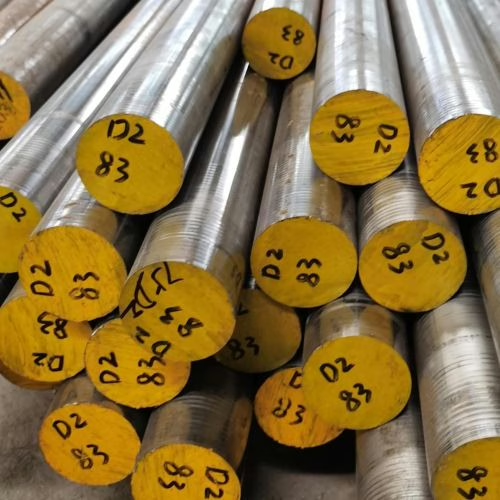
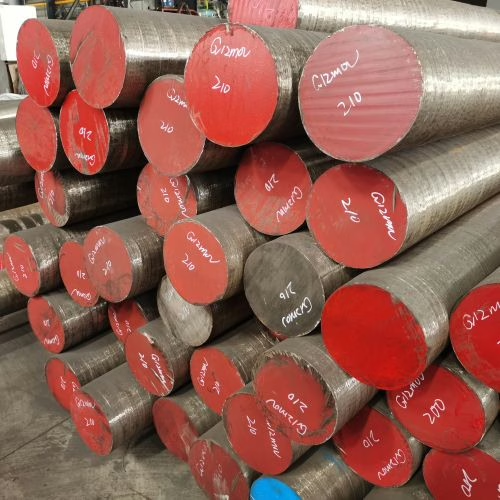
D2 Offers Stronger Wear Resistance and Secondary Hardening Than Cr12MoV
D2 usually provides better abrasive wear resistance because its higher Mo and V content promotes the formation of harder alloy carbides. These carbides help the tool keep its working edge and surface under abrasive contact.
D2 also responds better to high-temperature tempering. During tempering at 500–550 °C, molybdenum and vanadium promote secondary hardening via fine-carbide precipitation. This helps D2 maintain high hardness after tempering.
| Factor de rendimiento | Cr12MoV | AISI D2 |
| Resistencia al desgaste | Bien | Mejor |
| Secondary hardening | Moderado | Stronger |
| Estabilidad dimensional | Good when properly treated | Very good with air hardening |
| Best fit | Herramientas generales para trabajo en frío | Long-run and wear-critical tooling |
This does not mean Cr12MoV is weak. It means D2 is the stronger option when abrasive wear, edge retention, and tool life are the main concerns.
D2 and Cr12MoV Use Similar Heat Treatment Steps but Respond Differently
Both steels require controlled heat treatment. The process usually includes preheating, austenitizing, quenching, and tempering. Their temperature ranges are close, but their responses are not identical.
| Heat Treatment Item | Cr12MoV | AISI D2 |
| Austenitización | About 1000–1050 °C | About 1010–1040 °C |
| Temple | Oil or air, depending on section size and process | Usually air quenching |
| Low-temperature tempering | About 150–200 °C | About 150–200 °C |
| High-temperature tempering | About 500–520 °C | About 500–550 °C |
| dureza de trabajo típica | About 58–61 HRC | About 58–62 HRC |
Cr12MoV can achieve high hardness and low deformation when heat treatment is properly controlled. Overheating should be avoided because it can cause grain growth and reduce toughness.
D2 has better air-hardening behavior. It can harden with lower quenching stress, so it usually provides better dimensional stability in precision tooling and long-run production. For details, see how to heat treat D2 tool steel.
Cr12Mo1V1 Is the Chinese Equivalent to AISI D2
Cr12MoV is not the Chinese equivalent of AISI D2. The Chinese GB equivalent is Cr12Mo1V1.
This distinction matters in international purchasing. Drawings and purchase orders may specify D2, 1.2379, SKD11, X153CrMoV12, or Cr12Mo1V1. These grades refer to D2-type material requirements. Cr12MoV should not be used in place of them unless the buyer confirms the substitution.
| Calificación | Standard / Region | Relationship |
| AISI D2 | USA | Reference grade |
| 1.2379 | DIN / EN | Common D2 equivalent |
| X153CrMoV12 | EN | Common D2-type designation |
| SKD11 | JIS | Common Japanese equivalent to D2 |
| Cr12Mo1V1 | Gran Bretaña | Chinese equivalent to AISI D2 |
| Cr12MoV | Gran Bretaña | Related cold-work tool steel, not direct D2 equivalent |
Cr12MoV Fits General Cold-Work Tooling, While D2 Fits Longer Production Runs
Cr12MoV and D2 can appear in similar tooling categories, but they are suited to different levels of working severity. Cr12MoV is more practical when cost control is a priority, and the tool does not experience extreme wear. D2 is more suitable when production volume, dimensional stability, and service life are more important.
| Application or Requirement | Mejor opción | Razón |
| General punching dies | Cr12MoV or D2 | Choose by wear level and production volume |
| Long-run blanking dies | D2 | Better edge retention and wear resistance |
| Thread-rolling dies | D2 | Better for high pressure and long service life |
| Cold shears and slitter blades | D2 | Better under abrasive cutting conditions |
| General drawing dies | Cr12MoV or D2 | Cr12MoV fits moderate use; D2 fits heavier wear |
| Gauges and precision tools | D2 | Better dimensional stability after heat treatment |
| Cost-sensitive cold-work tools | Cr12MoV | Lower alloy content can reduce material cost |
| International D2-type requirement | D2 or Cr12Mo1V1 | Matches common D2 equivalent expectations |
Choose Cr12MoV as a cost-effective option for standard cold-work tooling. Choose D2 or Cr12Mo1V1 when the tool needs higher wear resistance, better dimensional stability, longer service life, or D2-type international equivalency.