
Heat treatment guidance for tool steel
Cold WorkWear-resistant grades for blanking, forming and cutting at room temperature.
D21.2379 / SKD11
High-carbon high-chromium cold-work steel. Air hardening keeps distortion low while delivering excellent wear resistance for long production runs.
Austenitize995–1030°C
QuenchAir
Working58–60 HRC
D31.2080 / SKD1
High-wear cold-work steel for long-run blanking and forming. Oil hardening reaches very high hardness but calls for care to avoid quench cracking.
Austenitize925–980°C
QuenchOil
Working58–64 HRC
D61.2436 / SKD2
Tungsten-alloyed cold-work steel with fine, stable carbides that hold a keen edge in cutting and trimming tools.
Austenitize~960°C
QuenchOil
Working58–64 HRC
A21.2363 / SKD12
Air-hardening cold-work steel that balances wear resistance and toughness, with better dimensional stability than oil-hardening grades.
Austenitize925–980°C
QuenchAir
Working57–62 HRC
O11.2510 / SKS3
General-purpose oil-hardening tool steel, easy to machine and forgiving in the shop, a reliable choice for short to medium runs.
Austenitize790–815°C
QuenchOil
Working57–62 HRC
O21.2842
Manganese oil-hardening steel with low distortion on quench, well suited to gauges and precision tooling.
Austenitize790–815°C
QuenchOil
Working57–62 HRC
Shock-ResistingTough grades for tooling under heavy impact and shock loads.
S11.2550
Tungsten shock-resisting steel for impact tools that also need moderate wear resistance. Often tempered immediately after quench to prevent cracking.
Austenitize900–955°C
QuenchOil
Working50–58 HRC
S71.2355
Air-hardening shock-resisting steel with high toughness and deep hardenability for dies that take repeated heavy impact.
Austenitize925–955°C
QuenchAir
Working54–58 HRC
Hot WorkGrades that hold strength and resist thermal fatigue at elevated temperatures.
H101.2365
Chromium-molybdenum hot-work steel with strong resistance to thermal softening, used for hot punches, extrusion tooling and inserts.
Austenitize995–1025°C
QuenchAir
Working40–52 HRC
H111.2343 / SKD6
Air-hardening hot-work steel with deep hardenability and high toughness for die casting, extrusion and forging dies.
Austenitize995–1025°C
QuenchAir
Working42–54 HRC
H131.2344 / SKD61
The workhorse hot-work grade, combining thermal-fatigue resistance with toughness for die casting, forging and extrusion dies.
Austenitize995–1040°C
QuenchAir
Working44–52 HRC
High SpeedRed-hard grades for cutting tools that run hot and fast.
M21.3343 / SKH51
Versatile high-speed steel with a strong balance of wear resistance and toughness for drills, taps and cutting tools.
Austenitize1190–1230°C
QuenchOil/Air/Salt
Working60–65 HRC
StainlessCorrosion-resistant grades for molds, blades and wear parts in wet or hygienic environments.
440C1.4125 / SUS440C
High-carbon martensitic stainless steel that reaches high hardness while resisting corrosion, used for bearings, knife blades and wear parts.
Austenitize1010-1065°C
QuenchOil / Air
Working58-60 HRC
4201.2083 / SUS420
Corrosion-resistant martensitic stainless steel with good polishability, widely used for plastic molds and blades that run in humid or corrosive conditions.
Austenitize980-1035°C
QuenchOil / Air
Working48-52 HRC
Bearing & OtherSpecialist grades for bearings and shock-loaded forging tooling.
521001.3505 / 100Cr6
High-carbon chromium bearing steel for components that need high hardness and good wear resistance, such as rollers and races.
Austenitize815–860°C
QuenchOil
Working60–64 HRC
L61.2714 / SKT4
Nickel-chromium tool steel with high toughness and good hardenability for shock-loaded dies and large forging tooling.
Austenitize815–870°C
QuenchOil
Working45–58 HRC
Heat treatment, in four steps
Heat treatment is controlled heating and cooling that changes microstructure and properties while limiting shape change. The chain runs preheat, austenitize, quench and temper, and the final result is set by its weakest link, above all furnace uniformity, part geometry and quench severity.
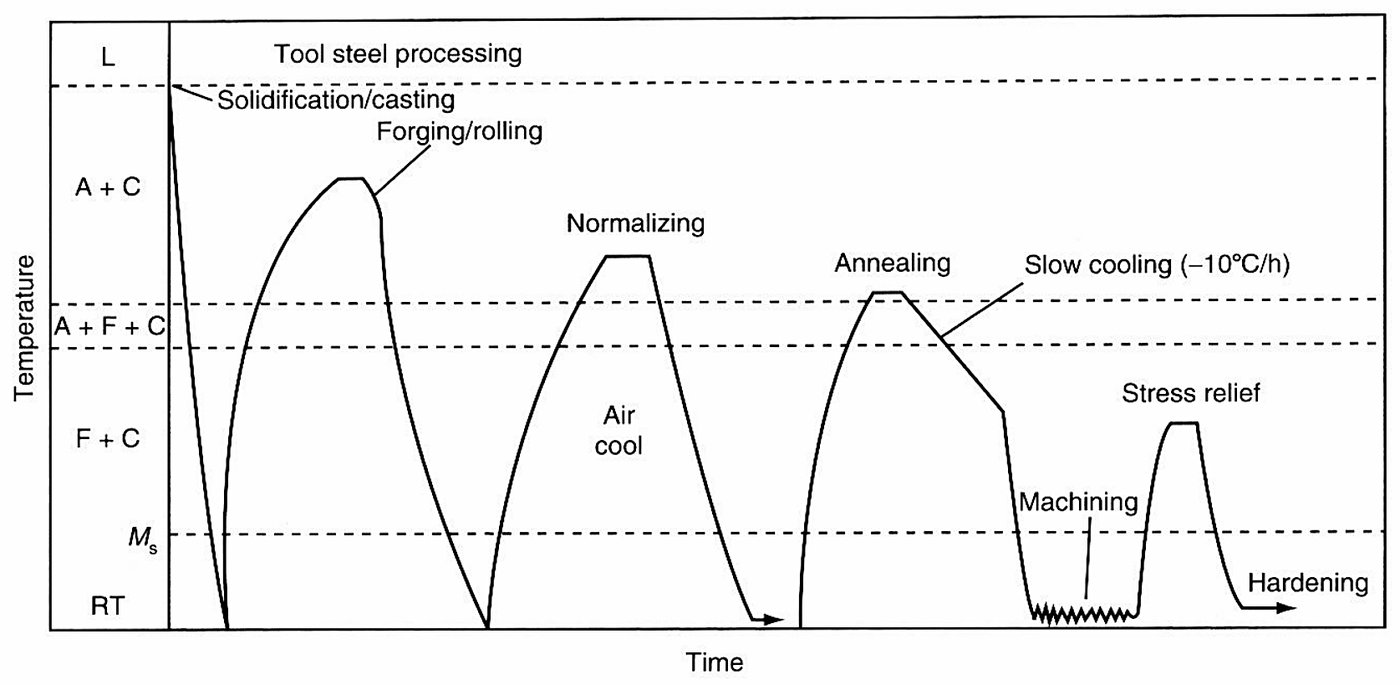
The four steps are part of one sequence that starts long before the tool is finished, and the structure changes at every stage of it.
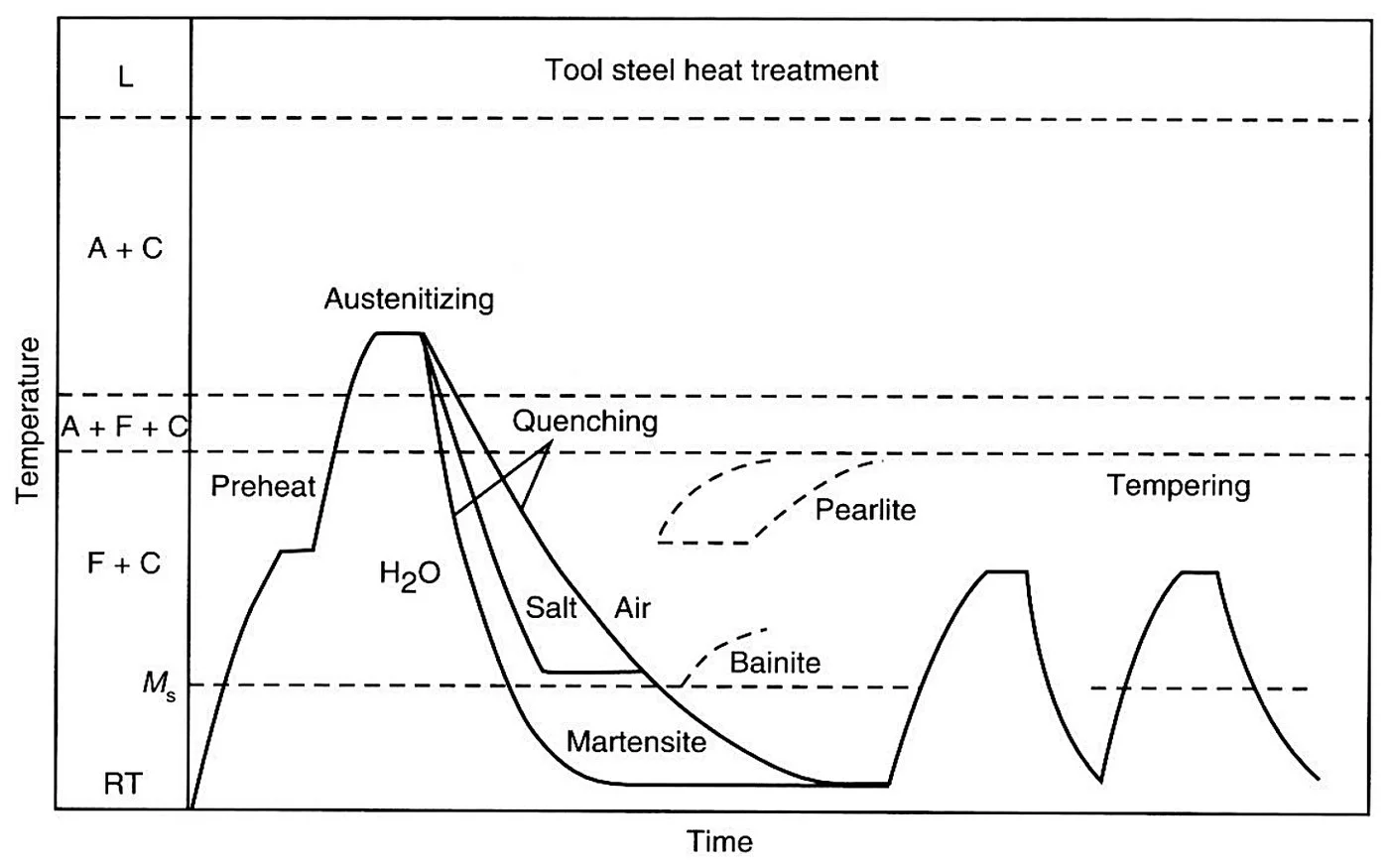
The last of those processes, the final hardening, is the three steps that set the properties the tool will work with.
Process chain
- Preheat reduces thermal shock and lowers the risk of cracking.
- Austenitize dissolves carbides to enrich the austenite with carbon and alloying elements.
- Quench suppresses pearlite and bainite to form martensite.
- Temper restores toughness and controls retained austenite.
Common risk factors
- Distortion Comes from residual stress, thermal gradients and the volume change of phase transformation.
- Quench cracking Rises with sharp corners, high tensile stress and excessive quench severity.
- Retained austenite May need multiple tempers or cryogenic treatment in high-alloy grades.
- Decarburization Comes from non-neutral atmospheres; protective atmospheres or vacuum furnaces help.
Aobo Steel supplies tool steel in the annealed condition, ready for you to machine and heat treat. The process ranges here are drawn from established metallurgical standards, international grade data and long-term industry practice, and reflect real operational feedback from forging, die-making and production users. Heat treatment itself is carried out on your side, so this guidance is offered as a reference to support that work. Because tool performance comes from many factors, with heat treatment just one stage whose outcome is further shaped by furnace control, part geometry and quench, these ranges are best read as a starting point and confirmed for your own parts.