
S1 Tool Steel Heat Treatment Guide
S1 tool steel (1.2550, SKS41) is hardened by preheating to about 650°C (1200°F), austenitizing at 900°C to 955°C (1650°F to 1750°F), oil quenching to 50°C to 70°C, and tempering immediately while the part is still warm. As-quenched hardness runs about 57 to 59 HRC, and a double temper between 205°C and 315°C (400°F and 600°F) delivers the high toughness and shock resistance S1 is valued for. Rough-machined or cold-worked parts should be stress relieved before hardening.
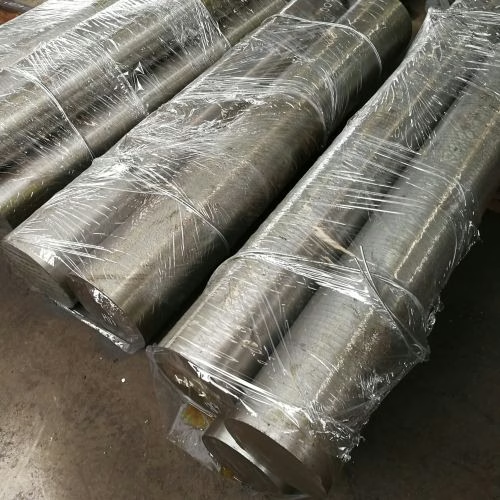
Aobo Steel supplies S1 tool steel (1.2550, SKS41) for shock-resisting applications. Send your required size, quantity, condition, and application for a quote.
Stress Relief
Stress relief prepares S1 components after rough machining or cold working, reducing the risk of distortion and cracking during hardening. Internal stresses from machining, if left in place, can cause severe microstructural or dimensional distortion once the part reaches hardening temperature.
- Heating temperature: Heat uniformly to 650°C to 675°C (1200°F to 1250°F).
- Soak time: 1 hour per 25 mm (1 inch) of thickness, with a minimum of 1 hour.
- Cooling: Slow air cooling.
Preheating
To prevent thermal shock and excessive deformation, cold S1 workpieces must never be placed directly into a furnace already at austenitizing temperature.
- Heating temperature: Slowly raise the temperature to about 650°C (1200°F).
- Soak: Hold until the cross-section is uniformly heated.
For parts with complex geometry or large variations in cross-section, preheating is critical. It synchronizes the temperature rise between core and surface during final heating, which lowers thermal stress and prevents cracking.
Austenitizing (Hardening)
Austenitizing is the core hardening step. Heating transforms the structure to austenite and dissolves carbides into the matrix. The austenitizing temperature for S1 must be neither too high nor too low.
- Heating temperature: 900°C to 955°C (1650°F to 1750°F).
- Hold time: 15 to 45 minutes, set by section thickness so the full cross-section through-hardens.
- Atmosphere: Because S1 has only moderate resistance to decarburization, heat in a controlled neutral atmosphere, vacuum, or neutral salt bath to prevent surface oxidation and carbon loss.
Quenching
S1 is an oil-hardening steel. Water quenching is occasionally used for large or simple sections, but oil quenching is preferred for the best toughness and the lowest risk of cracking.
- Quenching medium: Preheated, circulating quenching oil.
- Procedure: Quench until the workpiece reaches 50°C to 70°C (120°F to 160°F), at which point it is still warm.
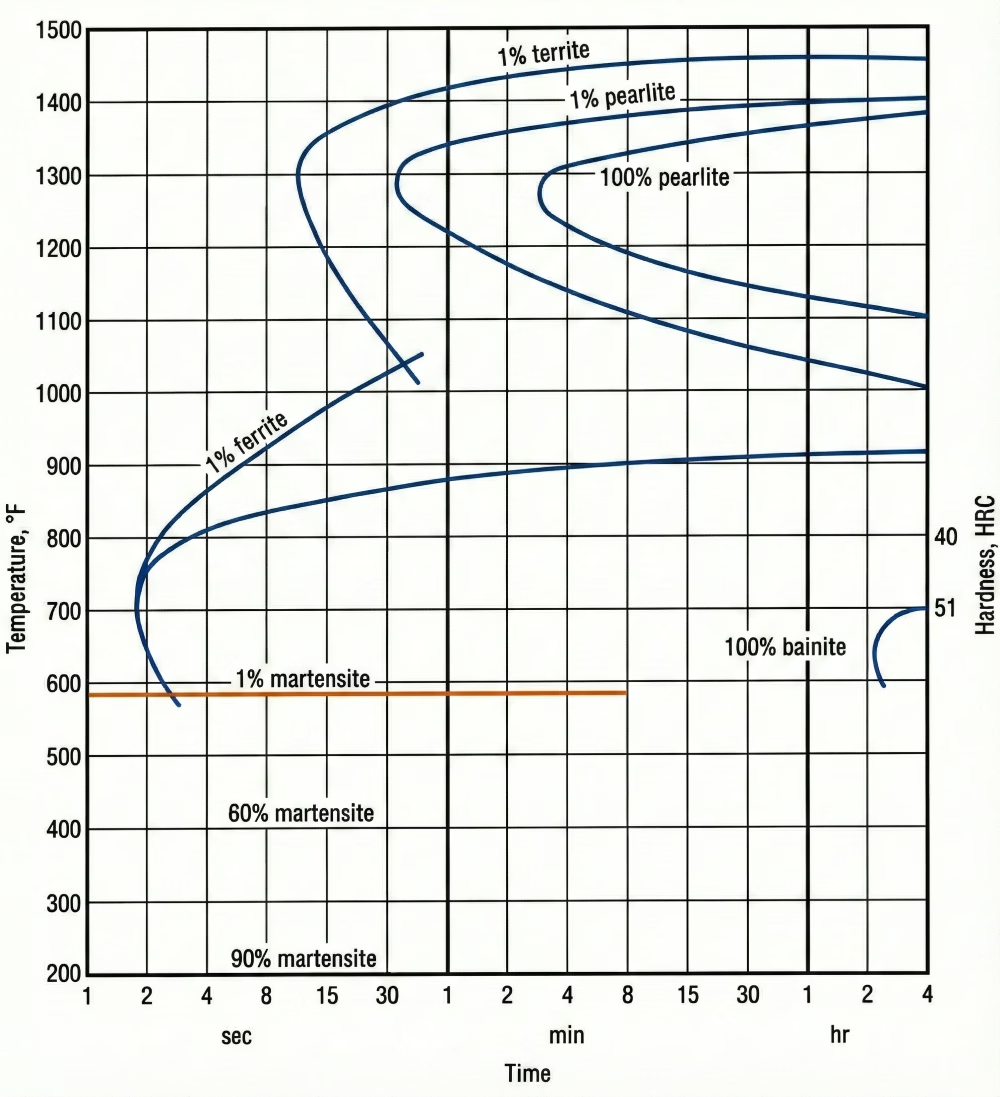
Never let the part cool to room temperature before tempering. The as-quenched structure carries high internal stress, and delayed tempering leaves S1 highly prone to spontaneous brittle fracture.
Tempering
Temper immediately after quenching to restore toughness and ductility. Tempering converts the as-quenched structure to tempered martensite, and the temperature is set by the hardness required.
- Soak time: At least 2 hours per 25 mm (1 inch) of section thickness.
- Secondary tempering: A second temper is recommended to remove unstable retained austenite, improve yield strength and impact properties, and reduce the chance of later distortion or cracking in service.
- Cooling: Cool to room temperature between the first and second temper.
Approximate hardness after oil quenching from 900°C to 955°C (1650°F to 1750°F):
| Tempering Temperature | Approximate Hardness (HRC) |
|---|---|
| As Quenched | 57 to 59 |
| 150°C (300°F) | 56 to 58 |
| 205°C (400°F) | 55 to 57 |
| 260°C (500°F) | 54 to 56 |
| 315°C (600°F) | 52 to 55 |
| 370°C (700°F) | 50 to 53 |
| 425°C (800°F) | 48 to 50 |
| 540°C (1000°F) | 40 to 45 |
For maximum toughness, as in chisels and heavy-duty punches, S1 is usually tempered between 205°C and 315°C (400°F and 600°F). Higher tempering temperatures can be used for warmer service conditions, but hardness drops significantly.
Common Heat Treatment Problems and Solutions
Quenching cracks
Two causes dominate. The first is delayed tempering, where the part sits at room temperature after quenching long enough for stress to exceed the material’s strength. The second is stress concentration at sharp corners, stamp marks, or rough-machined surfaces. Temper immediately, transferring the part to the tempering furnace while it still holds residual heat near 50°C to 70°C. At the design and machining stage, use rounded corners at critical junctions and keep surfaces to a high finish.
Low hardness
Common causes are surface decarburization from an improper austenitizing atmosphere, insufficient austenitizing temperature or hold time, and weak quenching from oil that is too hot or poorly agitated.
Deformation
Deformation usually comes from thermal shock caused by heating too quickly, or from residual machining stress released during heating. Preheat to 650°C before hardening, stress relieve rough-machined parts before quenching, and support long or complex parts to prevent sagging.
Decarburized soft layer
A soft surface layer forms when oxygen or moisture in the furnace reacts with surface carbon and carries it off as carbon monoxide or carbon dioxide. A quick check is to draw a file across the surface; if it scratches easily, a soft layer is present. To prevent it, use a vacuum furnace or an inert-gas atmosphere (nitrogen or argon) to exclude oxygen, calibrate salt baths regularly to keep them neutral, and leave enough grinding allowance so the decarburized layer can be removed after heat treatment.
Need S1 tool steel for shock-resisting applications?
S1 tool steel (1.2550, SKS41) is used where high toughness and shock resistance are required. Send your required size, quantity, condition, and application for a quote.