
M2 Tool Steel Heat Treatment Guide
M2 tool steel is heat-treated by double preheating, austenitizing at 1190–1230°C, quenching in oil, air, or a salt bath, then double or triple tempering at 538–595°C. Tempered correctly, M2 reaches about 60–65 HRC, with the high hardness, wear resistance, and red hardness expected from a high-speed steel. Hardness values by tempering temperature, together with the annealed and red hardness range, are charted on the M2 tool steel hardness page.
A typical sequence is a first preheat at 540–650°C and a second at 845–870°C. After the section equalizes, soak briefly—about 2–5 minutes. Quench to about 66–93°C. Temper immediately. The processing window is narrow. Controls below matter more than furnace time.
M2 is a molybdenum-tungsten high-speed tool steel. Problems such as decreased hardness, grain coarsening, persistent retained austenite, cracking, surface decarburization, or dimensional instability can result from excessive soaking, overheating, suboptimal atmosphere control, or delayed and inadequate tempering.
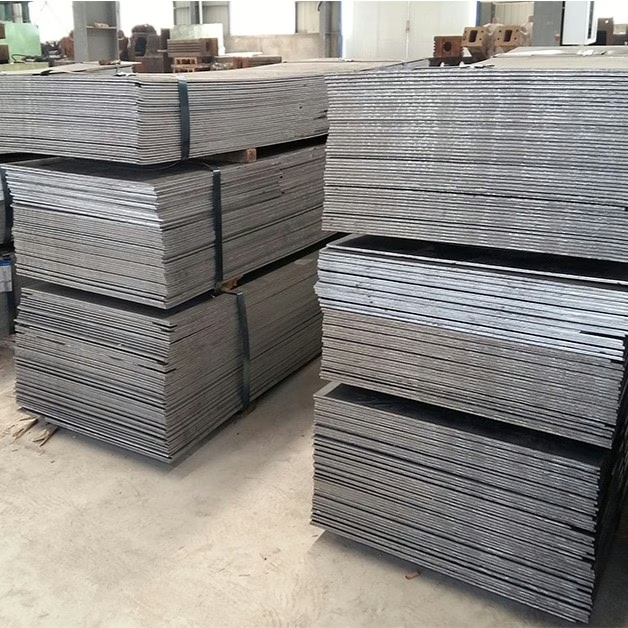
Source M2 High-Speed Tool Steel from Aobo Steel
Aobo Steel supplies M2 in the annealed condition for bulk orders, MOQ 5 tons. Send your sizes and quantities for a quote, or open the product page for chemical composition, equivalent grades, available sizes, tolerance, and inspection details. Size range, tolerances, minimum order and lead times are set out on our tool steel supply capability page.
M2 Tool Steel Heat Treatment Temperature Chart
The chart below summarizes the main heat-treatment data for M2 tool steel. The full process sequence is explained in the step-by-step section that follows.
| Process Step | Temperature / Condition | Key Control |
|---|---|---|
| Annealing | 870–900°C / 1600–1650°F | Hold about 1 hour per inch of thickness. Furnace cool slowly to 650°C, then air cool. Annealed hardness is typically about 241 HB, up to a specification maximum of roughly 248 HB. |
| Stress relieving | 650–675°C / 1200–1245°F | Used after heavy machining. Hold 1–2 hours per inch of cross-section, then cool slowly. |
| First preheating | 540–650°C / 1000–1200°F | Reduces initial thermal shock. |
| Second preheating | 845–870°C / 1555–1600°F | Equalizes the tool before austenitizing. |
| Austenitizing | 1190–1230°C / 2175–2245°F | Lower range for toughness; higher range for hardness, wear resistance, and red hardness. |
| Soaking time | Usually 2–5 minutes after equalization | Avoid long soaking. |
| Quenching | Oil, air, or salt bath | Quench to about 66–93°C / 150–200°F. |
| As-quenched hardness | About 64–66 HRC | Temper immediately. Do not leave M2 in the as-quenched condition. |
| Optional sub-zero treatment | -100 to -195°C / -150 to -320°F | Used when dimensional stability is critical. |
| Tempering | 538–595°C / 1000–1105°F | Double tempering is required. Triple tempering is often used for demanding tools. |
| Typical final hardness | About 60–65 HRC | Depends on austenitizing temperature, quenching method, tempering temperature, and section size. |
M2 should be heated in a vacuum furnace, in a controlled neutral atmosphere, or in a neutral salt bath when possible. At M2 hardening temperatures, surface decarburization can occur. This leaves a soft outer layer and reduces wear resistance.
How to Heat Treat M2 Tool Steel Step by Step
M2 heat treatment must be managed as a continuous metallurgical process; each stage interrelates with and influences the others. Inadequate preheating elevates the likelihood of thermal shock and cracking. Suboptimal austenitizing disrupts carbide dissolution and increases retained austenite. Improper quenching impairs achievable hardness and causes distortion. Insufficient multi-stage tempering leaves the microstructure metastable.
Step 1: Stress Relieving Before Hardening
Stress relieving is recommended when an M2 tool has been heavily machined before hardening. When a large amount of material has been removed, internal machining stress can cause movement or cracking during final heat treatment.
Heat the tool slowly to 650–675°C (1200–1245°F) and hold for about 1–2 hours per inch of cross-section. Cool the tool slowly to room temperature. This step does not harden the steel. It relieves internal stress before the high-temperature hardening cycle. Complete rough machining before stress relieving. Leave enough allowance for final grinding after hardening and tempering.
Step 2: Double Preheating for M2 Tool Steel
M2 should not be placed directly into the austenitizing range. Because of its high alloy content and high hardening temperature, direct high-temperature heating can cause significant thermal shock and increase the risk of cracking.
| Preheating Stage | Temperature Range | Purpose |
|---|---|---|
| First preheat | 540–650°C / 1000–1200°F | Reduces the first temperature shock and begins uniform heating. |
| Second preheat | 845–870°C / 1555–1600°F | Equalizes the tool before rapid heating to the austenitizing range. |
The purpose of preheating is to equalize temperatures, not for long soaking. Once uniformly heated, austenitize the tool without delay. Excessive holding during heating is unnecessary. It can increase decarburization if the atmosphere is poorly protected.
Some references list a general M2 preheating range of 730–845°C, or an elevated two-stage cycle at 843°C and 1010°C. For a clear, staged process, the 540–650°C and 845–870°C sequences are easier to follow and directly explain the heating order before hardening.
Step 3: Austenitizing Temperature and Soaking Time
M2 is typically austenitized at 1190–1230°C (2175–2245°F). This is the most critical step. The temperature must be sufficient to dissolve requisite alloy carbides yet remain below the thresholds for grain coarsening, excessive retained austenite, or thermal damage.
| Austenitizing Target | Temperature Range | Application Logic |
|---|---|---|
| Toughness priority | 1175–1190°C / 2150–2175°F | Used when toughness and cracking resistance matter more than maximum hardness. |
| Standard M2 hardening range | 1190–1230°C / 2175–2245°F | General range for M2 cutting tools and wear-resistant tooling. |
| Maximum hardness and wear resistance | Around 1230°C / 2245°F | Used when high hardness, wear resistance, and red hardness are required. |
| Salt bath adjustment | About 14°C / 25°F lower | Used when hardening from a salt bath. |
| High-carbon M2 adjustment | About 14°C / 25°F lower | Helps reduce overheating and retained austenite risk. |
Soaking time at austenitizing temperature should be short. After the tool reaches temperature, hold M2 for only about 2–5 minutes. This is the time at temperature after the section is equalized, not the total furnace cycle. Time spent heating is not counted as soaking. Very large sections may need about 5–7 minutes. Do not soak M2 as you would a low-alloy steel.
Over-soaking is one of the most common causes of M2 heat treatment failure. Too much time at high temperature dissolves too much carbon and alloy into austenite. It increases retained austenite, coarsens the grain, and reduces toughness. Underheating has the opposite effect. It causes insufficient carbide solution, lower hardness, and weaker secondary hardening during tempering. The goal is a controlled carbide solution within a narrow window, not maximum furnace time.
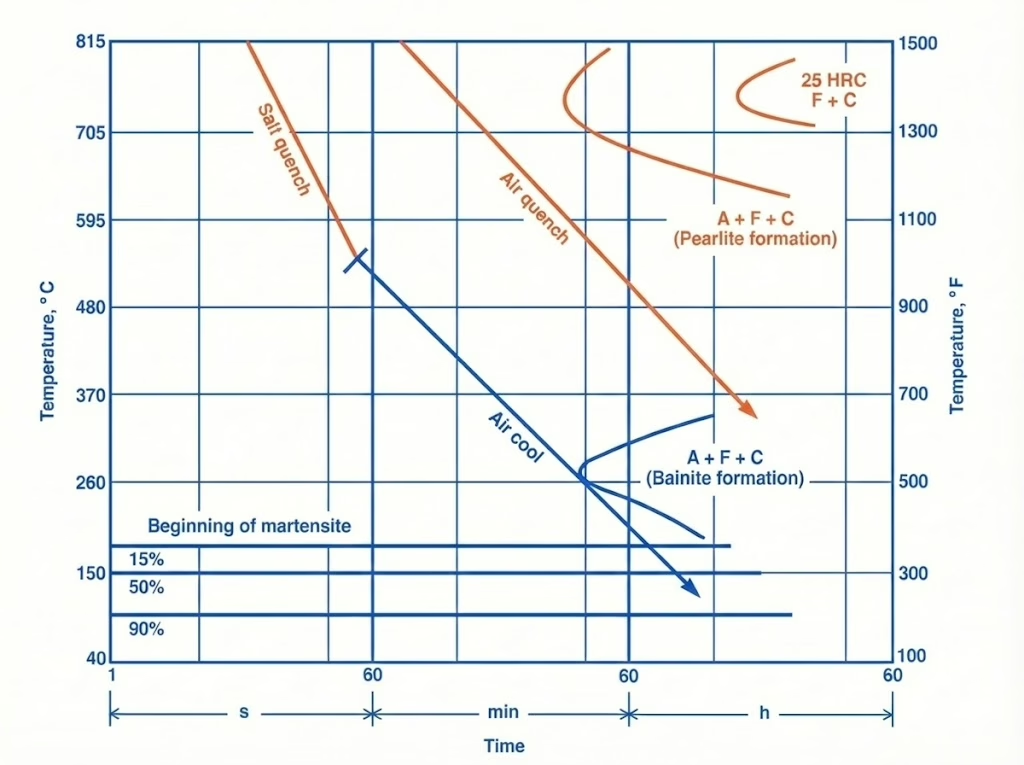
Step 4: Quenching Methods: Oil, Air, and Salt Bath
After austenitizing, quench M2 in oil, air, or a hot salt bath. The best method depends on tool size, target hardness, distortion tolerance, and available equipment.
| Quenching Method | Best Use | Main Limitation |
|---|---|---|
| Oil quenching | Higher hardness response | Higher distortion and cracking risk than air cooling. |
| Air quenching | Better dimensional stability | Hardness may be lower in larger or slower-cooling sections. |
| Hot salt bath quenching | Good temperature equalization and reduced thermal shock | Requires suitable salt bath equipment and strict control. |
Oil quenching is often selected when maximum hardness response is required, cooling the tool from austenitizing to 66–93°C (150–200°F). Air quenching is milder and reduces distortion risk, which suits smaller sections or tools where dimensional stability matters more than aggressive cooling. Hot-salt bath quenching provides better control of temperature equalization: the tool is held until the section equalizes, then cooled further before tempering, which reduces thermal shock and distortion when properly controlled.
Regardless of quenching medium, tempering should commence as soon as the tool cools to 66–93°C. Extended retention in the as-quenched, martensitic state increases the risk of delayed cracking or dimensional distortion due to untempered retained austenite and residual stress.
Step 5: Optional Sub-Zero Treatment
Sub-zero treatment is optional. It is mainly used when dimensional stability is critical, such as for intricate tools, precision components, or parts where retained austenite must be further reduced.
A typical sub-zero range is -100 to -195°C (-150 to -320°F). After the part returns to room temperature, tempering should begin immediately. For intricate shapes, a brief low-temperature stress-relief temper may be applied before freezing to reduce the risk of cracking. Sub-zero treatment does not replace proper austenitizing, quenching, and multiple tempering. It is only an additional stabilizing step when the tool design and service conditions require it.
Step 6: Double or Triple Tempering
Tempering must begin right after quenching. If a sub-zero cycle is used, temper immediately upon the part’s return to room temperature. M2 relies on secondary hardening. Tempering does more than relieve stress. It controls the transformation of retained austenite, carbide precipitation, final hardness, and toughness.
The common tempering range for M2 is 538–595°C (1000–1105°F). Double tempering is the minimum practical requirement. Triple tempering is often used for cutting tools, precision tooling, and demanding service conditions.
Each tempering cycle should be followed by cooling to room temperature before the next one begins. This cooling stage matters because retained austenite can transform into fresh martensite during cooling, and the next temper then relieves the stress in that newly formed martensite. Do not rely on single tempering for M2. One cycle is usually not enough to stabilize the structure.
M2 Tempering Temperature and Hardness Chart
M2 has a strong secondary hardening response. Its hardness does not simply fall as the tempering temperature rises. In the high-tempering range, fine alloy carbides precipitate, and hardness can rise again.
The chart below shows typical hardness after double tempering when M2 is austenitized around 1230°C / 2250°F.
| Tempering Temperature | Oil Quenched Hardness | Air Quenched Hardness |
|---|---|---|
| As quenched | 64.0–66.0 HRC | 64.0–66.0 HRC |
| 400°F / 204°C | 63.0 HRC | 63.0 HRC |
| 500°F / 260°C | 62.5 HRC | 62.5 HRC |
| 600°F / 316°C | 62.5 HRC | 62.5 HRC |
| 700°F / 371°C | 62.5 HRC | 62.5 HRC |
| 800°F / 427°C | 63.5 HRC | 63.5 HRC |
| 900°F / 482°C | 64.0 HRC | 64.0 HRC |
| 1000°F / 540°C | 64.5–65.5 HRC | 62.0 HRC |
| 1025°F / 550°C | 65.0 HRC | 63.0 HRC |
| 1050°F / 565°C | 63.5–65.5 HRC | 64.0 HRC |
| 1100°F / 595°C | 61.5–64.0 HRC | 63.0 HRC |
| 1150°F / 620°C | 60.0–62.0 HRC | 60.0 HRC |
| 1200°F / 650°C | 53.0–53.5 HRC | 53.0 HRC |
For many M2 cutting and tooling applications, tempering around 540–565°C is common because it sits near the secondary hardening range and balances hardness, cutting performance, toughness, and stability.
M2 should not be undertempered. A low tempering temperature or too few cycles can lead to high internal stress and unstable retained austenite. Double tempering is the minimum, and triple tempering is often used for more demanding tools.
Effect of Austenitizing Temperature on M2 Tempered Hardness
The austenitizing temperature affects the final hardness response. A higher hardening temperature dissolves more carbon and alloying elements, strengthening secondary hardening during tempering, but it also increases retained austenite and the risk of overheating.
The table below uses a separate data set reported in °C, so its peak values differ slightly from the °F double-tempering chart above. The two are not contradictory. They come from different heats, austenitizing conditions, and test setups, and both show the same trend: a secondary hardening peak near 525–550°C followed by a drop above 575°C.
| Tempering Temperature | Hardened at 1180°C | Hardened at 1200°C | Hardened at 1220°C | Hardened at 1240°C |
|---|---|---|---|---|
| As quenched | 66.0 HRC | 64.0 HRC | 65.0 HRC | 64.0 HRC |
| 200°C | 63.0 HRC | 61.5 HRC | 62.5 HRC | 61.5 HRC |
| 300°C | 62.7 HRC | 61.5 HRC | 62.5 HRC | 61.5 HRC |
| 400°C | 63.0 HRC | 62.0 HRC | 62.5 HRC | 62.0 HRC |
| 500°C | 63.5 HRC | 64.0 HRC | 64.5 HRC | 64.5 HRC |
| 525°C | 64.5 HRC | 65.0 HRC | 65.5 HRC | 66.0 HRC |
| 550°C | 64.5 HRC | 65.5 HRC | 66.0 HRC | 66.5 HRC |
| 575°C | 64.0 HRC | 63.5 HRC | 64.5 HRC | 66.0 HRC |
| 600°C | 62.0 HRC | 62.5 HRC | 62.5 HRC | 63.0 HRC |
This is why M2 should not be heat-treated only to chase the highest hardness number. A higher hardening temperature can produce stronger secondary hardening, but the safe processing margin becomes narrower. In production, the better target is stable hardness with acceptable toughness, controlled retained austenite, and reliable tool life.
M2 Heat Treatment Problems
Most M2 heat-treatment failures come from five areas: incorrect austenitizing, excessive soaking, poor atmosphere protection, improper quenching, and insufficient tempering.
| Problem | Main Cause | Result |
|---|---|---|
| Low hardness | Underheating, insufficient carbide solution, poor quenching, or excess retained austenite | The tool cannot reach the required working hardness. |
| Grain coarsening | Overheating or over-soaking | Lower toughness and higher cracking risk. |
| Excess retained austenite | High austenitizing temperature, long soaking, or insufficient tempering | Dimensional change and unstable hardness. |
| Quench cracking | Thermal shock, severe quench stress, or delayed tempering | Cracking during or after hardening. |
| Decarburization | Heating without atmosphere protection | Soft surface and poor wear resistance. |
| Under-tempering | Low tempering temperature or too few tempering cycles | Brittleness and unstable structure. |
Overheating and over-soaking are serious because M2 is processed close to its high-temperature limit. Excess temperature or time coarsens the grain, increases retained austenite, reduces toughness, and lowers tool reliability. Underheating prevents sufficient alloy carbides from dissolving, lowering the quenched hardness and weakening secondary hardening during tempering.
Retained austenite is expected in M2, but excess retained austenite causes problems. It can transform later during service, forming fresh martensite, causing dimensional growth and internal stress, and increasing the risk of cracking. Decarburization is another major failure source: when heated without a vacuum, in a neutral atmosphere, or without salt bath protection, the surface loses carbon and remains soft after hardening.
Tempering errors are especially costly. M2 needs multiple tempering cycles because the transformation of retained austenite and the tempering of fresh martensite cannot be completed in a single cycle. For stable performance, the tool should cool to room temperature between temperings.
Aobo Steel supplies M2 / DIN 1.3343 / JIS SKH51 high-speed tool steel in the annealed condition and does not provide final heat-treatment services such as hardening, quenching, sub-zero treatment, or tempering.
The heat-treatment parameters, hardness data, and process recommendations in this guide are provided as general technical support references for customers. Actual results may vary with furnace capability, section size, tool geometry, steel condition, quenching practice, atmosphere control, and final application. Final heat-treatment procedures should be confirmed and validated by the customer’s heat-treatment provider before production.
Need annealed M2 high-speed tool steel for bulk orders?
Aobo Steel supplies M2 / DIN 1.3343 / JIS SKH51 round bar and plate with mill certificates and dimensional inspection before shipment.