
H13 vs A2 Tool Steel
H13 and A2 are air-hardening tool steels used in different conditions. H13, a hot work tool steel, performs well under heat, pressure, cycling, and impact. Its main strengths are toughness, hot strength, and heat checking resistance. A2 is an air-hardening cold-work tool steel. It is used when tools operate at room temperature and need high hardness, wear resistance, edge retention, and dimensional stability.
Use H13 for hot-work cracking, heat checking, or thermal fatigue. Use A2 for cold-work wear, edge retention, or when minimal distortion is needed.
H13 and A2 both contain about 5% chromium. However, A2 has higher carbon and vanadium content, giving it greater hardness and wear resistance, while H13 offers better toughness and stability at high temperatures.
H13 and A2 Tool Steel Available from Aobo Steel
Aobo Steel supplies H13 hot-work tool steel and A2 air-hardening cold-work tool steel for different tooling failure modes, from thermal fatigue and hot cracking to wear resistance and dimensional stability.
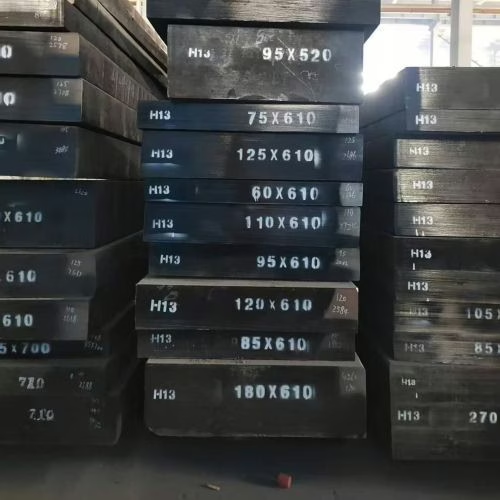
H13 | 1.2344 | SKD61
Hot-work tool steel for die casting dies, hot forging dies, extrusion tooling, hot punches, hot shear blades, heat checking resistance, and thermal fatigue resistance.
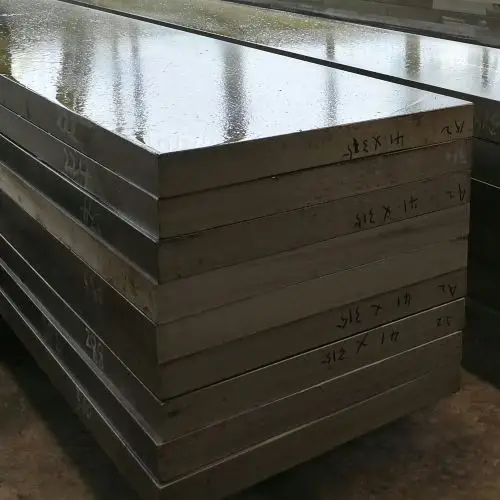
A2 | 1.2363 | SKD12
Air-hardening cold-work tool steel for blanking dies, punches, cold forming tools, thread rolling dies, cold-work shear blades, precision tooling, and dimensional stability.
H13 vs A2 Quick Comparison
| Item | H13 Tool Steel | A2 Tool Steel |
|---|---|---|
| Steel type | Hot work tool steel | Air-hardening cold work tool steel |
| Main working condition | Heat, pressure, thermal cycling, impact | Room-temperature cutting, forming, punching, shearing |
| Main failure resistance | Heat checking, thermal fatigue, hot cracking | Abrasive wear, edge wear, dimensional change |
| Typical working hardness | 38-53 HRC | 57-62 HRC |
| Common working range | 40-48 HRC for many hot-work tools | 58-60 HRC for many cold-work tools |
| Abrasive wear resistance | Medium | High |
| Toughness | High | Medium |
| Hot hardness | High | Limited |
| Thermal fatigue resistance | Excellent | Not suitable for hot-work service |
| Dimensional stability | Very good | Excellent |
| Typical applications | Die casting dies, hot forging dies, hot extrusion tooling, hot punches, hot shear blades | Blanking dies, punches, cold forming tools, thread rolling dies, cold-work shear blades, precision tooling |
| Wrong-use risk | Not ideal for high-wear cold-work edges | Not suitable for repeated heating and cooling |
Chemical Composition Difference
| Grade | C | Cr | Mo | V |
|---|---|---|---|---|
| H13 | 0.32-0.45% | 4.75-5.50% | 1.10-1.75% | 0.80-1.20% |
| A2 | 0.95-1.05% | 4.75-5.50% | 0.90-1.40% | 0.15-0.50% |
A2 has about 1.0% carbon, over twice that of H13. After heat treatment, it forms a harder, more wear-resistant matrix. This supports A2’s edge retention in cold-work tools.
H13’s lower carbon reduces brittleness and improves resistance to shock and thermal stress. Molybdenum and vanadium help it retain strength at high temperatures.
Equivalent Grades
| AISI Grade | DIN / W.-Nr. | JIS | UNS | GB Reference | Steel Type |
|---|---|---|---|---|---|
| H13 | 1.2344 | SKD61 | T20813 | 4Cr5MoSiV1 | Hot work tool steel |
| A2 | 1.2363 | SKD12 | T30102 | Cr5Mo1V-type reference | Air-hardening cold work tool steel |
In international standards, H13 is also 1.2344 or SKD61. A2 matches 1.2363 or SKD12.
Hardness and Heat Treatment Difference
A2 is generally used at a higher hardness for wear resistance. H13 is used at a lower hardness to achieve toughness and thermal fatigue resistance required for hot-work tools.
| Item | H13 | A2 |
|---|---|---|
| Steel category | Hot work tool steel | Air-hardening cold work tool steel |
| Austenitizing range | About 995-1025 °C | About 925-980 °C |
| Quenching | Air or pressurized gas | Air |
| Tempering practice | Double or triple temper commonly used | Double temper commonly recommended |
| Typical working hardness | 38-53 HRC | 57-62 HRC |
| Common working range | 40-48 HRC for many hot-work tools | 58-60 HRC for many cold-work tools |
| Annealed hardness reference | Around 220-235 HB | Around 220-235 HB |
| Heat-treatment target | Toughness, hot strength, stress relief, thermal fatigue resistance | High hardness, wear resistance, edge retention, dimensional stability |
A2 is typically 57-62 HRC. Air-hardening limits distortion, supporting precision tooling.
H13 is tempered at higher temperatures to maintain stability in hot-work situations. In these applications, balancing toughness, hot strength, and resistance to heat checking is prioritized over maximum hardness.
Wear Resistance, Toughness, and Thermal Fatigue
A2 has superior abrasive wear resistance; H13 has superior toughness and thermal fatigue resistance.
| Property | H13 | A2 | Better Choice |
|---|---|---|---|
| Abrasive wear resistance | Medium | High | A2 |
| Edge retention in cold work | Medium | High | A2 |
| Toughness | High | Medium | H13 |
| Shock resistance | High | Medium | H13 |
| Hot hardness | High | Limited | H13 |
| Thermal fatigue resistance | Excellent | Not suitable for hot-work service | H13 |
| Dimensional stability after heat treatment | Very good | Excellent | A2 |
Choose A2 when tools fail due to abrasive wear, edge rounding, or loss of performance in cold work. Choose H13 when tools are subject to impact, hot pressure, repeated heating-cooling, or heat checking. In these conditions, wear resistance alone is insufficient.
Application Selection Guide
| Application or Working Condition | Better Choice | Reason |
|---|---|---|
| Aluminum die casting dies | H13 | Resists heat checking and thermal fatigue |
| Zinc and magnesium die casting tooling | H13 | Handles repeated heating and cooling |
| Hot forging dies | H13 | Better toughness under heat and impact |
| Hot extrusion dies, mandrels, and liners | H13 | Resists heat, pressure, and thermal cycling |
| Hot punches | H13 | Better hot strength and shock resistance |
| Hot shear blades | H13 | Better resistance to heat and impact |
| Blanking dies | A2 | Better cold-work edge retention |
| Punches for cold work | A2 | Higher hardness and wear resistance |
| Cold forming tools | A2 | Good wear resistance with low distortion |
| Thread rolling dies | A2 | Good dimensional stability and wear resistance |
| Cold-work shear blades and slitters | A2 | Higher working hardness |
| Precision gauges and tooling | A2 | Good dimensional stability after heat treatment |
| Tool fails by heat checking | H13 | Better thermal fatigue resistance |
| Tool fails by abrasive edge wear | A2 | Higher carbon and better wear resistance |
| Tool fails by impact cracking | Usually H13 | Better toughness |
| Tool requires 57-62 HRC | A2 | More suitable for high-hardness cold-work tooling |
| Tool requires hot stability at 38-53 HRC | H13 | Better for hot-work service |
Injection molds may use either. Choose A2 if abrasive wear is key; H13 if toughness, stability, polishability, or lifespan matter more.
When H13 or A2 Is the Wrong Choice
| Situation | Avoid | Better Direction |
|---|---|---|
| Long-run cold blanking or cold shearing with severe abrasive wear | H13 | A2 or higher-wear cold work steels may be better |
| Die casting, hot forging, hot extrusion, or repeated heating and cooling | A2 | H13 is the correct direction |
| Severe impact, cracking, or sudden fracture at room temperature | A2 | H13 or a shock-resistant grade such as S7 may be safer |
| High-hardness cold-work tooling with no heat and no severe impact | H13 | A2 is usually more practical |
| Extremely abrasive cold-work production | A2 may be insufficient | D2 or other higher-carbide cold work steels may give better edge life |
| Extremely high hot-wear or hot-hardness demand | Standard H13 may be insufficient | Higher-alloy hot work grades may be considered |
| Tool requires very tight final dimensions after heat treatment | Do not assume zero distortion | A2 has good stability, but final size change still depends on section size, geometry, and heat-treatment practice |
Do not select H13 solely for toughness. If no heat, cycling, or impact exists, H13 is likely unnecessary. Do not use A2 for hot work. It is not designed for heat checking, hot cracking, or long exposure to high temperatures.
Final Selection
Choose H13 for hot-work failure
Choose H13 for tools exposed to heat, pressure, thermal cycling, impact, hot cracking, thermal fatigue, or heat-checking risk.
Choose A2 for cold-work wear
Choose A2 for room-temperature applications requiring high hardness, abrasive wear resistance, edge retention, precision, and dimensional stability.
The practical rule is that H13 is for hot-work failure. A2 is for cold-work wear and precision tooling.
Need H13 or A2 tool steel?
Aobo Steel supplies H13 hot-work tool steel and A2 air-hardening cold-work tool steel for die casting, hot forging, extrusion tooling, blanking dies, punches, cold forming tools, and precision tooling applications.
Email [email protected] · Tel and WhatsApp +86 180 6294 5370
Related pages
H13 comparisons: H13 vs H11 · H13 vs P20 · H13 vs H21 · H13 vs SKD61
Reference pages: A2 heat treatment guide · H13 steel hardness
Grade families: Tool steel grades · H-series tool steels · Tool steel material finder
Composition, hardness and heat-treatment figures are typical published values for H13 / 1.2344 / SKD61 and A2 / 1.2363 / SKD12. Confirm the exact range against the mill certificate for the delivered lot.