
O1 vs O2 Tool Steel: Which Cold Work Steel Should You Choose?
Choose O1 tool steel when the tool needs better toughness, edge stability, and general cold-work reliability. Choose O2 tool steel when machining efficiency, dimensional accuracy, and low distortion after hardening matter more.
Both are oil-hardening cold-work tool steels with similar working hardness after heat treatment. O1 offers a wider safety margin for general applications, while O2 excels in machining and control for intricate or precision shapes.
O1 and O2 Tool Steel Available from Aobo Steel
Aobo Steel supplies O1 and O2 oil-hardening cold-work tool steels for gauges, punches, blanking dies, intricate tools, and short- to medium-run tooling.
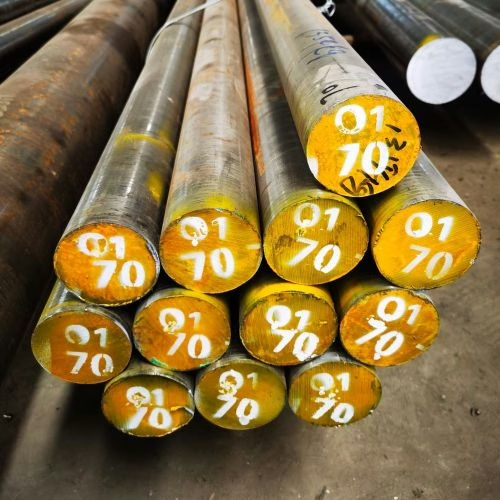
O1 | 1.2510 | SKS3
Oil-hardening cold-work tool steel with better toughness, edge stability, and general tooling reliability.
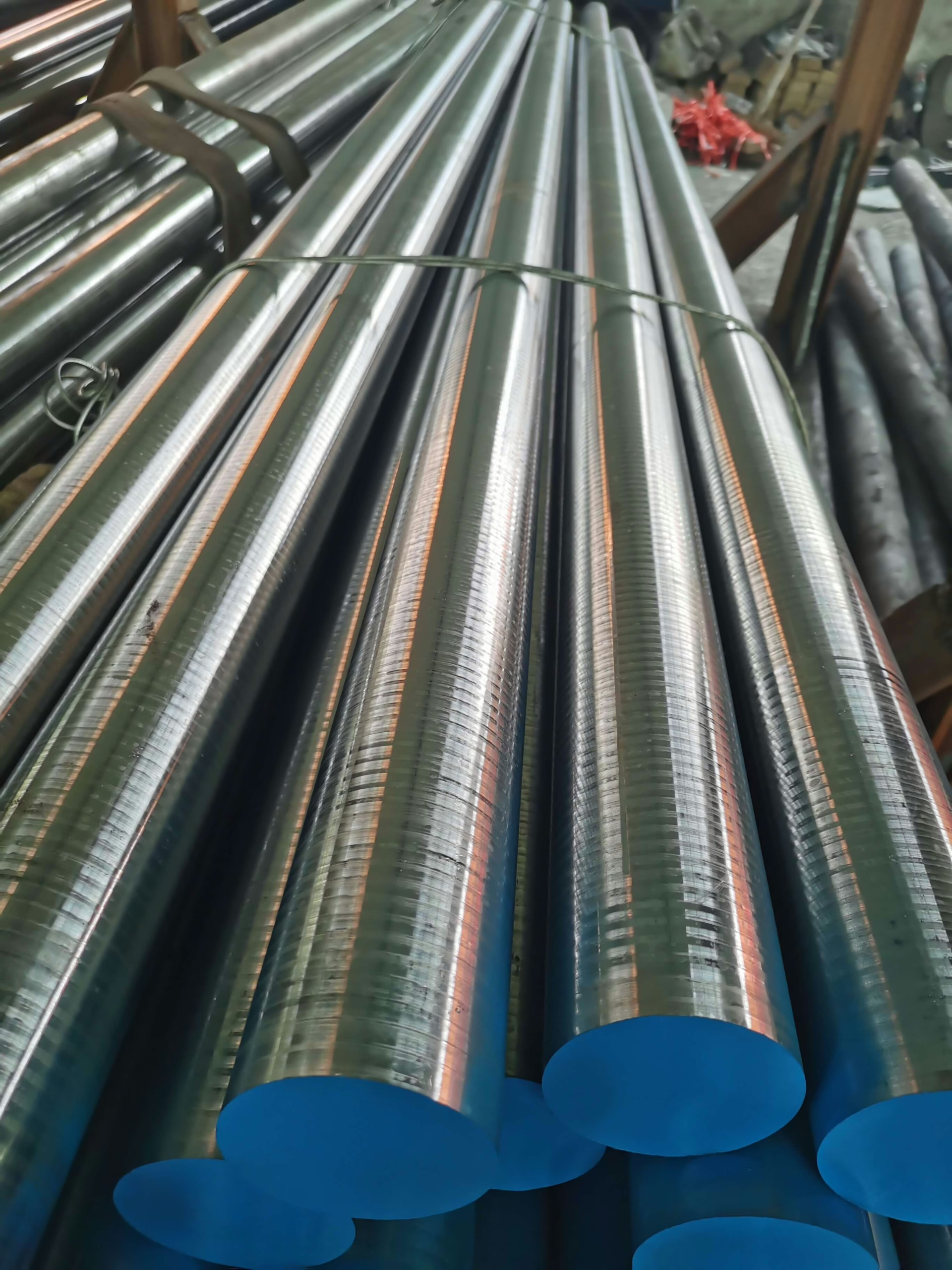
O2 | 1.2842
Oil-hardening cold-work tool steel for easier machining, better dimensional control, and intricate shapes.
Quick Selection Table: O1 vs O2 Tool Steel
| Requirement | Better Choice | Practical Reason |
|---|---|---|
| Better toughness | O1 | More reliable under moderate impact and edge loading. |
| Better edge stability | O1 | Safer for cutting tools, punches, and shear blades. |
| Deeper hardening response | O1 | Better hardening depth for small and medium tools. |
| General cold-work tooling | O1 | More suitable for cutting, forming, blanking, and punching. |
| Lower distortion after hardening | O2 | Better shape retention after oil quenching. |
| Easier machining | O2 | Lower cutting resistance before heat treatment. |
| Precision gauges | O2 | Better dimensional control. |
| Intricate dies and complex shapes | O2 | Less correction and grinding after hardening. |
| Long or thin parts | O2 | Lower risk of warpage compared with O1. |
O1 vs O2 Equivalent Grades
O1 and O2 are sold under different standard names in different markets. When sourcing internationally, buyers should check both the grade name and the material standard before confirming an order.
| AISI Grade | UNS Designation | DIN / W.-Nr. | Common European Designation | British Standard |
|---|---|---|---|---|
| O1 Tool Steel | T31501 | 1.2510 | 100MnCrW4 | BO1 |
| O2 Tool Steel | T31502 | 1.2842 | 90MnCrV8 | BO2 |
O1 is commonly matched with 1.2510 / 100MnCrW4. O2 is commonly matched with 1.2842 / 90MnCrV8.
Equivalent grades are useful for sourcing, but the final result still depends on chemical composition control, heat treatment, tool size, and working conditions.
O1 vs O2 Chemical Composition
Compared with O2, O1 has a more balanced alloy design because chromium and tungsten are added beside manganese. O2 depends more heavily on manganese, which supports hardenability at relatively low hardening temperatures.
| Element | O1 Tool Steel | O2 Tool Steel |
|---|---|---|
| Carbon | 0.85-1.00% | 0.85-0.95% |
| Manganese | 1.00-1.40% | 1.40-1.80% |
| Silicon | <=0.50% | <=0.50% |
| Chromium | 0.40-0.60% | <=0.50% |
| Tungsten | 0.40-0.60% | Not typically added |
| Molybdenum | <=0.30% | <=0.30% |
| Vanadium | <=0.30% | <=0.30% |
The chromium and tungsten additions make O1 less dependent on manganese alone. This gives O1 a more balanced hardening response and better edge-stability support after heat treatment.
O2’s higher manganese content helps it harden effectively at lower temperatures and supports better dimensional stability during hardening. Its simpler alloy design also contributes to better machinability before heat treatment.
O1 vs O2 Heat Treatment
Both O1 and O2 are easier to control than water-hardening steels, but oil quenching still creates thermal stress. Sharp corners, thin sections, long lengths, and complex geometries require careful heat-treatment.
| Heat Treatment Factor | O1 Tool Steel | O2 Tool Steel |
|---|---|---|
| Steel type | Oil-hardening cold-work tool steel | Oil-hardening cold-work tool steel |
| Main alloying feature | Mn, Cr, W, small V | High Mn, lower Cr and Mo |
| Austenitizing temperature | About 788-816 C | About 760-802 C |
| Preheating | Recommended | Controlled heating recommended |
| Soaking practice | Usually based on section size | Short or limited soaking is often used |
| Quenching | Oil quench | Oil quench |
| Dimensional stability | Good | Better |
| Cracking risk | Manageable with proper control | Lower because of lower hardening temperature |
| Tempering range | About 163-260 C | About 163-316 C |
| Hardenability | Better depth of hardening | Shallower than O1 |
| Main heat-treatment advantage | Better performance reliability | Better distortion control |
The main differences in heat treatment are the risk of distortion and the hardening depth. O1 is better when the tool needs a more consistent hardening depth throughout. O2 is better when maintaining the part’s shape after hardening is the main concern.
For detailed heat-treatment information, see our O1 tool steel heat-treatment guide and O2 tool steel heat-treatment guide.
O1 vs O2 Application Comparison
O1 and O2 overlap in many cold-work applications, but the reasons for choosing one over the other differ. O1 is selected when the tool must tolerate cutting pressure, edge loading, or light impact. O2 is selected when the part is difficult to machine, sensitive to distortion, or costly to correct after hardening.
| Application | Better Choice | Reason |
|---|---|---|
| General punches | O1 | Better edge stability under cutting pressure. |
| Long precision punches | O2 | Lower distortion after hardening. |
| Blanking dies | O1 | Better general cutting performance. |
| Precision blanking dies | O2 | Better dimensional control when shape accuracy matters. |
| Coining dies | O1 | Better under moderate compressive and edge loading. |
| Intricate dies | O2 | Easier machining and less correction after hardening. |
| Shear blades | O1 | Better resistance to edge loading. |
| Precision gauges | O2 | Better shape retention and dimensional stability. |
| Drawing dies | Depends | O1 for loading resistance; O2 for lower distortion. |
| Plastic mold inserts for low-demand use | O2 | Easier machining and better stability. |
| Tool shanks and support parts | O2 | Good machinability and acceptable hardness after treatment. |
O1 vs O2 Hardness, Wear Resistance, and Machinability
O1 and O2 can both reach about 57-62 HRC after proper heat treatment.
| Performance Factor | O1 Tool Steel | O2 Tool Steel |
|---|---|---|
| Typical working hardness | 57-62 HRC | 57-62 HRC |
| Wear resistance | Medium | Medium |
| Impact toughness | Slightly higher | Slightly lower |
| Edge stability | Better under moderate loading | Good, but less robust than O1 |
| Dimensional stability | Good | Better |
| Machinability | 65-75% relative rating | 90-100% relative rating |
| Hot hardness | Low | Low |
| Suitable production scale | Short to medium runs | Short to medium runs |
Their wear resistance mainly comes from the hardened matrix, not from a high volume of hard alloy carbides. For severe abrasion or very long production runs, D2, D3, or other higher-wear cold-work steels are usually more suitable.
O1 vs O2 Cost Difference
The price difference in raw materials between O1 and O2 is usually not the main cost factor.
O2 can reduce machining costs by allowing easier cutting before heat treatment. It can also reduce finishing costs because it has better dimensional stability after hardening.
O1 can reduce failure costs when the tool is under cutting, edge loading, or experiencing moderate impact. In those conditions, better toughness and edge stability may matter more than easier machining.
| Cost Factor | O1 Tool Steel | O2 Tool Steel |
|---|---|---|
| Raw material cost | Slightly higher | Slightly lower |
| Machining cost | Higher | Lower |
| Cutting tool wear during machining | Higher | Lower |
| Post-hardening correction | Moderate | Lower |
| Risk under moderate impact | Lower | Higher |
| Best cost advantage | Lower service failure risk | Lower manufacturing and finishing cost |
When Not to Use O1 or O2 Tool Steel
O1 and O2 are economical oil-hardening tool steels for controlled cold-work applications. They are not the best choice when the main problem is severe abrasion, heavy shock, high working temperature, or large-section through-hardening.
| Unsuitable Condition | Why O1 or O2 May Fail | Better Material Direction |
|---|---|---|
| Severe abrasive wear | Medium wear resistance is not enough | D2, D3, or other high-wear cold-work steels |
| Heavy shock loading | High hardness reduces toughness under impact | S1, S7, or other shock-resisting steels |
| High working temperature | Low hot hardness and poor softening resistance | H11, H13, or other hot-work steels |
| High-speed cutting | No red hardness | M2, M35, or high-speed steel |
| Large sections requiring deep hardening | Limited hardenability, especially for O2 | A-series or D-series tool steels |
| Very tight distortion control on larger tools | Oil quenching still creates stress | A2 or other air-hardening steels |
Conclusion
Choose O1 for reliability
Choose O1 when cutting pressure, edge loading, moderate impact, or general cold-work demands a wider safety margin.
Choose O2 for precision control
Choose O2 when machining speed, distortion control, or dimensional accuracy outweighs toughness needs.
O1 is usually safer for general tools. O2 offers easier precision control for tight geometries.
Need O1 or O2 tool steel for cold-work tooling?
Aobo Steel supplies O1 and O2 oil-hardening tool steels in practical supply conditions for gauges, punches, dies, inserts, and short- to medium-run tooling projects.
Email [email protected] · Tel and WhatsApp +86 180 6294 5370
Related pages
Related comparisons: O1 vs D2 · A2 vs O1 · D2 vs A2
Reference pages: Tool steel tempering chart · S7 Rockwell hardness chart · H13 heat treatment guide · H13 steel hardness
Grade families: Tool steel grades · Tool steel material finder
Composition ranges, hardness figures and heat-treatment temperatures are typical published values for O1 / 1.2510 and O2 / 1.2842. Confirm the exact range against the mill certificate for the delivered lot.