

Home > Tool Steel Heat Treatment Technical Center > O2 Tool Steel Heat Treatment Guide
Aobo Steel | Global Tool Steel Supplier in China
O2 Tool Steel Heat Treatment Guide
Heat treatment guidance for O2 tool steel (DIN 1.2842/JIS SKS31), focusing on wear resistance, machinability, and dimensional stability for cold-work tooling applications.
O2 tool steel is an oil-quenched cold work tool steel with high hardness, high wear resistance, and minimal deformation during heat treatment. Compared with water-quenched steel, O2 steel exhibits better dimensional stability and higher toughness after complete quenching 11. The equivalent grades of O2 tool steel include:
| Standard | Grade |
|---|---|
| EN/DIN | 1.2842 / 90MnCrV8 |
| JIS | SKS31 |
| GB | 9Mn2V |
A Quick Checklist of O2 Tool Steel Heat Treatment
Follow these sequential steps for proper heat treatment of O2 tool steel: preheating, hardening (austenitizing), oil quenching, and tempering.
- Preheating
Preheat to 649–677°C (1200–1250°F) until evenly heated. Reduces thermal shock and the risk of deformation or cracking.
- Austenitizing (Hardening)
Heat to 760–800°C (1400–1472°F). Alloy carbides dissolve, and the microstructure transforms to austenite.
- Quenching
Quench in oil. Stop when the workpiece reaches 66–93°C (150–200°F).
- Tempering
Begin immediately once the workpiece cools to 52–65°C (125–150°F). Temper at 150–260°C (300–500°F). Minimum soak: 2 hours per inch (4.7 min/mm) of cross-section.
Heat Treatment Process
Preheating
Preheat to 649–677°C (1200–1250°F) and hold until the workpiece is uniformly heated throughout. This reduces thermal shock and the risk of deformation or cracking when the steel enters the austenitizing furnace.
Austenitizing
Heat to 760–800°C (1400–1472°F). At this temperature, alloy carbides dissolve and the microstructure transforms to austenite. 790°C (1450°F) is the recommended standard temperature for most applications. Control soak time carefully — excessive soaking raises retained austenite content and reduces final hardness.
Quenching
Quench in oil, stopping when the workpiece reaches 66–93°C (150–200°F). Maintain quenching oil temperature between 50–70°C (120–160°F). Do not use water or brine — the risk of cracking is severe. Do not wrap in stainless foil, as it impedes oil contact.
Tempering
Begin tempering immediately once the workpiece cools to 52–65°C (125–150°F) — do not allow it to reach room temperature first. Temper at 150–260°C (300–500°F). Minimum soak time: 2 hours per inch (4.7 min/mm) of cross-section, followed by air cooling.
For demanding applications, double tempering is preferred. For most tooling, a single temper at 175–205°C (345–400°F) achieves a working hardness of 58–62 HRC.
Hardness vs. tempering temperature:
| Tempering Temperature °C (°F) | Hardness (HRC) |
|---|---|
| 150 (300) | 62.5 |
| 205 (400) | 59.5 |
| 260 (500) | 56.5 |
| 315 (600) | 54.0 |
| 370 (700) | 52.0 |
| 425 (800) | 49.5 |
| 480 (900) | 46.0 |
| 540 (1000) | 41.5 |
Common Issues and Solutions
Deformation and Dimensional Changes
Deformation in O2 steel is usually caused by excessive quench rates or uneven heating. Three controls:
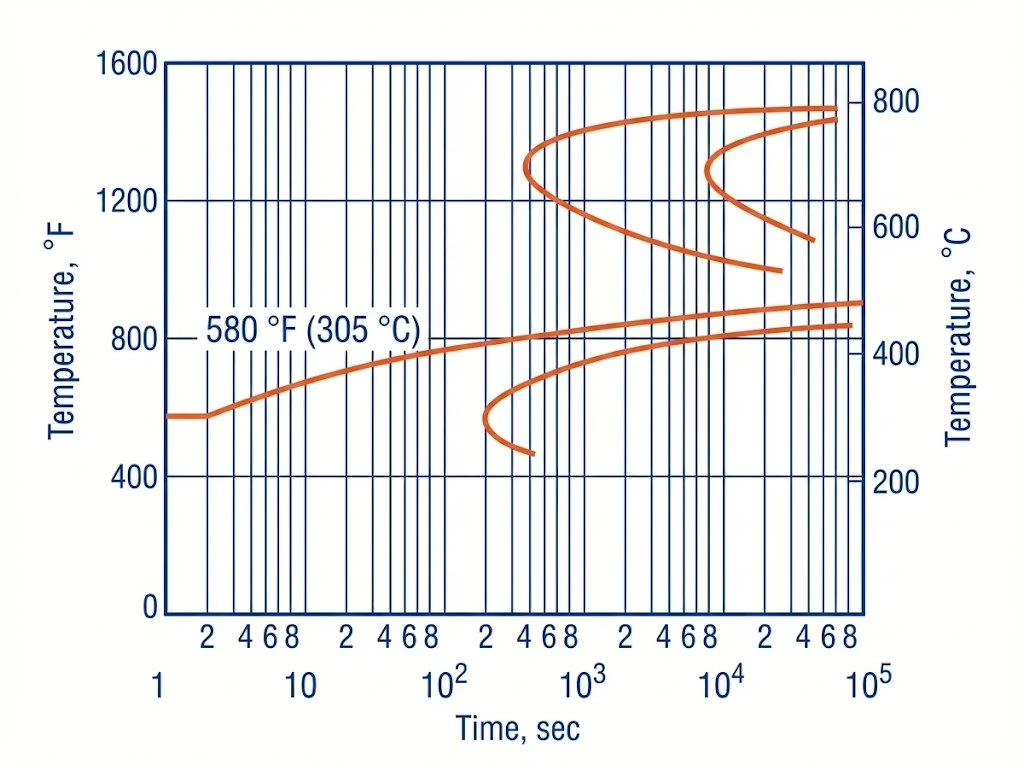
- Martempering: Interrupt the quench in hot oil or molten salt, held at 14–28°C (25–50°F) above the martensite start temperature (Ms), hold until the workpiece temperature equalizes, then air-cool.
- Preheating: Preheating to 650°C (1200°F) before austenitizing significantly reduces distortion during hardening.
- Machining allowance: Retain sufficient stock after rough machining to correct any distortion from final heat treatment.
Quench Cracking
Causes include excessive heating rates, sharp corners, and abrupt changes in cross-section in the tool geometry.
- Oil quench only. Water and brine are prohibited.
- Temper the workpiece before it fully cools to room temperature to relieve residual stress.
- For complex geometries, perform stress-relief annealing at 650–675°C after rough machining and before final hardening.
Surface Decarburization
O2 steel is sensitive to decarburization during heating. Carbon loss at the surface produces a soft layer that reduces wear resistance.
- Heat in a protective atmosphere — an endothermic gas, a salt bath, or a vacuum.
- Remove all oxide scale and any existing decarburized layer from the surface before final heat treatment.
Retained Austenite and Hardness Control
Austenitizing above the recommended temperature raises retained austenite content, leading to insufficient hardness and dimensional instability after quenching.
- Stay within the 760–800°C range. Exceeding this is the primary cause of retained austenite problems.
- Cryogenic treatment at −196°C (−321°F) converts a significant portion of retained austenite to martensite.
- Temper at 175–205°C (345–400°F) to reach a stable working hardness of 58–62 HRC.
Application Limits
O2 steel has no red hardness. It is suitable for cold stamping, shearing, and forming at ambient temperatures. It must not be used in hot-work applications such as die casting or hot forging.
FAQ
O2 tool steel should be preheated to 649-677°C (1200-1250°F) until the material is evenly heated. Preheating helps reduce thermal shock and lowers the risk of deformation or cracking.
The typical austenitizing (hardening) temperature range for O2 steel is 760 to 800°C (1400 to 1472°F). At this temperature, complex alloy carbides are dissolved, and the microstructure transforms into austenite.
After austenitizing, O2 tool steel is typically rapidly quenched in oil to transform the austenite into hard martensite. The material should be cooled to a temperature between 66 and 93 °C (150 and 200 °F) before proceeding to tempering.
Tempering must begin immediately when the temperature from the quenching step has dropped to 52-65°C (125-150°F). This immediate timing is critical to prevent adverse effects on tool life and avoid stabilization of retained austenite.
Each tempering cycle for O2 tool steel requires a soak time of at least 2 hours per inch (4.7 minutes per millimeter) of cross-section. Tempering typically occurs at low temperatures between 150 °C and 260 °C (300 °F to 500 °F) to maintain high hardness.
O2 tool steel commonly requires only a single tempering cycle. However, double tempering is sometimes preferred, requiring air cooling to room temperature between temperings.
- Nee, J. G. (Chief Technical Reviewer & Managing Editor). (2010). Fundamentals of Tool Design (6th ed.). Society of Manufacturing Engineers. ↩︎