
D2 vs D3 Steel: Which Tool Steel Should You Choose?
D2 tool steel and D3 are high-carbon, high-chromium cold-work tool steels used for dies, knives, punches, wear parts, and cold-work tooling that require high wear resistance.
For most cold-work tools, D2 is the safer first choice because it offers a better balance of wear resistance, toughness, heat-treatment stability, and processing reliability. D3 is most common when abrasive wear is severe and impact is low.
D2 and D3 Tool Steel Available from Aobo Steel
Aobo Steel supplies D2 and D3 cold-work tool steels for high-wear dies, knives, punches, wear parts, and abrasive tooling applications.
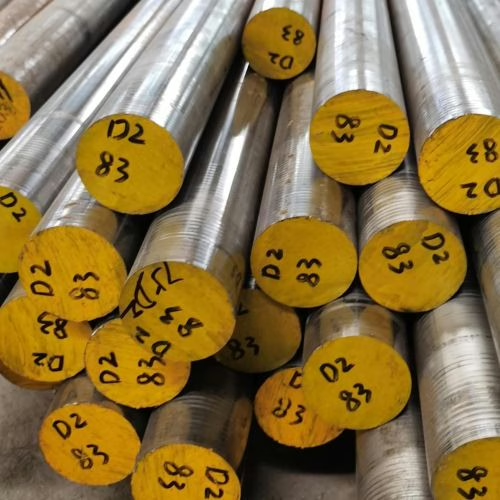
D2 | 1.2379 | SKD11
Balanced high-wear cold-work tool steel for general dies, knives, forming tools, precision tooling, and applications needing better processing reliability.
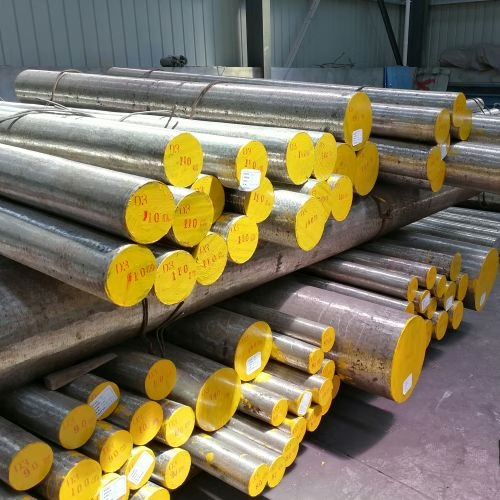
D3 | 1.2080 | SKD1
Very high-carbon, high-chromium cold-work tool steel for severe abrasive wear, simple dies, wear parts, and low-impact tooling.
Quick Comparison
| Factor | D2 Tool Steel | D3 Tool Steel |
|---|---|---|
| Steel type | High-carbon, high-chromium cold work tool steel | High-carbon, high-chromium cold work tool steel |
| Alloy design | Cr-Mo-V cold work steel | High-carbon chromium cold work steel |
| Carbon content | 1.40-1.60% | 2.00-2.35% |
| Wear resistance | High | Very high |
| Toughness | Better | Lower |
| Dimensional stability | Better | Lower |
| Hardening method | Air hardening | Oil hardening |
| Machining difficulty | High | Higher |
| Grinding difficulty | High | Higher |
| Typical direction | General cold work dies, knives, forming tools, precision tooling | Abrasive wear tools, simple dies, wear parts |
Chemical Composition and Performance Difference
| AISI Grade | UNS No. | C (%) | Mn (%) | Si (%) | Cr (%) | Mo (%) | V (%) |
|---|---|---|---|---|---|---|---|
| D2 | T30402 | 1.40-1.60 | 0.60 max | 0.60 max | 11.00-13.00 | 0.70-1.20 | 1.10 max |
| D3 | T30403 | 2.00-2.35 | 0.60 max | 0.60 max | 11.00-13.50 | – | – |
D3 contains significantly higher carbon while maintaining a similar chromium level. This increases the amount of chromium carbides, enhancing abrasive wear resistance but making the steel more brittle and harder to grind.
D2 features lower carbon content and includes added molybdenum and vanadium. Molybdenum improves hardenability and tempering response. Vanadium enhances wear resistance and refines carbides. Therefore, D2 is less extreme than D3 and easier to control during toolmaking.
Wear Resistance, Edge Failure, and Tool Shape
D3 performs well for tools subjected primarily to abrasive, gradual wear. It is suitable for simple wear parts, dies, and tools that operate against abrasive materials.
D2 is usually preferred for tools with thin edges, complex geometry, tight tolerances, or repeated mechanical stress. In blanking, stamping, forming, shearing, slitting, and coining tools, pure wear rarely causes failure; instead, chipping, cracking, edge collapse, distortion, and regrinding loss often determine real tool life.
D3 should not be chosen solely for its higher wear resistance in data sheets. Tool shape, edge support, impact load, and heat-treatment risk must also be considered.
Equivalent Grades
D2 and D3 are often specified under different standard names in international purchasing.
| Standard | D2 Equivalent | D3 Equivalent |
|---|---|---|
| AISI | D2 | D3 |
| UNS | T30402 | T30403 |
| DIN / EN | 1.2379 / X155CrMoV12-1 | 1.2080 / X210Cr12 |
| JIS | SKD11 | SKD1 |
| GB | Cr12Mo1V1 | Cr12 |
Heat Treatment Behavior
| Item | D2 Tool Steel | D3 Tool Steel |
|---|---|---|
| Hardening type | Air hardening | Oil hardening |
| Austenitizing temperature | 995-1030 C | 925-980 C |
| Typical working hardness | 58-62 HRC | 60-64 HRC |
| Distortion risk | Lower | Higher |
| Cracking risk | Lower | Higher |
| Tempering behavior | High-temperature tempering possible | Low-temperature tempering typical |
D2 is easier to control in precision tools because it is an air-hardening steel, meaning it hardens when cooled in still air, which reduces quenching stress. D3, an oil-hardening tool steel, requires greater caution when used with tools with sharp corners, uneven sections, or strict dimensional requirements.
Machining, Grinding, and Total Cost
D3 is more challenging to machine and grind. Its higher carbide volume increases tool wear, grinding resistance, finishing time, and regrinding costs.
The price of raw materials alone can be misleading. A cheaper D3 bar can become more expensive after machining, heat treatment, grinding, and tool repair are counted. D2 is often more predictable for batch production because it is easier to source and process than D3, and it is more widely accepted by toolmakers and heat treaters.
Practical Selection Advice
Choose D2 for a safer starting point
When working conditions are unclear, choose D2 for its broader safety margin in toughness, dimensional control, heat treatment, and processing.
Choose D3 only for severe low-impact abrasion
Select D3 only when failures are definitely due to abrasive wear, the tool shape is simple, and the application has minimal impact or edge shock.
For overseas buyers, D2 offers a lower-risk, dependable procurement choice. Opt for D3 only if you have verified that your application meets the specific requirements it imposes.
Need D2 or D3 tool steel for high-wear cold-work tooling?
Aobo Steel supplies D2 and D3 tool steel for dies, knives, punches, wear parts, and abrasive cold-work tooling. Share your grade, size, quantity, and application for a practical supply suggestion.