
Aobo Steel | Global Tool Steel Supplier in China
Selection of Tool Steel for Hot Stamping (Press Hardening)
Hot Stamping, also known as Press Hardening, is a widely used non-isothermal forming process in the automotive industry. It is primarily employed to manufacture structural components from ultra-high-strength steel with minimal thinning and springback.
In this process, boron-alloyed steel blanks, typically 22MnB5, are heated to 900°C–950°C for austenitizing. The hot blank is then rapidly transferred into an internally cooled die, where forming and quenching occur simultaneously within the tool, transforming the workpiece into martensite.
Since forming and phase transformation occur within the same die, the tooling must not only withstand high mechanical loads from forming and closing pressures but also function as an efficient heat exchanger. During production, the die must continuously absorb and dissipate substantial energy (up to 100 kW) and experience extreme temperature gradients (up to 25 K/mm) between its interior and surface layers, which generate thermal stresses.
Furthermore, to ensure complete martensitic transformation within the die, cooling rates must not fall below 27 K/s. Hot stamping die materials endure intense cyclic thermal and mechanical stresses, making the proper selection of tool steels the first critical step toward successful hot stamping.
Selection Factors
When selecting tool steel for hot stamping, material properties must consider thermal management capabilities and service reliability.
- Thermal Conductivity. Productivity on a hot stamping line largely depends on the die’s heat dissipation efficiency. Higher thermal conductivity facilitates rapid, uniform heat removal during the quenching stage, preventing the formation of localized hot spots and ensuring the workpiece achieves the required cooling rate.
- Resistance to Heat Checking / Thermal Fatigue. During hot stamping, the die surface repeatedly contacts high-temperature blanks and is subjected to internal water cooling, causing periodic expansion and contraction of the surface layer. This thermal cycling induces thermal fatigue on the die surface, gradually forming “heat checking”—surface cracks exhibiting a network-like distribution. Therefore, enhancing tool steel’s resistance to heat checking is critical to extending tool life.
- Tempering Resistance. Since tools experience elevated surface temperatures during forming and quenching, tool steel must exhibit excellent resistance to softening, particularly tempering resistance. Sufficient high-temperature strength helps maintain geometric stability under service loads and effectively suppresses plastic deformation.
- Wear Resistance. Although mechanical loads on dies during hot stamping are lower than those in cold extrusion, wear resistance remains essential for ensuring surface quality and dimensional tolerances, particularly under long-term mass production conditions.
Recommended Tool Steels
Based on the comprehensive requirements for thermal management capability, high-temperature strength, and thermal fatigue resistance during the press-hardening process, the following tool steel grades are commonly selected for hot-stamping dies.
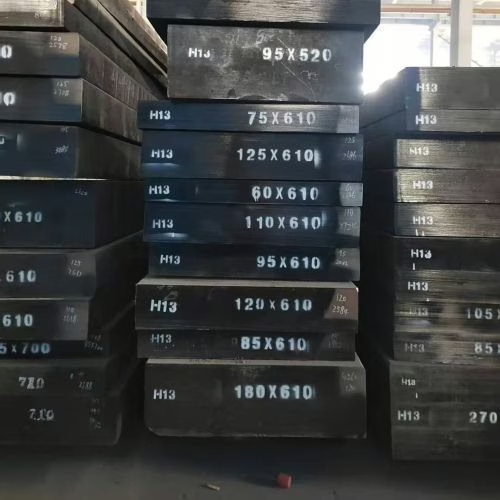
H13 Tool Steel | 1.2344 | SKD61
AISI H13 is one of the most widely used tool steels in hot work applications, extensively employed in die casting, forging, and hot stamping dies, serving as the benchmark material in this field. This steel grade balances toughness with resistance to heat checking. H13 exhibits excellent hardenability during heat treatment with minimal distortion. H13 also exhibits good resistance to softening at elevated temperatures, maintaining hardness below approximately 425°C. It can be water-quenched for use in hot stamping dies. Its typical working hardness range is 42–53 HRC.
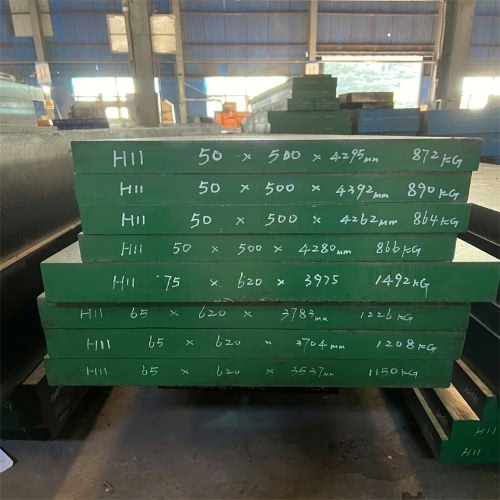
H11 Tool Steel | 1.2343 | SKD6 (High Toughness Alternative)
AISI H11 is a 5% chromium hot-work steel with a composition similar to H13 but lower vanadium content, offering superior toughness and fracture resistance. H11 is particularly suitable for hot-work tools at risk of gross cracking(catastrophic failure). Like H13, this steel type is air-hardened and exhibits relatively uniform property distribution in large-section dies. H11 exhibits strong resistance to thermal softening and is a standard choice for hot-work tooling, typically operating in the 38–54 HRC hardness range. For applications highly susceptible to cracking, “Low Si H11” can be selected, offering improved toughness.
DIN 1.2367(H10 Modified)
DIN 1.2367(H10 Modified) is a low-chromium hot-work steel specifically optimized for press-hardening and hot-stamping dies. DIN 1.2367(H10 Modified) contains higher molybdenum, offering significantly superior tempering resistance compared to H13 or H11. Its high thermal conductivity facilitates rapid heat removal, making it suitable for small, high-strength dies subjected to severe thermal shock and reliant on water cooling. For applications where standard grades fail prematurely due to thermal fatigue or insufficient high-temperature strength, DIN 1.2367(H10 Modified) is a superior choice. After tempering at 600°C, its hardness reaches 52–54 HRC, and DIN 1.2367(H10 Modified) exhibits superior high-temperature yield strength compared to H13/H11.
FAQ
Key factors include thermal conductivity for heat dissipation, resistance to heat checking, high-temperature strength to resist softening, and wear resistance to ensure surface quality.
High thermal conductivity allows rapid, uniform heat removal during quenching. This prevents localized hot spots, ensures the workpiece achieves the necessary cooling rate, and directly increases production efficiency.
Common selections include AISI H13 for a balance of toughness and heat check resistance, AISI H11 for high toughness, and DIN 1.2367 for superior thermal shock resistance and conductivity.
Select AISI H11 when the tool is at risk of gross cracking or catastrophic failure. It contains lower vanadium than H13, providing superior toughness and fracture resistance.
DIN 1.2367 has higher thermal conductivity and superior tempering resistance than H13. It is ideal for small, high-strength dies subjected to severe thermal shock that require rapid heat removal.
Heat checking results from thermal fatigue caused by cyclic expansion and contraction. The die surface alternates continuously between contact with hot blanks and internal water cooling, eventually forming a network-like pattern of cracks.
Working hardness ranges vary by grade: AISI H13 typically operates at 42–53 HRC, AISI H11 at 38–54 HRC, and DIN 1.2367 reaches 52–54 HRC after tempering.
Dies experience elevated surface temperatures during forming and quenching. Sufficient high-temperature strength prevents softening and plastic deformation, ensuring the tool maintains its geometric stability under heavy loads.