
Cr12 Tool Steel (D3 / 1.2080 / SKD1) Supplier from China
Bulk Supply for Distributors & Stockists | Stable Quality, Reliable Delivery
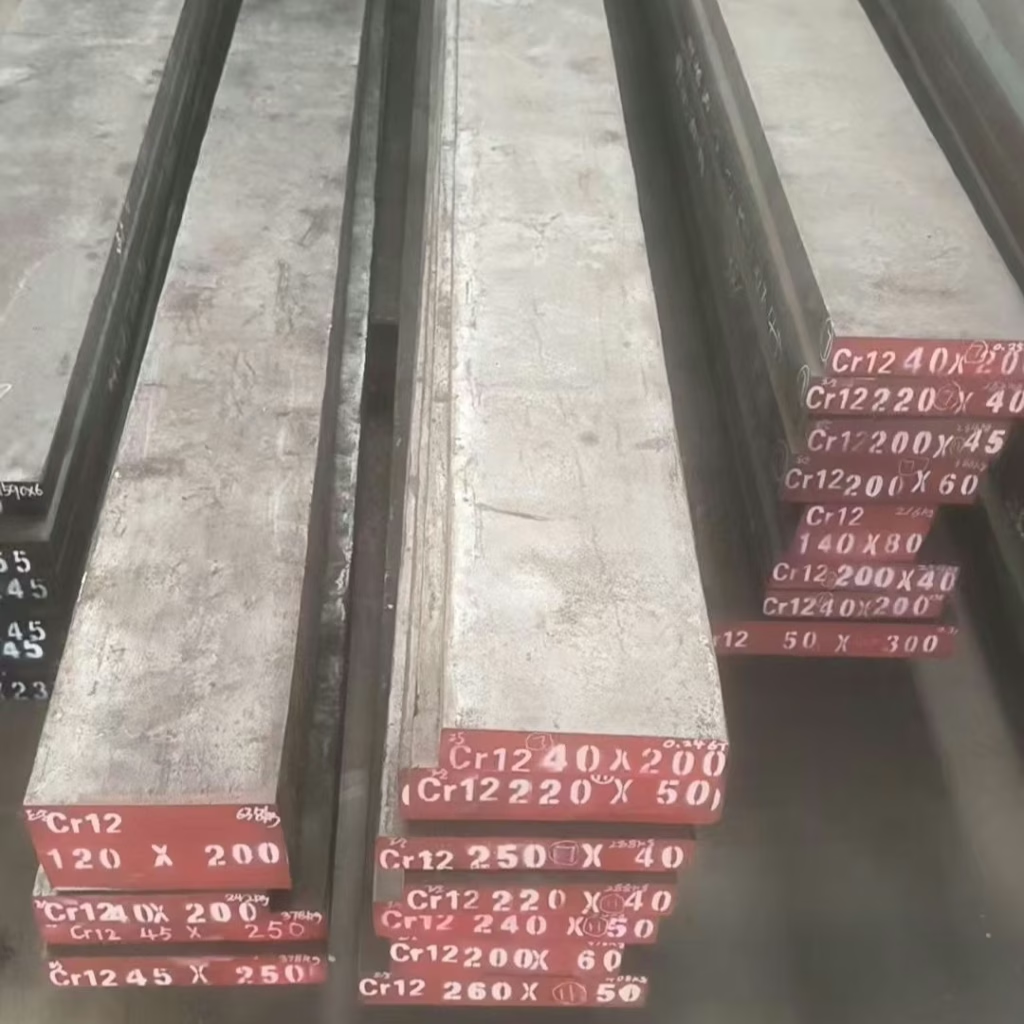
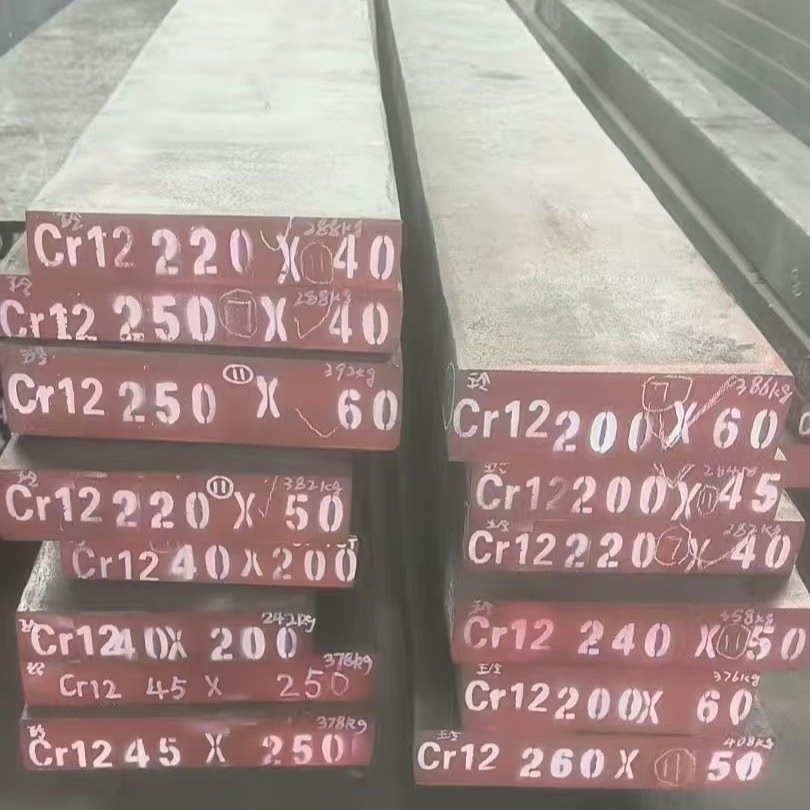
Cr12 tool steel is a grade under the Chinese national standard. It is a classic high-carbon, high-chromium cold-work die steel that combines high strength, wear resistance, and hardenability. Equivalent grades to Cr12 include American AISI D3, German W-Nr. 1.2080, and Japanese JIS SKD1.
Cr12 Tool Steel Supply Overview
| Grade | GB Cr12 / AISI D3 / DIN 1.2080 / JIS SKD1 |
| Delivery Condition | Fully Annealed (Soft Condition for Machining) |
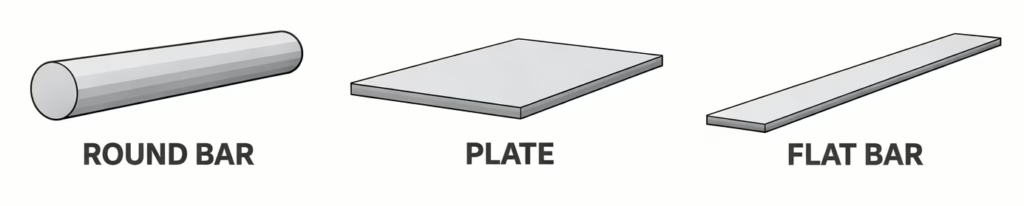
| Available Forms | Round Bar / Flat Bar / Plate / Forged Block |
| Monthly Production Capacity | Approx. 1000 metric tons |
| Recommended Export Quantity | Full 20GP container (~26 tons) |
| MOQ | 5 tons |
| Lead Time (With Ingot Stock) | Approx. 20 days |
| Lead Time (Fresh Melt) | 30–45 days |
| Lead Time (ESR Grade) | Approx. 60 days |
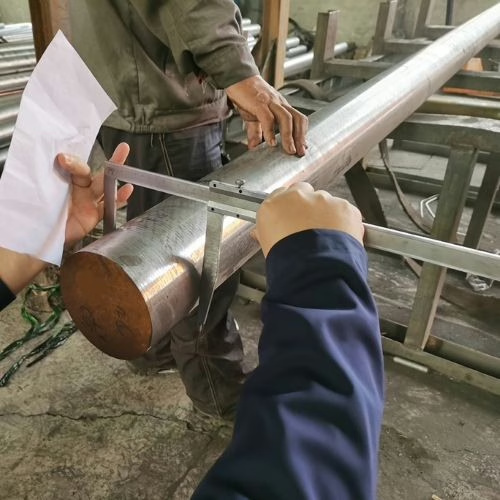
| Inspection | In-house UT team + Third-party inspection available |
| Documentation | MTC (EN 10204 3.1) + UT Report |
Why Global Distributors Source Cr12 from Aobo Steel
- Continuous monthly supply of around 1000 tons
- MOQ from 5 tons for wholesale orders
- Container-optimized bar and plate lengths
- Mixed sizes are supported for export loading
- Annealed delivery for downstream machining
- Stable sourcing through integrated supply chain partners
- UT inspection available to SEP 1921-82 D/d or E/e
- MTC and batch traceability with each shipment
- Heat number tracking for order control
- Black, turned, and polished surface options
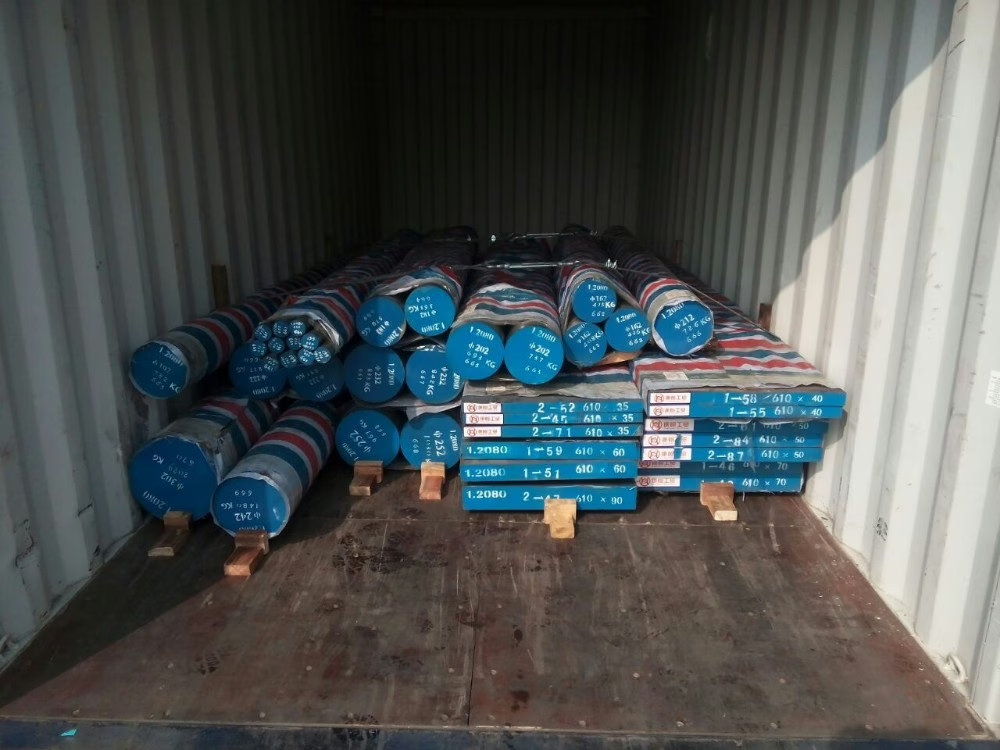
- Bulk export packing for sea shipment
- Clear conversion path to the dedicated bulk supply page
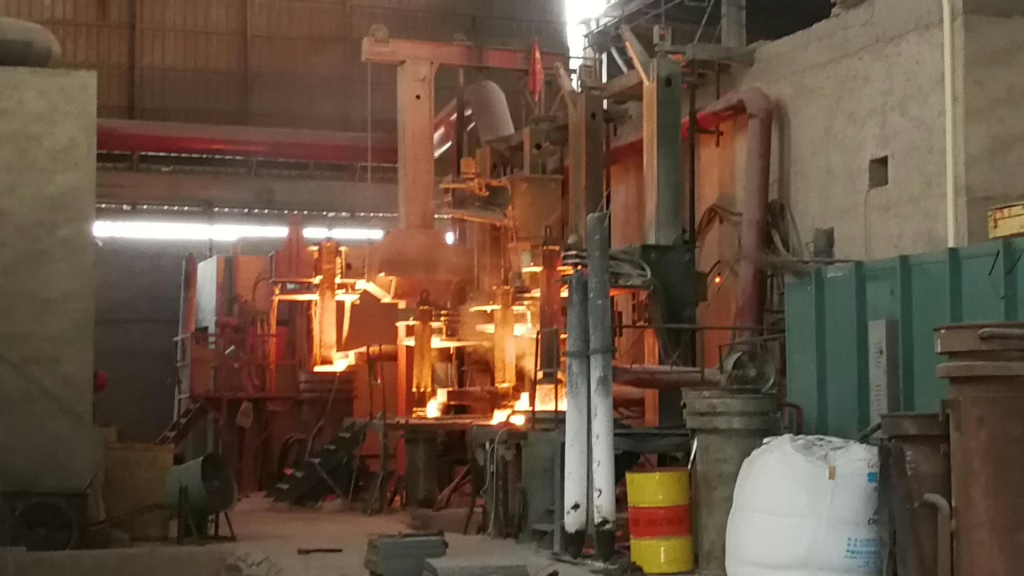
Stable Production for Long-Term Bulk Supply
- Continuous monthly output of around 1000 tons
- Continuous production cycles for inventory replenishment
- ESR (Electro-Slag Remelting) is available upon request
- Stable alloy sourcing to reduce supply interruption risk
- Full batch traceability linked to the original heat number
Available Cr12 Tool Steel Forms
Quality Control for Bulk Orders
Every batch of tool steel supplied by Aobo Steel is verified before shipment to ensure grade accuracy, internal soundness, and traceability for bulk orders.
- Chemical composition verified by a spectrometer
- Ultrasonic testing available (SEP 1921-82)
- Delivered in spheroidized annealed condition
- Mill Test Certificate (EN 10204 3.1) with heat number
- Dimensional and surface inspection before shipment
Export Packaging and Container Loading
- Professional seaworthy export packing
- 20GP loading optimized up to ~26 tons
- Mixed grades and mixed sizes supported
- Anti-rust protection for long sea transit
For international shipments, full-container loading is strongly recommended to ensure cost efficiency and smoother customs processing.
Cr12 Tool Steel Composition(GB / T 1299—2000)
| C | Cr | Si | Mn | P | S |
| 2.00 – 2.30 | 11.50 – 13.00 | ≤ 0.40 | ≤ 0.40 | ≤ 0.030 | ≤ 0.030 |
Cr12 Tool Steel Mechanical Properties
Cr12 steel is classified as a high-carbon, high-chromium ledeburitic steel. Due to its high carbon mass fraction, it exhibits lower impact toughness and a tendency toward brittle fracture, coupled with a susceptibility to forming non-uniform eutectic carbides.
The high concentration of chromium in the steel promotes the formation of (CrFe)₇C₃ complex carbides, which in turn reduces the amount of cementite (Fe₃C). During quenching, a significant volume fraction of these carbides dissolves into the austenite phase. Subsequent quenching transforms the austenite into high-hardness martensite. Upon tempering, a fine and dispersed precipitation of carbides occurs within the martensitic matrix, resulting in excellent wear resistance.
Through an appropriate heat treatment process, a microstructure that combines high strength and toughness can be achieved.
Cr12 Tool Steel Forging Process
| Item | Heating Temperature/°C | Initial Forging Temperature/°C | Final Forging Temperature/°C | Cooling Method |
| Steel Ingot | 1140 ~ 1160 | 1100 ~ 1120 | 900 ~ 920 | Slow Cooling |
| Steel Billet | 1120 ~ 1140 | 1080 ~ 1100 | 880 ~ 920 | Slow Cooling |
The primary objective of forging Cr12 steel is to break down and refine the coarse carbides inherent in the steel, ensuring they are distributed uniformly throughout the matrix. This process significantly improves the material’s overall strength and toughness. Furthermore, proper forging establishes a rational alignment of flow lines within the die, which helps promote consistent, predictable dimensional changes (distortion) in all directions during subsequent quenching.
Regarding the heating procedure for forging, it is crucial to first preheat the workpiece before gradually increasing it to the final forging temperature. Attention must be paid to the proper placement of the workpiece within the furnace, and the material should be turned or flipped periodically to ensure uniform heating.
Cr12 Tool Steel Heat Treatment
Preheating
| Process Parameters | |
| General Annealing after Forging | Heating temperature: 850 ~ 870 °C. After uniform heating, hold for 4 ~ 5h. Furnace cool at a rate of <30°C/h to below 500°C, then air cool. Hardness after annealing: ≤229HBW. Microstructure after annealing: granular pearlite + carbide. |
| Isothermal Annealing after Forging | Heating temperature: 830 ~ 850 °C. Hold for 2 ~ 3h. Furnace cool to 720 ~ 740°C and hold for 3 ~ 4h. Furnace cool to below 550°C, then air cool. Hardness after annealing: ≤269HBW. Microstructure: granular pearlite + carbide. |
Quenching
Quenching Specification
| Process | Quenching Temperature/°C | Cooling Method | Hardness HRC |
| Recommended Quenching Specification | 950 ~ 980 | Oil Cooling | ≥60 |
| Isothermal Quenching Process | Heat to 980°C, hold for a certain period, then isothermally hold in a salt bath at 250 ~ 280°C for a period of time, and then air cool to obtain a mixed structure of lower bainite + martensite + retained austenite + carbide. Then, temper at an appropriate temperature to obtain a high-toughness structure. | ||
Performance Comparison of Different Heat Treatment Processes
| Heat Treatment Process | Hardness HRC | Impact Toughness aᴋ / (J/cm²) | Retained Austenite (Volume Fraction, %) | Tapping Plate Life / x10⁴ pieces | Wear Loss/mg |
| 980°C heating, oil quenching | 66.5 | 14.1 | 13.2 | 4 | — |
| 980°C heating, 180°C graded quenching 50min | 65.8 | 15.8 | — | 5 | — |
| 980°C heating, 270°C isothermal 3h | 62.5 | 15.9 | — | 6 | 11.9 |
| 980°C heating, 270°C isothermal 4h | 60 | 17.7 | 15.02 | — | — |
| 980°C heating, 270°C isothermal 5h | 59 | 16.8 | — | — | — |
| 980°C heating, 180°C pre-quenching 35min, 270°C isothermal 1h | 64.6 | 14.6 | — | 12 ~ 15 | 8.2 |
| 980°C heating, 180°C pre-quenching 35min, 270°C isothermal 2h | 46.2 | 14.9 | 18.31 | 12 ~ 28 | — |
| 980°C heating, 180°C pre-quenching 35min, 270°C isothermal 3h | 63.8 | 15.2 | — | — | — |
Note: All samples were tempered twice at 180°C, 1.5h each time.
Relationship between Quenching Temperature and Hardness
| Quenching Temperature/°C | 875 | 900 | 925 | 950 | 975 | 1000 | 1050 | 1100 |
| Hardness HRC | 54.5 | 57 | 60 | 62.5 | 65 | 66 | 64 | 59.5 |
Tempering
Tempering Specification
| Purpose of Tempering | Heating Temperature/°C | Tempering Time (h) | Number of Tempers | Hardness HRC |
| Relieve stress, stabilize structure | 180 ~ 200 | 2 | 1 | 60 ~ 62 |
| Relieve stress, reduce hardness | 320 ~ 350 | 2 | 1 | 57 ~ 58 |
Note: The tempering temperature is generally 180-200°C, with a hardness ≥ 60 HRC. To avoid cracks caused by EDM and grinding and to improve the mold’s toughness, it is often tempered below 400°C. The hardness after tempering is 54 ~ 58HRC. The temper brittleness range is 275 ~ 375°C, which should be avoided as much as possible during tempering.
Relationship between Tempering Temperature and Hardness
| Tempering Temperature/°C | Not Tempered | 200 | 300 | 400 | 450 | 500 | 550 | 600 | 650 |
| Hardness HRC | 65 | 63 | 62 | 60 | 60 | 60 | 59.5 | 57.1 | 44 |
Note: 955°C oil quenching.
Cr12 Tool Steel Applications
It is predominantly selected for manufacturing components that require high wear resistance but are subjected to relatively low impact loads.
Specific applications include:
- Cold shearing blades and cutters
- Drill bushings
- Gauges
- Punches
- Thread rolling plates and dies
- Stamping and punching dies
- Wire drawing dies
- Cold extrusion dies
- Coining and embossing dies
- Deep drawing dies