
What Is Air-Hardening Tool Steel and How Does It Work?
Air-hardening tool steel is a high-alloy tool steel that can form martensite through air or gas cooling instead of severe liquid quenching. Its main value is dimensional stability, which makes it useful for precision dies, molds, gauges, blades, and complex tooling where heat-treatment distortion must be controlled.
Air-Hardening Tool Steels Available from Aobo Steel
Aobo Steel supplies common air-hardening tool steel grades in bulk round bar and flat bar for precision tooling, cold work dies, hot work tools, shock-resisting tools, and high-speed cutting tools.
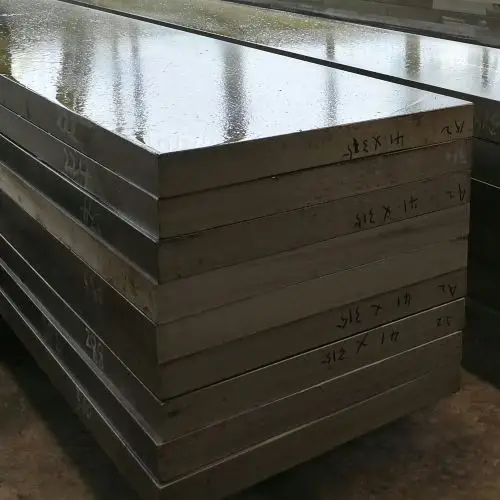
A2 | 1.2363 | SKD12
Balanced cold work grade for toughness, wear resistance, and dimensional stability.
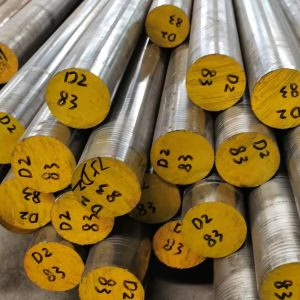
D2 | 1.2379 | SKD11
High wear resistance cold work steel for long-run dies, knives, and forming tools.
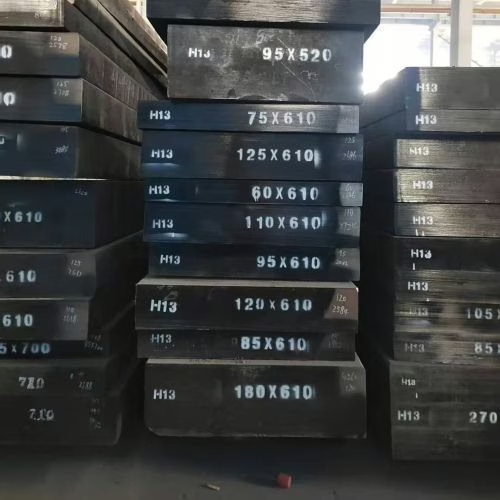
H13 | 1.2344 | SKD61
Hot work tool steel for die casting, hot extrusion, forging, and thermal fatigue service.

S7 | 1.2355
Shock-resisting tool steel for impact tools, punches, chisels, and shear blades.
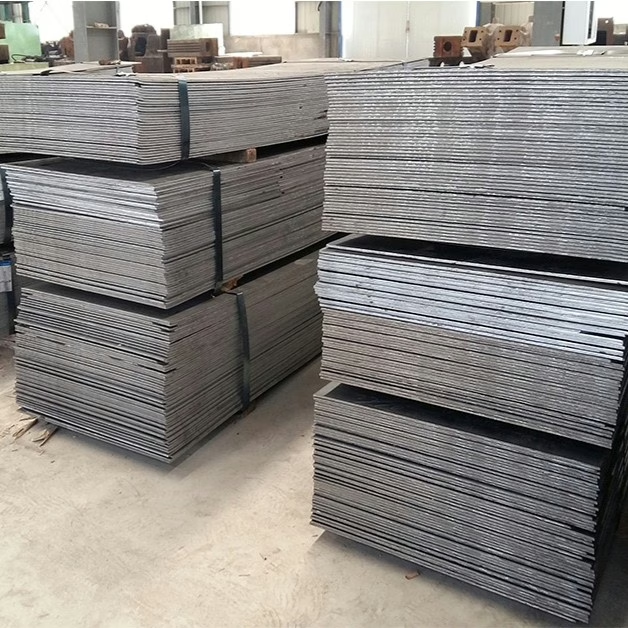
M2 | 1.3343 | SKH51
High-speed steel for cutting tools that require red hardness and wear resistance.
What Is Air-Hardening Tool Steel?
Air-hardening tool steels contain enough carbon and alloying elements to harden during air cooling from the austenitizing temperature. In the AISI system, the A-series is the primary group of air-hardening cold-work tool steels. A2, A6, and A7 are typical examples.
In practical tool steel selection, air-hardening behavior also appears outside the A-series. D2, H13, S7, M2, and many other high-alloy tool steels can also be hardened by air, forced air, or gas cooling. The common point is high hardenability.
Hardenability means the ability of steel to harden through its section during quenching. In air-hardening tool steel, high hardenability allows the steel to harden without water or oil quenching.
How Does Air-Hardening Tool Steel Work?
Steel hardening depends on martensite formation. When tool steel is heated to its austenitizing temperature, its structure changes into austenite. During cooling, the steel must avoid forming softer structures such as pearlite or bainite. If the cooling rate is high enough, austenite transforms into martensite.
Plain carbon steels need a high critical cooling rate. They must cool very quickly to avoid pearlite formation, so water-hardening steels need a severe quench.
Air-hardening tool steels have a lower critical cooling rate. Alloying elements such as chromium, molybdenum, manganese, vanadium, and tungsten delay the transformation from austenite into pearlite or bainite. This gives the steel enough time to reach the martensite transformation range during slower cooling.
As a result, air or gas cooling can still produce martensite. The steel becomes hard, but the quenching stress is much lower than in water or oil quenching.
Why Air Hardening Reduces Distortion and Cracking
Distortion mainly comes from uneven cooling and uneven transformation.
In water or oil quenching, the surface cools much faster than the core. The surface contracts first, while the inside remains hot and expanded. This creates thermal stress. If the stress becomes too high, the tool can warp or crack.
Martensite formation also creates stress because the steel expands during transformation. In a severe quench, the surface may become hard martensite while the core is still hot austenite. When the core later transforms and expands, it pushes against the already hardened surface. This can cause cracking or heavy distortion.
Air hardening reduces this problem. The surface and core cool more evenly. The temperature difference within the tool decreases. The martensite transformation also occurs more uniformly throughout the section. This gives air-hardening tool steels better dimensional stability and better safety during hardening.
Air-Hardening vs Oil-Hardening vs Water-Hardening Tool Steel
Water-hardening, oil-hardening, and air-hardening tool steels mainly differ in alloy content, hardenability, quenching severity, and dimensional stability.
| Tool Steel Type | Typical Grades | Quenching Medium | Main Advantage | Main Limitation |
|---|---|---|---|---|
| Water-hardening tool steel | W1, W2, W5 | Water or brine | Low alloy cost and good machinability | Highest distortion and cracking risk |
| Oil-hardening tool steel | O1, O2, O6, O7 | Oil | Better hardenability than W-series steels | Still has liquid-quench distortion risk |
| Air-hardening tool steel | A2, A6, D2, H13, S7, M2 | Air, forced air, gas, or controlled cooling | Better dimensional stability and lower quench cracking risk | Higher alloy cost and lower machinability |
Air-hardening steels are usually selected when dimensional stability, deep hardening, or a lower risk of cracking matters more than raw material cost.
Common Air-Hardening Tool Steel Grades
Air-hardening tool steels are not limited to one AISI group. The A-series is the classic air-hardening cold work family, but many D-series, H-series, S-series, and high-speed steels also harden by air or gas cooling.
| Grade | Tool Steel Family | Main Strength | Typical Applications |
|---|---|---|---|
| A2 | Air-hardening cold work steel | Balanced toughness, wear resistance, and dimensional stability | Blanking dies, forming dies, punches, gauges |
| A6 | Air-hardening cold work steel | Low hardening temperature and low movement | Precision tools, medium-duty dies |
| A7 | Air-hardening cold work steel | Very high abrasion resistance | Abrasive wear applications with limited shock |
| D2 | High-carbon high-chromium cold work steel | High wear resistance and good dimensional stability | Long-run blanking dies, slitter knives, shear blades |
| H13 | Hot work tool steel | Hot hardness and thermal fatigue resistance | Die casting dies, hot extrusion dies, forging dies |
| S7 | Shock-resisting tool steel | High impact toughness with air-hardening ability | Punches, chisels, shear blades, impact tools |
| M2 | High-speed steel | Red hardness and cutting wear resistance | Cutting tools, hobs, broaches, drills |
Heat Treatment Considerations for Air-Hardening Tool Steel
Air-hardening tool steel needs controlled heat treatment. The usual process includes annealing, machining, stress relieving when needed, austenitizing, air or gas quenching, and tempering.
| Heat Treatment Step | Purpose | Key Point |
|---|---|---|
| Annealing | Soften the steel for machining | Required before major machining |
| Stress relieving | Reduce machining stress | Useful for complex or heavily machined tools |
| Austenitizing | Prepare the steel for hardening | Temperature depends on the grade |
| Air or gas quenching | Form martensite with lower stress | Cooling must still match section size |
| Tempering | Reduce brittleness and adjust hardness | Multiple tempering cycles are common |
The exact temperature depends on the grade. A2, D2, H13, S7, and M2 do not share one heat-treatment schedule. A cold-work steel, a hot-work steel, and a high-speed steel require different hardening and tempering conditions.
Surface protection also matters. Many air-hardening grades use high austenitizing temperatures. A poor furnace atmosphere can cause decarburization, leaving a soft surface layer. Vacuum furnaces, controlled atmospheres, salt baths, or proper wrapping methods help reduce this risk.
Retained austenite can also affect dimensional stability. High alloy content can leave unstable austenite after quenching. Multiple tempering cycles, and sometimes cryogenic treatment, help stabilize the structure before service.
When Should You Choose Air-Hardening Tool Steel?
Choose air-hardening tool steel when the tool needs high hardness with minimal heat-treatment distortion. It is especially useful when the tool’s shape makes water- or oil-quenching risky.
| Requirement | Suitable Choice |
|---|---|
| Low distortion in cold work dies | A2 or D2 |
| Better balance of toughness and wear resistance | A2 |
| Higher wear resistance | D2 or selected high-speed steels |
| Hot work, die casting, extrusion, and forging | H13 |
| High impact loading | S7 |
| Cutting under heat | M2 |
| Precision tools and gauges | A2, A6, or similar stable grades |
Limitations of Air-Hardening Tool Steel
Air-hardening tool steel has clear advantages, but it also has limits.
The first limitation is machinability. High alloy content and hard carbides make many air-hardening steels harder to machine and grind. A-series steels are usually less machinable than water-hardening steels. D2 is more difficult because of its high carbide volume.
The second limitation is cost. Chromium, molybdenum, vanadium, tungsten, and other alloying elements increase raw material cost. Air-hardening grades usually cost more than simple W-series or O-series steels.
The third limitation is section size. Air-hardening steels are deep-hardening, but still air has limits. Very large sections may require forced-air, gas-quenching, or another controlled-cooling method. The correct choice depends on grade, size, geometry, and furnace capability.
Normalizing is usually not suitable for air-hardening tool steels. Air cooling from high temperature can harden the steel into brittle martensite. When softening is needed, these steels typically require full annealing rather than normalizing.
Air hardening also does not mean zero distortion. Poor heating, uneven section thickness, improper cooling, delayed tempering, or poor furnace control can still cause cracking, dimensional changes, or reduced tool life.
Need Bulk Air-Hardening Tool Steel Supply?
Aobo Steel supplies tool steel round bar and flat bar for bulk orders. Available grades include D2, A2, H13, S7, M2 and other tool steel materials for industrial tooling applications.
Send Inquiry