
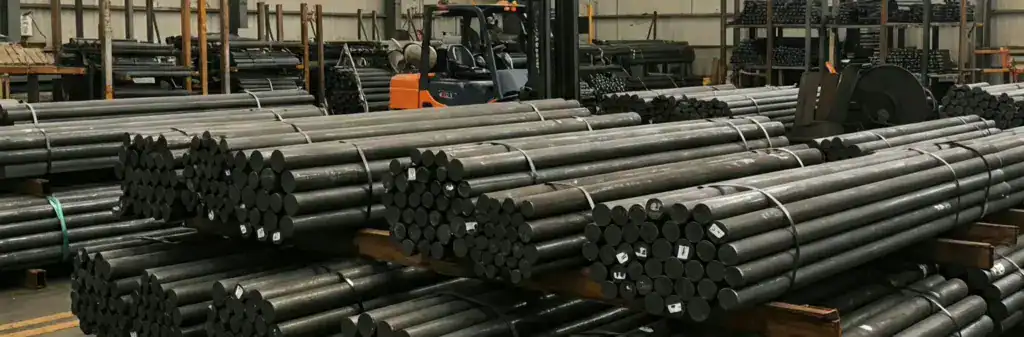
Selection of Tool Steels for Forming & Drawing
In metal-forming processes, dies are frequently subjected to extremely high contact pressures, high sliding speeds, and high temperatures. The rationale for selecting tool and die steel is to prevent plastic deformation under high stresses and to effectively suppress adhesive wear, which is commonly encountered when processing stainless steel or advanced high-strength steel (AHSS).
Explore Our Forming & Drawing Die Steel Solutions
Material Selection Recommendations
Surface Treatment and Substrate Stability
In AHSS or stainless steel forming applications, PVD or TD surface treatments are commonly employed to suppress adhesive wear and reduce friction. Coating performance depends on the substrate’s ability to support the hard thin layer, necessitating avoidance of the “eggshell effect” induced by substrate deformation. Compared to D2, DC53 (8% Cr) serves as a superior coating substrate. It exhibits significant secondary hardening properties during high-temperature tempering at 500–550°C, ensuring the substrate does not soften during coating. It consistently maintains a hardness of >60 HRC, providing stable support for the coating under high loads.
Forming High-Strength Steel (HSS)
Compared to low-carbon steel, forming HSS and AHSS involves extremely high contact pressures and temperatures, significantly increasing the risk of adhesive wear and die deformation. Conventional D2 steel struggles to meet these demanding conditions due to its low toughness and coarse eutectic carbides in the microstructure, which readily induce crack initiation. For high-strength steel applications, powder metallurgy grades or DC53 (8% Cr modified steel) should be selected. Their combination of high compressive strength and high toughness reduces plastic deformation in dies and reduces the risk of chipping.
Comparison Table
| Grade | Galling Resistance | Compressive Strength | Toughness | Best Application |
| D2 (1.2379) | Moderate | High | Low | Heavy-duty forming of AHSS; substrate for PVD/TD coatings; complex dies requiring toughness. |
| DC53 (8% Cr) | High | Very High | High | General-purpose forming, short-run dies, and less demanding tolerances. |
| Cr12MoV | Low/Moderate | Moderate | Moderate | General purpose forming; short-run dies; less demanding tolerances. |
FAQ
You need steel combining high toughness to withstand impact loads and high hardness to delay edge wear. This combination helps maintain precise bending angles and effectively control springback.
Select tool steel with a low coefficient of friction and high compressive yield strength. These properties prevent adhesive wear and surface scratches caused by high-pressure sliding contact during the drawing process.
Powder metallurgy grades, such as DC53, are recommended due to their high compressive strength and toughness. Conventional D2 often fails in these applications because its low toughness can induce cracking.
DC53 exhibits significant secondary hardening, maintaining >60 HRC after high-temperature tempering. This stability prevents substrate softening and the “eggshell effect,” providing superior support for the coating compared to D2.
Roll forming rollers require exceptional dimensional stability to maintain precise tolerances. They also need high wear resistance to prevent deviations and excellent toughness to delay fatigue failure from cyclic contact stresses.
Dies require high yield strength to suppress plastic deformation and high fatigue strength to reduce the risk of cracking. The steel must withstand high-pressure internal loads and pulsating hydraulic forces.
D2 is best suited for abrasive wear applications and simple forming dies where toughness is a secondary concern. It offers high compressive strength but has low toughness and moderate galling resistance.