
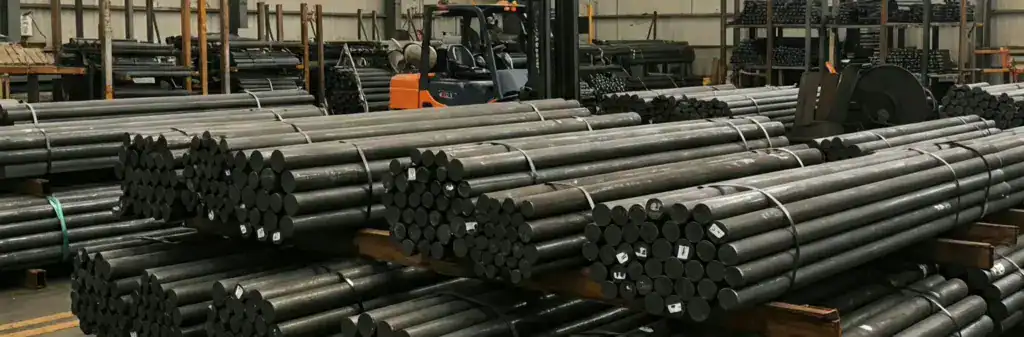
Selection of Tool Steels for Cold Forming & Extrusion
Cold forming and extrusion dies endure extreme tribological and mechanical stresses. The process achieves metal displacement through plastic flow under non-uniform transient pressures, with die internal pressures typically exceeding 1895 MPa (275 ksi) and punch pressures reaching up to 2370 MPa (344 ksi).
Under these operating conditions, the primary failure modes include abrasive wear, fracture, upsetting or bulging, and high-cycle fatigue. To withstand high unit pressures and prevent workpiece-to-tool interlocking, cold-work tool steels exceeding standard grades—such as DC53 and M2 high-speed steel—should be selected. These grades exhibit high compressive yield and fatigue strengths, effectively resisting permanent deformation and delaying crack initiation.
Explore Our Forming & Extrusion Die Steel Solutions
Material Selection Strategy
Materials for heavy-duty cold-forming tools are typically selected from M2 high-speed steel (HSS) and high-performance cold-work tool steels, such as DC53.
M2 (HSS): When compressive loads exceed the yield strength of D2, select M2 for punches and dies. This steel grade offers high compressive yield strength, making it suitable for applications requiring a tool pressure exceeding 2100 MPa. Additionally, M2 exhibits red hardness, counteracting the effects of adiabatic heating on tools during rapid extrusion.
DC53 (8% Cr): For applications where D2 fails due to chipping or cracking, select DC53 (8% Cr modified). Its finely distributed carbides provide superior toughness over D2 while maintaining hardness at 62–64 HRC, enhancing resistance to adhesive wear and scoring on metal contact surfaces.
Heat Treatment and Compressive Strength
The properties of tool steel are determined by heat treatment. To prevent plastic deformation, the tool steel’s hardness must ensure that its yield strength exceeds the applied process stress. High-speed steel and DC53 require high-temperature tempering to promote the complete transformation of retained austenite. If transformation is incomplete, retained austenite may undergo strain-induced phase transformation under cyclic stress, converting to untempered martensite. This leads to dimensional instability and tool embrittlement.
Comparison Table
| Steel Grade | Compressive Strength | Toughness | Fatigue Resistance | Typical Application |
| M2 (SKH51) | Very High (>2200 MPa) | Moderate/Good | Excellent (High elastic limit) | Heavy-duty extrusion punches, Thread rolling dies, |
| DC53 | High (Superior to D2) | High (Finer carbides than D2) | High (Resists micro-chipping) | Cold heading dies, High-load stamping, Trimming dies |
| D2 (1.2379) | Moderate/High (up to 2000 MPa) | Low (Prone to chipping) | Moderate (limited by coarse carbides) | General purpose forming, blanking dies |
FAQ
Primary failure modes include abrasive wear, fracture, upsetting, and high-cycle fatigue failure due to non-uniform transient pressures. Thread rolling dies may also experience flaking and chipping at the thread crest.
M2 high-speed steel is suitable for applications with tool pressures exceeding 2100 MPa. It offers high compressive yield strength and exhibits red hardness to counteract adiabatic heating effects during rapid extrusion.
Select DC53 when D2 fails due to chipping or cracking. DC53 features finely distributed carbides that provide superior toughness compared to D2 while maintaining a hardness of 62–64 HRC.
The surface hardness must exceed 60 HRC to resist scoring. Additionally, the core requires high-impact toughness to inhibit crack propagation caused by impact stresses during upsetting of wire or bar stock.
The die steel must resist subsurface shear stresses to suppress crack initiation. For work-hardened alloys, ensure die hardness exceeds 64 HRC to maintain thread profile tolerances and prevent edge chipping.
High-temperature tempering promotes the complete transformation of retained austenite. If incomplete, retained austenite may convert to untempered martensite under stress, leading to dimensional instability and tool embrittlement.
Die inserts are typically prestressed using a shrink ring to suppress cracking caused by internal pressure cycles. Inserts require high fatigue strength to endure the radial and circumferential stresses generated during operation.