
H11 Tool Steel Heat Treatment Guide
Harden H11 by austenitizing at 995 to 1025°C (1825 to 1875°F), air quench to about 50 to 65°C, then double temper at 510 to 540°C (950 to 1000°F) for two hours per cycle. H11 is air hardening, so never water quench, and always temper immediately while the part is still warm.
Correct heat treatment converts the soft annealed structure of H11, a ferrite matrix with spheroidized alloy carbides, into a tempered martensitic structure that holds strength and toughness at elevated temperature. The full sequence is annealing or stress relief to prepare the part, then preheating, austenitizing, quenching, and double tempering. Which property each step is protecting is explained in the H11 properties and performance guide.
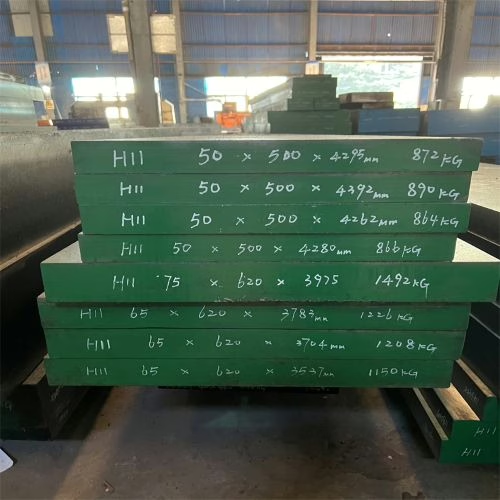
Aobo Steel supplies H11 hot-work tool steel as forged bar, plate, and block, delivered annealed and ready for machining, with a mill test certificate on every order. Minimum order quantity is 5 tons. Send us your sizes, condition, and quantities for a quote.
H11 heat treatment at a glance
| Stage | Temperature | Hold or rate | Notes |
|---|---|---|---|
| Annealing | 845 to 900°C (1550 to 1650°F) | Furnace cool to 480°C at ~22°C per hour, then air cool | Softens to roughly 192 to 235 HB for machining |
| Stress relief | 650 to 675°C (1200 to 1250°F) | 1 hour per inch of section | Air cool slowly before hardening |
| Preheat | 815°C (1500°F) typical | Equalize | Add a 650°C first stage for large or complex parts |
| Austenitize | 995 to 1025°C (1825 to 1875°F), 1010°C typical | 20 min plus 5 min per 25 mm | Vacuum, salt bath, or controlled atmosphere |
| Quench | Air to 50 to 65°C (125 to 150°F) | Still air or air blast | Air hardening, never water quench |
| Temper | 510 to 540°C (950 to 1000°F) | 2 hours per cycle, temper twice | Temper immediately while the part is warm |
Annealing and stress relieving
Annealing restores a soft, machinable structure after forging or before rework. Heat slowly to 845 to 900°C (1550 to 1650°F) under a controlled atmosphere or inert packing to avoid decarburization, cool in the furnace to 480°C (900°F) at about 22°C (40°F) per hour, then air cool. The result is a spheroidized structure of roughly 192 to 235 HB.
Stress relief removes machining and forming stresses before hardening, so the part distorts less. After heavy machining, grinding, welding, or EDM, heat rough-machined parts to 650 to 675°C (1200 to 1250°F), hold one hour per inch of the largest section, then cool slowly in still air. For a stress-relief temper applied to an already hardened part, set the temperature 14 to 28°C (25 to 50°F) below the last tempering temperature so you do not lower the hardness.
Hardening: preheating and austenitizing
Preheating reduces thermal shock, shortens time at high heat, and limits decarburization. Preheat to 815°C (1500°F) and let the part equalize. For large, intricate, or sharply changing sections, use a two-stage preheat with a first stop near 650°C (1200°F) to bring the part up gently. Vacuum and controlled-atmosphere furnaces commonly use a single preheat of 790 to 845°C (1450 to 1550°F).
Austenitizing dissolves the alloy carbides and forms the austenite that transforms to martensite on cooling. Austenitize H11 at 995 to 1025°C (1825 to 1875°F), with 1010°C (1850°F) a common target. After the part equalizes, hold about 20 minutes plus 5 minutes for each 25 mm (1 inch) of section thickness. Use a vacuum furnace, neutral salt bath, or endothermic atmosphere to protect the surface. H13 austenitizes in nearly the same window, only slightly higher at roughly 1010 to 1040°C, so do not assume H13 needs a much hotter soak. See our [H11 vs H13 comparison] for grade selection.
Quenching
H11 is an air-hardening steel, which keeps residual stress and dimensional change low. Cool in still air, or use an air blast for heavier sections, down to 50 to 65°C (125 to 150°F), then temper. For thick sections that will not reach full hardness in still air, use interrupted quenching: hold in a salt bath at 595 to 650°C (1100 to 1200°F) until the temperature is uniform, then air cool. If oil must be used, remove the part at about 540°C (1000°F) surface temperature and finish cooling in air. Never water quench H11, because the thermal shock cracks hot-work steel.
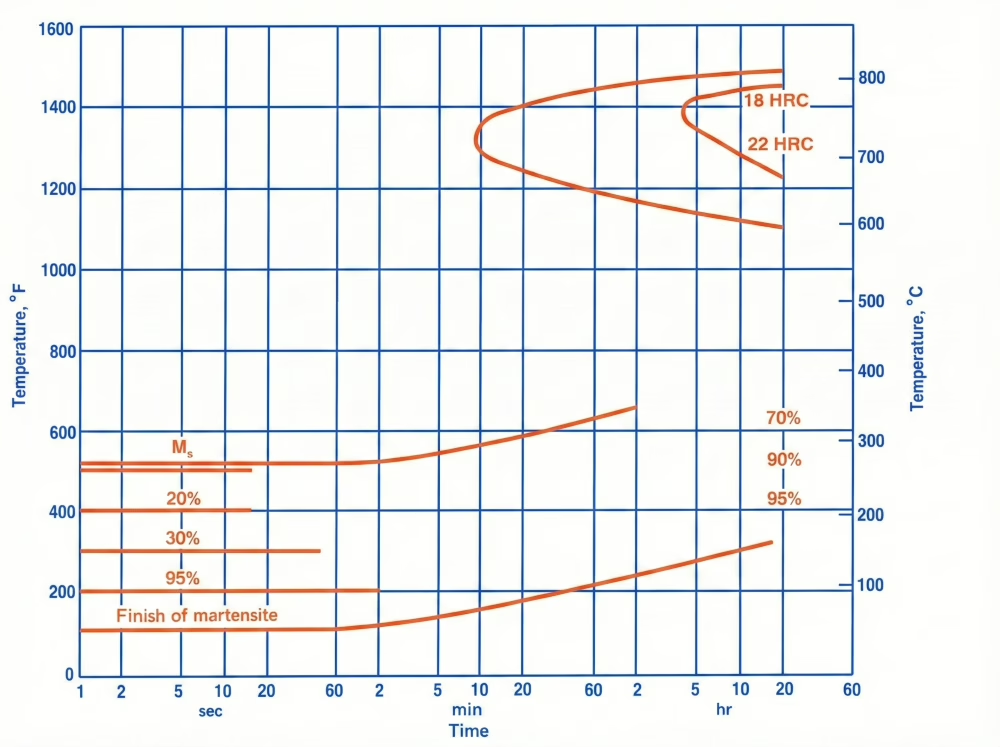
Chemical composition: C 0.40%, Si 1.05%, Cr 5.00%, Mo 1.35%, V 0.35%
Austenitizing temperature: 1010°C / 1850°F
Source: Heat Treater’s Guide: Practices and Procedures for Irons and Steels, 2nd ed., ASM International, 1995, p. 592.
Tempering and hardness
Tempering toughens the brittle as-quenched martensite and relieves quenching stress. H11 is a secondary hardening steel, so its hardness rises again during high-temperature tempering as fine alloy carbides precipitate. Always double temper, two hours minimum per cycle, air cooling to room temperature between cycles. The first temper conditions retained austenite into fresh martensite, and the second temper toughens that new martensite. Temper immediately once the part cools to 50 to 65°C (120 to 150°F), and never let it sit at room temperature before tempering.
Choose the tempering temperature from the working hardness you need. A double temper at 510 to 540°C (950 to 1000°F) sits at or just above the secondary hardening peak and gives a stable structure for hot-work service.
H11 tempering chart (austenitized at 1010°C / 1850°F, air quenched):
| Tempering temperature | Hardness (HRC) |
|---|---|
| As quenched | 56 |
| 370°C (700°F) | 54 |
| 425°C (800°F) | 55 |
| 480°C (900°F) | 57 (peak) |
| 540°C (1000°F) | 56 |
| 595°C (1100°F) | 46 |
| 650°C (1200°F) | 36 |
For hot-work dies that see thermal cycling, temper above the peak so the structure stays stable above the service temperature, even at a small cost in hardness.
Common H11 heat treatment problems and how to solve them
Quench cracking. Cooling too fast during hardening can crack air-hardening steel, while very thick sections may not reach full hardness in still air. Use interrupted quenching in a 595 to 650°C salt bath until the temperature is uniform, then air cool. If oil is unavoidable, stop the quench near 540°C (1000°F) surface temperature, or pull the part while it is still warm at about 60 to 80°C and move it straight to the tempering furnace. Never let it reach room temperature first.
Distortion. Complex dies distort from uneven heating or from stresses locked in during machining. Stress relieve rough-machined parts at 650 to 675°C (1200 to 1250°F), one hour per inch, and air cool before hardening. Use a two-stage preheat to limit thermal shock, and rely on air cooling rather than liquid quenching to keep dimensional change low.
Decarburization. H11 loses surface carbon when heated in an oxidizing atmosphere, which cuts strength and fatigue life. Austenitize in a neutral salt bath, controlled-atmosphere furnace, or vacuum furnace. Without that equipment, wrap the part in stainless steel foil or pack it in a neutral medium to limit oxygen exposure.
Heat checking (thermal fatigue cracking). A network of fine surface cracks forms under repeated heating and cooling in service. It cannot be eliminated, but correct processing slows it. Temper to the correct hardness rather than running the tool too hard, and if the part is nitrided, control the nitriding depth and white layer so the brittle layer does not spall.
Low hardness. Tempering below the secondary hardening range leaves an unstable structure that softens in service. Temper at or above the secondary hardening peak, generally 510°C (950°F) or higher, to relieve stress and stabilize the structure, and always double temper.
Need H11 tool steel for hot-work applications?
Aobo Steel supplies H11 hot-work tool steel as forged bar, plate, and block, delivered annealed and ready for machining, with a mill test certificate on every order. Minimum order quantity is 5 tons. Send us your sizes, condition, and quantities for a quote.