
Aobo Steel · Tool Steel Supplier · Huangshi, China
1.2344 ESR Die Steel
DIN 1.2344 / X40CrMoV5-1 — AISI H13 / JIS SKD61 equivalent · electro-slag remelted
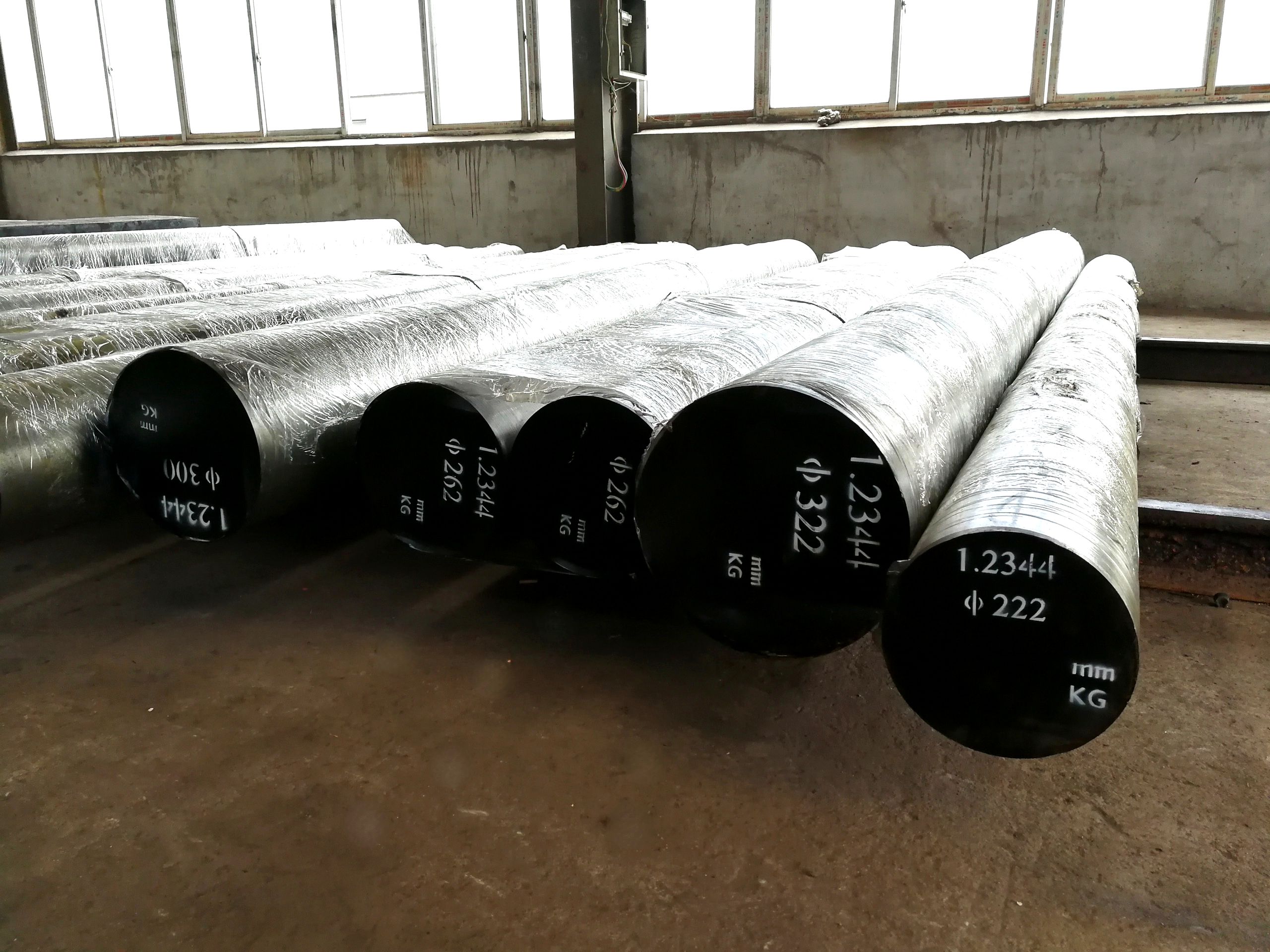
ESR die steel for aluminium extrusion tooling — die holders, mandrels, container liners, backers and bolsters. Supplied annealed and turned, heat number on every bar, cut to length on request.
Also supplied: H13 tool steel, ESR tool steel and D2 round bar. Selection: tool steels for aluminium extrusion dies · order planning: steel weight calculator.
Request price & delivery
Tell us the diameters, quantity and destination port — we confirm price, sizes and delivery within one working day.
Where 1.2344 ESR goes on your press
The die stack behind the die carries most of the press tonnage, and the hardness changes part by part. A die wants wear resistance at the bearing. A holder or backer needs toughness, because a brittle support cracks under the load it’s meant to spread. The ranges below are working hardness in service, not the hardness of the annealed bar.
Die types and tooling sets determine the stack before ordering the steel.
| Part | Working hardness | Typical section | What limits its life |
|---|---|---|---|
| Flat, porthole and bridge die | 46 to 50 HRC | 100 to 500 mm | Bearing wash first, then heat checking. 47 to 51 HRC on thin profiles. |
| Die holder | 40 to 46 HRC | 200 to 800 mm | Bending and fatigue cracking. Prehardened 4140 at 28 to 32 HRC is the cheaper option where wear allows. |
| Die ring | 42 to 48 HRC | 200 to 800 mm | Hoop stress from the shrink fit. |
| Die backer and bolster | 40 to 46 HRC | 150 to 1000 mm | Compressive yield and permanent deflection. 44 to 48 HRC for heavy loads. |
| Container liner | 42 to 47 HRC | 150 to 500 mm bore | Scoring and heat checking, balanced against radial burst risk. |
| Mandrel and piercer | 43 to 48 HRC | 20 to 150 mm | Necking and thermal fatigue. Hollow tips run 55 to 60 HRC in M2. |
| Dummy block | 42 to 48 HRC | 150 to 500 mm | Mushrooming, thermal softening and edge wear. |
| Shear blade holder | 40 to 45 HRC | Block or bar | Bolt hole cracking and structural fatigue. |
Composition data is for general reference only. Actual values vary by standard, mill, and heat number. Confirm against the material test certificate (MTC) or contact Aobo Steel.
Why ESR on the heavy sections
A ring with a 150 mm wall is not the same steel at the bore as at the outside. Conventional casting segregates carbon and chromium toward the center, and the difference comes out as a hardness spread after tempering. Remelting rebuilds the ingot droplet by droplet through a reactive slag, so the analysis stays even across the section, and fewer inclusions sit under the nitrided case. The ESR process is covered separately.
The remelt is not always the right buy. A die holder or backer under 200 mm doesn’t gain enough to justify the cost, and the EAF + LF + VD route is cheaper for the same job. It earns its price on thick walls, shrink fits, and nitrided bores. For long campaigns on thin wall profiles, 1.2367 versus 1.2344 is the other decision, since the 3 percent molybdenum grade holds hot hardness and conducts heat better. 1.2343 stays the tougher choice for holders and backers.
What decides die life
Hardness comes out of the heat treatment, not out of the certificate. Stress relieve at 650 to 675 °C after rough machining, austenitize at 995 to 1025 °C, quench in gas, then temper twice. At 580 °C, the die comes out at 48 to 50 HRC; at 600 °C, at 44 to 46 HRC, so a bearing that needs 47 to 50 HRC is tempered between about 570 and 590 °C. Nitriding follows at 510 to 540 °C to a case of 0.10 to 0.20 mm and 900 to 1100 HV, so the final temper must be 15 to 30 °C above the nitriding temperature, or the core softens in the furnace. Preheat the die to 425 to 480 °C before the first billet, because the die land runs 550 to 600 °C in service. The full schedule is in the H13 heat treatment guide, and the case detail is in the nitriding guide.
In service, the order is usually bearing wear first, then heat checking, then plastic deformation at the die land, and fracture last, from a cold billet or a corner that was nitrided when it should have been masked. Die wear patterns separate wash from erosion, and softening in service points back to tempering temperature.
Working hardness, heat treatment and nitriding ranges follow ASM Handbook Volume 14, Forming and Forging, and Volume 4, Heat Treating.