
Propriedades gerais dos aços para ferramentas
Tabela de referência das principais classes de aço ferramenta AISI, abrangendo resistência ao desgaste, tenacidade, dureza a quente, dureza de trabalho usual, profundidade de têmpera, tamanho de grão e dureza após têmpera. As classificações são comparações relativas em uma escala de 1 (baixo) a 9 (alto) e representam um ponto de partida prático na seleção de uma classe para uma determinada aplicação em ferramentas.
| Grau | Vestir (b) | Robustez (c) | Dureza quente | Dureza de trabalho, HRC | Profundidade (d) | Tamanho do grão (Pastor) | HRC de superfície | Recursos Humanos Essenciais |
|---|---|---|---|---|---|---|---|---|
| Aços rápidos com molibdênio | ||||||||
| M1 | 7 | 3 | 8 | 63–65 | D | 9½ | 64–66 | 64–66 |
| M2 | 7 | 3 | 8 | 63–65 | D | 9½ | 64–66 | 64–66 |
| M3, classe 1 | 8 | 3 | 8 | 63–66 | D | 9½ | 64–66 | 64–66 |
| M3, classe 2 | 8 | 3 | 8 | 63–66 | D | 9½ | 64–66 | 64–66 |
| M4 | 9 | 3 | 8 | 63–66 | D | 9½ | 65–67 | 65–67 |
| M7 | 8 | 3 | 8 | 63–66 | D | 9½ | 64–66 | 64–66 |
| M10 | 7 | 3 | 8 | 63–65 | D | 9½ | 64–66 | 64–66 |
| M30 | 7 | 2 | 8 | 63–65 | D | 9½ | 64–66 | 64–66 |
| M33 | 8 | 1 | 9 | 63–65 | D | 9½ | 64–66 | 64–66 |
| M34 | 8 | 1 | 9 | 63–65 | D | 9½ | 64–66 | 64–66 |
| M35 | 7 | 2 | 8 | 63–65 | D | 9½ | 64–66 | 64–66 |
| M36 | 7 | 1 | 9 | 63–65 | D | 9½ | 64–66 | 64–66 |
| M41 | 8 | 1 | 9 | 66–70 | D | 9½ | 63–65 | 63–65 |
| M42 | 8 | 1 | 9 | 66–70 | D | 9½ | 63–65 | 63–65 |
| M43 | 8 | 1 | 9 | 66–70 | D | 9½ | 63–65 | 63–65 |
| M44 | 8 | 1 | 9 | 66–70 | D | 9½ | 63–65 | 63–65 |
| M46 | 8 | 1 | 9 | 66–69 | D | 9½ | 63–65 | 63–65 |
| M47 | 8 | 1 | 9 | 66–70 | D | 9½ | 63–65 | 63–65 |
| Aços rápidos intermediários | ||||||||
| M50 | 6 | 3 | 6 | 61–63 | D | 8½ | 63–65 | 63–65 |
| M52 | 6 | 3 | 6 | 62–64 | D | 8½ | 63–65 | 63–65 |
| Aços rápidos de tungstênio | ||||||||
| T1 | 7 | 3 | 8 | 63–65 | D | 9½ | 64–66 | 64–66 |
| T2 | 8 | 3 | 8 | 63–66 | D | 9½ | 65–67 | 65–67 |
| T4 | 7 | 2 | 8 | 63–65 | D | 9½ | 63–66 | 63–66 |
| T5 | 7 | 1 | 9 | 63–65 | D | 9½ | 64–66 | 64–66 |
| T6 | 8 | 1 | 9 | 63–65 | D | 9½ | 64–66 | 64–66 |
| T8 | 8 | 2 | 8 | 63–65 | D | 9½ | 64–66 | 64–66 |
| T15 | 9 | 1 | 9 | 64–68 | D | 9½ | 65–68 | 65–68 |
| Aços cromados para trabalho a quente | ||||||||
| H10 | 3 | 9 | 6 | 39–56 | D | 8 | 52–59 | 52–59 |
| H11 | 3 | 9 | 6 | 38–55 | D | 8 | 53–55 | 53–55 |
| H12 | 3 | 9 | 6 | 38–55 | D | 8 | 53–55 | 53–55 |
| H13 | 3 | 9 | 6 | 40–53 | D | 8 | 51–54 | 51–54 |
| H14 | 4 | 6 | 7 | 40–54 | D | 8 | 53–57 | 53–56 |
| H19 | 5 | 6 | 7 | 40–55 | D | 8½ | 48–57 | 48–57 |
| Aços para trabalho a quente com tungstênio | ||||||||
| H21 | 4 | 6 | 8 | 40–55 | D | 9 | 45–63 | 45–63 |
| H22 | 5 | 5 | 8 | 36–54 | D | 9 | 48–56 | 48–56 |
| H23 | 5 | 5 | 8 | 38–48 | D | 7 | 34–40 | 34–40 |
| H24 | 5 | 5 | 8 | 40–55 | D | 9 | 52–56 | 52–56 |
| H25 | 4 | 6 | 8 | 35–45 | D | 9 | 33–46 | 33–46 |
| H26 | 6 | 4 | 8 | 50–58 | D | 9 | 51–59 | 51–59 |
| Aços para trabalho a quente com molibdênio | ||||||||
| H42 | 6 | 4 | 7 | 45–62 | D | 8½ | 54–62 | 54–62 |
| Aços de endurecimento ao ar, de média liga e para trabalho a frio | ||||||||
| A2 | 6 | 4 | 5 | 57–62 | D | 8½ | 63–65 | 63–65 |
| A3 | 7 | 3 | 5 | 58–63 | D | 8½ | 63–65 | 63–65 |
| A4 | 5 | 4 | 4 | 54–62 | D | 8½ | 61–63 | 61–63 |
| A5 | 5 | 4 | 4 | 54–60 | D | 8½ | 60–62 | 60–62 |
| A6 | 4 | 5 | 4 | 54–60 | D | 8½ | 60–62 | 60–62 |
| A7 | 9 | 1 | 6 | 58–66 | D | 8½ | 64–66 | 64–66 |
| A8 | 4 | 8 | 6 | 48–57 | D | 8 | 60–62 | 60–62 |
| A9 | 4 | 8 | 6 | 40–56 | D | 8 | 55–57 | 55–57 |
| A10 | 3 | 3 | 3 | 55–62 | D | 8 | 60–63 | 60–63 |
| Aços para trabalho a frio com alto teor de carbono e cromo | ||||||||
| D2 | 8 | 2 | 6 | 58–64 | D | 7½ | 61–64 | 61–64 |
| D3 | 8 | 1 | 6 | 58–64 | D | 7½ | 64–66 | 64–66 |
| D4 | 8 | 1 | 6 | 58–64 | D | 7½ | 64–66 | 64–66 |
| D5 | 8 | 2 | 7 | 58–63 | D | 7½ | 61–64 | 61–64 |
| D7 | 9 | 1 | 6 | 58–66 | D | 7½ | 64–68 | 64–68 |
| Aços para trabalho a frio com têmpera em óleo | ||||||||
| O1 | 4 | 3 | 3 | 57–62 | M | 9 | 61–64 | 59–61 |
| O2 | 4 | 3 | 3 | 57–62 | M | 9 | 61–64 | 59–61 |
| O6 | 3 | 3 | 2 | 58–63 | M | 9 | 65–67 | 50–55 |
| O7 | 5 | 3 | 3 | 58–64 | M | 9 | 61–64 | 59–61 |
| Aços resistentes a choques | ||||||||
| S1 | 4 | 8 | 5 | 50–58 | M | 8 | 55–58 | 55–58 |
| S2 | 2 | 8 | 2 | 50–60 | M | 8 | 61–63 | 56–60 |
| S5 | 2 | 8 | 3 | 50–60 | M | 9 | 61–63 | 58–62 |
| S6 | 2 | 8 | 3 | 50–56 | M | 8 | 56–58 | 56–58 |
| S7 | 3 | 8 | 5 | 47–57 | D | 8 | 59–61 | 59–61 |
| Aços especiais de baixa liga | ||||||||
| L2 | 1 | 7 | 2 | 45–62 | M | 8½ | 56–62 | 54–58 |
| L6 | 3 | 6 | 2 | 45–62 | M | 8 | 58–63 | 58–62 |
| Aços para moldes com baixo teor de carbono | ||||||||
| Para cavidades com cubo e/ou cementadas | ||||||||
| P2 (e) | 1(e) | 9 | 2(e) | 58–64 (e) | S | … | 62–65 (um) | 15–21 |
| P3 (e) | 1(e) | 9 | 2(e) | 58–64 (e) | S | … | 62–64 (um) | 15–21 |
| P4 (e) | 1(e) | 9 | 4(e) | 58–64 (e) | M | … | 62–65 (um) | 33–35 |
| P5 (e) | 1(e) | 9 | 2(e) | 50–64 (e) | S | … | 62–65 (um) | 20–25 |
| P6 (e) | 1(e) | 9 | 3(e) | 58–61 (e) | M | … | 60–62 (um) | 35–37 |
| Para cavidades usinadas | ||||||||
| P20 (e) | 1(e) | 8 | 2(e) | 30–50 | M | 7½ | 52–54 | 45–50 |
| P21 | 1 | 8 | 4 | 36–39 (e) | D | … | 22–26 | 22–26 |
| Aços para ferramentas de têmpera em água | ||||||||
| W1 | 2–4 | 3–7 | 1 | 58–65 | S | 9 | 65–67 | 38–43 |
| W2 | 2–4 | 3–7 | 1 | 58–65 | S | 9 | 65–67 | 38–43 |
| W5 | 3–4 | 3–7 | 1 | 58–65 | S | 9 | 65–67 | 38–43 |
Notas e referências
- (um) A classificação varia de 1 (baixo) a 9 (alto).
- (b) A resistência ao desgaste aumenta com o aumento do teor de carbono.
- (c) A tenacidade diminui com o aumento do teor de carbono e da profundidade de endurecimento.
- (d) S, raso; M, médio; e D, profundo.
- (e) Após a cementação.
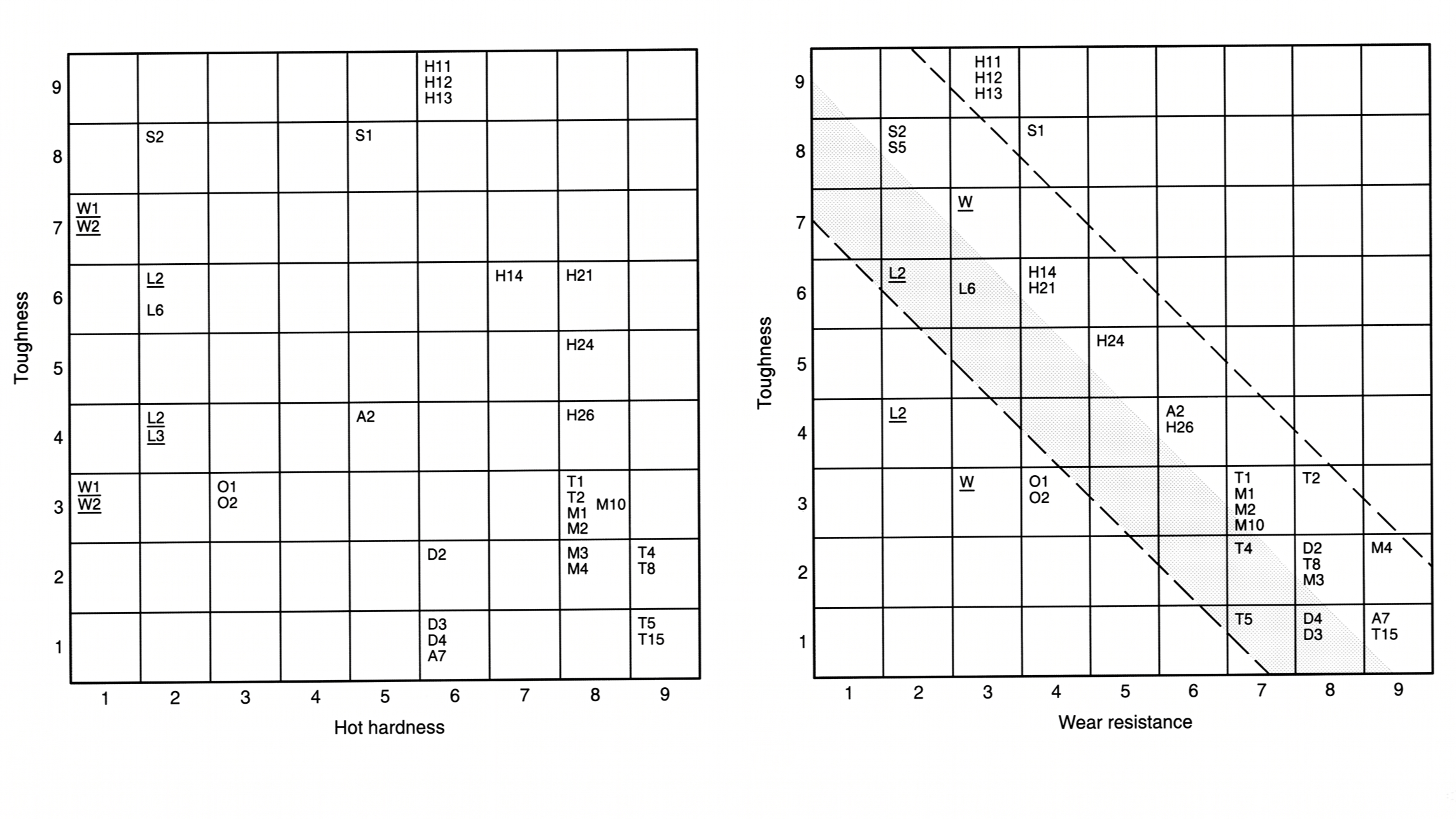
Módulo de elasticidade dos aços para ferramentas
Para todos os efeitos práticos, o módulo de elasticidade de todos os aços para ferramentas, em todas as condições, é de aproximadamente 210 GPa (30 × 106 psi) à temperatura ambiente. Diminui uniformemente para cerca de 185 GPa (27 × 106 psi) a 260 °C (500 °F) e cerca de 150 GPa (22 × 106 psi) a 540 °C (1000 °F).
Resistência ao desgaste
Wear resistance increases with carbon content. At a given hardness, however, it may vary widely depending on the wear mechanism and heat treatment used. Steels with similar hardness can behave very differently under identical wear conditions. The grades that resist wear best are also the hardest to machine, and the machinability rating chart puts a number on that trade-off.
Resistência e testes
At maximum hardness, most tool steels are brittle, so tensile testing rarely gives reliable strength values. Compression, bending and torsion tests are more useful; torsion impact testing gives reproducible data on the effect of composition and heat treatment, particularly for drills and tools loaded in torsion. Where toughness and wear resistance pull in opposite directions, selection by application is the faster route to a grade.
Escopo do Fornecimento e Nota de Referência Técnica
Aobo Steel supplies tool steel in round bar and plate form, in annealed condition. Hardening, quenching and tempering are performed by the customer’s heat-treatment facility. The tool steel heat treatment guide covers austenitizing temperatures, soak times and tempering windows for these grades.
As classificações de propriedades e os dados de dureza nesta referência são comparações relativas compiladas a partir do Manual ASM, Volume 1, Tabela 13. O desempenho real depende do tratamento térmico, da dimensão da seção transversal, da geometria da ferramenta e das condições de serviço. Sempre verifique as propriedades finais e os procedimentos de tratamento térmico com a sua empresa de tratamento térmico.
Páginas de referência relacionadas
Tool steel composition chart · Tabela de dureza a quente do aço ferramenta · Temperaturas de têmpera e revenido · Machinability ratings · Selection by application · Grade comparison and equivalents · Calculadora de conversão de dureza · Tool steel heat treatment guide · Tool steel thermal conductivity chart
Fonte: Manual da ASM, Volume 1 — Propriedades e Seleção: Ferros, Aços e Ligas de Alto Desempenho, Tabela 13 “Propriedades gerais dos aços-ferramenta” (dados para as classes marcadas com “e” após cementação). Dados de referência para comparação — verifique o tratamento térmico final com o fornecedor da classe.