
Melhores aços para matrizes de extrusão a frio
Para insertos de extrusão a frio de alta pressão, M2, M4, T15, D2, D3, D4 e A2 são escolhas comuns. Para matrizes, bases, recipientes, anéis de contração e retentores, aços mais resistentes como o A2, S1, L6, H11, e H13 são mais adequados.
A regra básica é usar aços duros e resistentes ao desgaste para a pastilha de trabalho. Para a estrutura de suporte, use aços ainda mais resistentes.
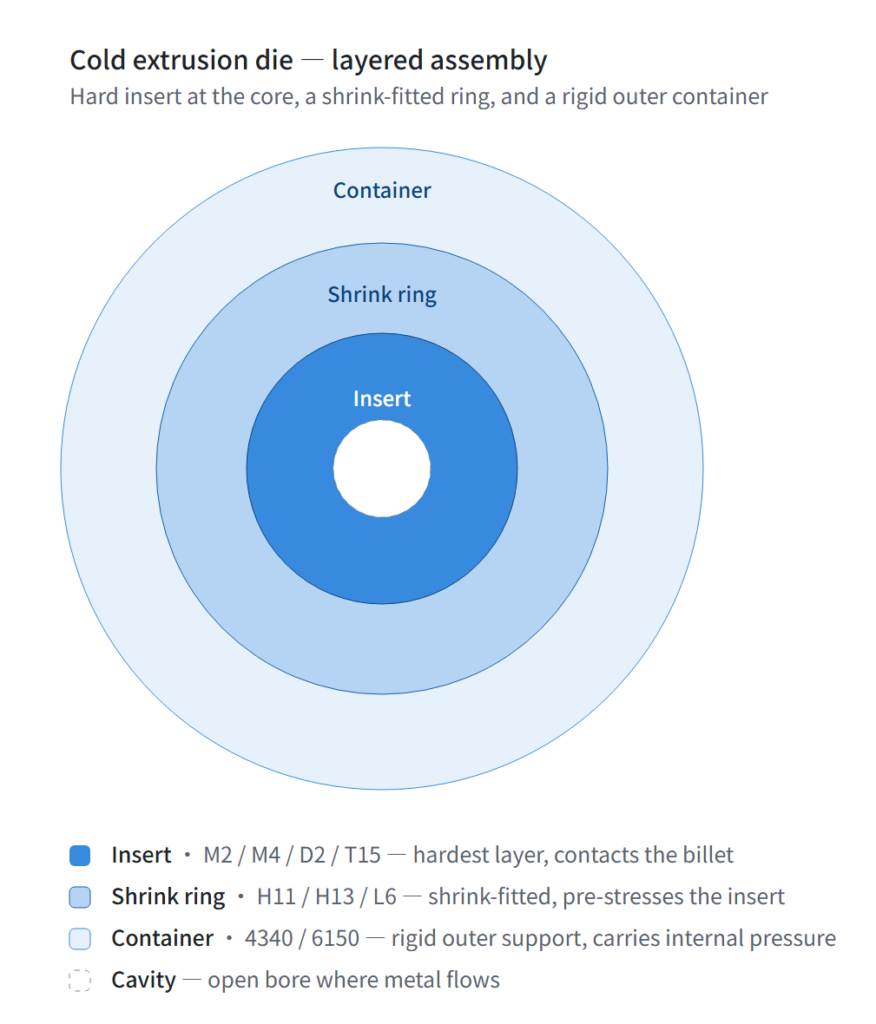
Tabela de seleção rápida para matrizes de extrusão a frio
| Posição da matriz / Condições de trabalho | Principal risco de falha | Aços para ferramentas recomendados | Dureza típica | Motivo da Seleção |
| Insertos de extrusão a frio de aço reforçado | Deformação plástica, desgaste abrasivo | M2, M4, T15 | 60–67 HRC | Alta resistência à compressão e forte resistência ao desgaste |
| Insertos gerais para extrusão a frio de longa duração | Desgaste, alteração dimensional | D2, D3, D4 | 58–64 HRC | Boa resistência à abrasão, estabilidade e custo-benefício. |
| Insertos com maior risco de fissuras | Lascando, rachando | A2 | 56–62 HRC | Maior resistência que os aços da série D |
| Matrizes de extrusão de alumínio ou metais não ferrosos mais macios | Desgaste moderado, controle de custos | A2, O1, O2, D2 | 56–62 HRC | Resistência ao desgaste suficiente sem custos desnecessários de material. |
| Bases de matrizes, recipientes, blocos de suporte | Rachaduras, tensão mecânica | A2, S1, L6 | Dependente da aplicação | Maior resistência e capacidade de suporte. |
| Anéis de contração e retentores | Pressão de ruptura, divisão | H11, H13 | 46–48 HRC | Suporte robusto para insertos de alta dureza. |
Por que as matrizes de extrusão a frio precisam de aços-ferramenta diferentes?
A extrusão a frio força o metal a fluir à temperatura ambiente. A matriz deve resistir a altas tensões de compressão, atrito e pressão interna. Em aplicações severas, a tensão de compressão pode ultrapassar 350 ksi (cerca de 2400 MPa).
Diferentes partes da matriz suportam cargas diferentes.
| Risco de falha | Posição comum | Requisito de aço |
| desgaste abrasivo | Inserir, perfurar, superfície de trabalho | Alta dureza e resistência ao desgaste com suporte de carboneto |
| Deformação plástica | Inserir sob pressão de conformação | Alta resistência à compressão |
| Lascas ou rachaduras | Borda de inserção, canto vivo, área sem suporte | Maior resistência e suporte adequado da matriz. |
| falha de ruptura | Inserir, recipiente, área do anel de encolhimento | Suporte externo resistente e pré-tensão compressiva. |
É por isso que as matrizes de extrusão a frio geralmente utilizam um inserto rígido juntamente com uma estrutura de suporte externa mais resistente. O inserto suporta o desgaste e a pressão de conformação. A estrutura de suporte reduz o risco de rachaduras, fissuras e rupturas.
Aços para ferramentas de insertos de extrusão a frio
Os insertos para extrusão a frio precisam apresentar alta dureza, resistência à compressão, resistência ao desgaste e estabilidade dimensional. O material ideal para o inserto depende do nível de pressão, do volume de produção, do material da peça e do risco de fissuras.
M2, M4 e T15 para insertos de extrusão a frio severo
Os aços rápidos para ferramentas são excelentes opções para insertos de extrusão a frio em condições severas, especialmente para extrusão de aço. Eles contêm elementos formadores de carbonetos, como molibdênio, tungstênio e vanádio. Esses carbonetos melhoram a resistência ao desgaste e a resistência à compressão.
| Grau | Melhor uso | Principal vantagem | Limitação |
| M2 | Insertos para extrusão a frio severa | Equilíbrio entre resistência à compressão e resistência ao desgaste | Mais caro que os aços da série D |
| M4 | Cargas mais pesadas e percursos mais longos | Maior resistência ao desgaste do que o M2. | Necessita de um bom suporte para o chip. |
| T15 | desgaste abrasivo extremo | Altíssima dureza e resistência ao desgaste. | Mais suscetível a rachaduras |
O M2 é a opção de aço rápido equilibrado. É adequado quando o D2 não oferece vida útil suficiente para a matriz sob alta pressão ou desgaste intenso.
O M4 é utilizado quando o M2 não é suficiente. Ele oferece maior resistência ao desgaste e é adequado para ciclos de produção mais longos ou condições de extrusão mais abrasivas.
O aço T15 é a escolha para extrema resistência ao desgaste. Ele pode operar com dureza muito alta, geralmente em torno de 65–67 HRC. No entanto, a alta dureza também aumenta o risco de trincas. Pastilhas de T15 exigem suporte robusto, tratamento térmico preciso e projeto adequado do anel de contração.
Os aços rápidos geralmente devem ser usados como insertos, e não como o corpo inteiro da matriz. Seu valor está concentrado na superfície de trabalho.
D2, D3 e D4 para insertos de extrusão a frio de longa duração
Série D Os aços para trabalho a frio são amplamente utilizados em insertos para extrusão a frio. Seu alto teor de carbono e cromo forma carbonetos de cromo duros, que melhoram a resistência à abrasão durante o fluxo de metal a frio.
| Grau | Melhor uso | Principal vantagem | Limitação |
| D2 | Insertos gerais para extrusão a frio de longa duração | Bom equilíbrio entre resistência ao desgaste, estabilidade e custo. | Menor resistência que A2, S1, H11 ou H13. |
| D3 | Aplicações de insertos de alto desgaste | Alta resistência à abrasão | Precisa de bom suporte porque a resistência é limitada. |
| D4 | Aplicações de insertos mais resistentes ao desgaste | Alta dureza e forte resistência ao desgaste | Não é adequado para locais com alto risco de fissuras. |
O aço D2 costuma ser a opção mais prática da série D. Ele oferece boa resistência ao desgaste, estabilidade dimensional e custo-benefício. Seu comportamento de endurecimento ao ar também ajuda a reduzir a distorção por tratamento térmico em comparação com aços de endurecimento em óleo ou água.
O D3 é adequado quando o desgaste abrasivo é o principal modo de falha e o projeto da matriz já controla o risco de fissuras.
O aço D4 pode ser usado quando se necessita de maior dureza e resistência ao desgaste. Assim como o D3, ele requer suporte adequado, pois aços com alto teor de carbono e cromo não são ideais para condições de impacto ou ruptura.
Quando a pressão e o desgaste se tornam muito severos para os aços da série D, os aços M2, M4 ou T15 são opções de insertos mais resistentes.
A2 para insertos com maior risco de fissuração
A2 é útil quando o inserto ainda precisa de resistência ao desgaste, mas também apresenta um risco maior de rachaduras ou lascas.
Em comparação com o D2, o A2 apresenta maior tenacidade, porém menor resistência à abrasão. Isso o torna adequado para insertos em situações onde o D2 pode ser muito frágil, especialmente em cantos vivos, suporte inadequado ou cargas de impacto moderadas.
O aço A2 não é a primeira escolha para máxima durabilidade. Seu valor reside no equilíbrio entre tenacidade, estabilidade dimensional e resistência moderada ao desgaste.
O1 e O2 para extrusão a frio menos severa
Os aços O1 e O2 podem ser usados em processos de extrusão a frio menos severos ou conformação de metais não ferrosos. Eles são mais econômicos do que os aços rápidos e certos aços de alta liga para trabalho a frio.
Não são adequadas para extrusão severa de aço. Seu papel se dá principalmente em aplicações com cargas moderadas, onde o custo das ferramentas é mais importante do que a vida útil máxima da matriz.
Aços para ferramentas para extrusão a frio de alumínio e metais não ferrosos mais macios
O alumínio e outros metais não ferrosos mais macios geralmente exercem cargas menores sobre a matriz do que o aço. Essas aplicações ainda exigem resistência ao desgaste, mas podem não justificar o custo dos aços rápidos.
| Condições de aplicação | Aços adequados para ferramentas | Razão |
| Extrusão moderada de metais não ferrosos | O1, O2 | Menor custo de ferramentas para trabalhos menos complexos. |
| É necessário maior resistência e estabilidade. | A2 | Equilíbrio entre resistência, estabilidade e resistência ao desgaste. |
| É necessário um ciclo de produção mais longo. | D2 | Melhor resistência ao desgaste e estabilidade dimensional. |
A liga A2 costuma ser uma boa escolha quando a matriz precisa de um equilíbrio entre resistência, resistência ao desgaste e estabilidade dimensional.
O1 e O2 são opções econômicas para condições de ferramentas moderadas. Página relacionada: Aço ferramenta O1 vs O2: qual aço para trabalho a frio escolher?
O aço D2 pode ser utilizado quando se necessita de maior resistência ao desgaste e vida útil mais longa. É mais adequado do que os aços da série O quando a estabilidade dimensional e a resistência à abrasão se tornam mais importantes.
Para extrusões de alumínio e outros metais não ferrosos mais macios, a melhor escolha nem sempre é o aço mais duro. O ideal é escolher um aço que ofereça resistência suficiente ao desgaste sem custos desnecessários ou risco de fissuras.
Aços para ferramentas destinados a bases de matrizes, recipientes e componentes de suporte.
As bases da matriz, os recipientes e os componentes de suporte não desempenham a mesma função que o inserto. Eles sustentam o inserto, suportam a carga de conformação e reduzem o risco de fissuras ou rupturas.
Essas peças precisam de resistência e capacidade de suporte, mais do que máxima resistência ao desgaste.
| Componente | Aços para ferramentas recomendados | Requisito principal |
| bases de matrizes | A2, S1, L6 | Resistência e suporte mecânico |
| Contêineres | A2, L6, H11, H13 | Suporte resistente e resistência a rachaduras |
| Peças de suporte reforçadas | S1, L6 | Resistência a impactos e tensões mecânicas |
A2 é útil quando a parte de suporte ainda precisa de alguma resistência ao desgaste, mas também precisa de uma tenacidade melhor do que a D2.
O aço S1 é um aço ferramenta resistente a choques. É adequado para componentes expostos a cargas pesadas, impactos ou risco de fissuras. Não deve substituir os aços M2, M4, T15, D2 ou D4 em insertos de alto desgaste.
O aço L6 é utilizado quando a resistência mecânica é o principal requisito. Ele funciona bem em bases de matrizes, recipientes e componentes de suporte robustos. Embora não seja um aço resistente ao desgaste para insertos severos, ele pode ajudar o conjunto da matriz a suportar altas tensões mecânicas.
Esses aços mais resistentes protegem o conjunto da matriz contra falhas repentinas. Eles são especialmente úteis quando um inserto duro seria muito frágil sem suporte externo.
H11 e H13 para Anéis de Contração e Retentores
Os anéis de contração e os retentores são essenciais em conjuntos de matrizes de extrusão a frio. Eles mantêm o inserto sob compressão, reduzindo o risco de fissuras devido à pressão interna.
| Grau | Melhor uso | Motivo principal |
| H11 | Anéis de contração, retentores, peças de suporte resistentes | Alta tenacidade e resistência a fissuras |
| H13 | Anéis termoencolhíveis, retentores, recipientes | Resistência, tenacidade e alta capacidade de endurecimento. |
O H11 é útil quando a estrutura de suporte necessita de alta tenacidade e resistência a fissuras.
O aço H13 é comumente conhecido como um aço ferramenta para trabalho a quente, mas também apresenta bom desempenho em estruturas de suporte para extrusão a frio. Oferece resistência, tenacidade e alta temperabilidade, tornando-o adequado para anéis de contração, retentores e recipientes.
Os aços H11 e H13 não foram selecionados por serem mais resistentes ao desgaste do que os aços M2 ou D2. Eles foram selecionados por sua capacidade de suportar insertos frágeis e de alta dureza sob alta pressão interna.
Aços-liga de alta resistência, como o 4340 e o 6150, também são usados em alguns componentes de retenção, mas não são aços-ferramenta. Para um guia de seleção focado em aços-ferramenta, H11 e H13 são recomendações mais adequadas. Página relacionada: Aço ferramenta H13 vs H11
Aço de inserção versus aço de suporte: a principal regra de seleção
Matrizes de extrusão a frio falham quando o aço errado é usado na posição errada. Os aços M2, M4, T15, D2, D3 e D4 oferecem alta resistência ao desgaste, mas podem trincar quando usados em posições de suporte devido à tenacidade insuficiente. Os aços S1, L6, H11 e H13 resistem a trincas e rupturas, mas geralmente não conseguem igualar a resistência ao desgaste abrasivo dos aços rápidos ou dos aços da série D.
| Se o principal problema for… | Escolha principalmente por… | Melhor Direção do Aço |
| A palmilha se desgasta muito rápido. | Resistência ao desgaste e dureza | D2, D3, D4, M2, M4, T15 |
| A inserção perde a forma sob pressão. | resistência à compressão | M2, M4, T15 |
| Inserir lascas ou rachaduras | Resistência e suporte | A2, melhor suporte da matriz, design adequado do anel de contração |
| A matriz se divide ou estoura. | Suporte, força e resistência | H11, H13, S1, L6 |
| O custo é muito alto para trabalhos com metais não ferrosos. | Resistência ao desgaste suficiente a um custo menor. | A2, O1, O2, D2 |
O melhor projeto de matriz de extrusão a frio geralmente combina um inserto de alto desempenho com uma estrutura de suporte ainda mais robusta.
Recomendação final
Para insertos de extrusão a frio severo, escolha M2, M4 ou T15 quando a resistência à compressão e a resistência ao desgaste forem os principais requisitos.
Para insertos de extrusão a frio de longa duração em geral, D2, D3 e D4 são opções práticas. O D2 oferece o melhor equilíbrio geral, enquanto o D3 e o D4 são opções mais resistentes quando a abrasão é mais severa.
Para insertos com maior risco de fissuração, o aço A2 costuma ser mais seguro do que os aços da série D, pois oferece melhor tenacidade.
Para extrusões de alumínio e outros metais não ferrosos mais macios, os aços A2, O1, O2 e D2 podem ser mais econômicos do que os aços rápidos.
Para matrizes, bases, recipientes, anéis de contração e retentores, utilize aços mais resistentes, como A2, S1, L6, H11 e H13.
O segredo não é selecionar o aço mais duro para todas as peças. Selecione o aço com base na posição da matriz e no principal risco de falha. Aços duros controlam o desgaste e a deformação. Aços tenazes controlam rachaduras e rupturas.