440C Stainless Steel Properties

440C Stainless Steel Properties

440C is a high-carbon, high-chromium martensitic stainless steel built for maximum hardness and wear resistance among corrosion-resistant steels. After proper heat treatment, it reaches up to 60 HRC and is typically used at 57 to 60 HRC, giving strong resistance to abrasion, edge wear, and surface deformation under contact loading.

Its high carbon content also means low ductility and limited impact toughness. This makes 440C a material for wear-dominated parts under stable loading, not for shock-loaded or structural service. Everything on this page follows from that single trade-off, so it helps to read the properties as a balance rather than as a list of strengths.

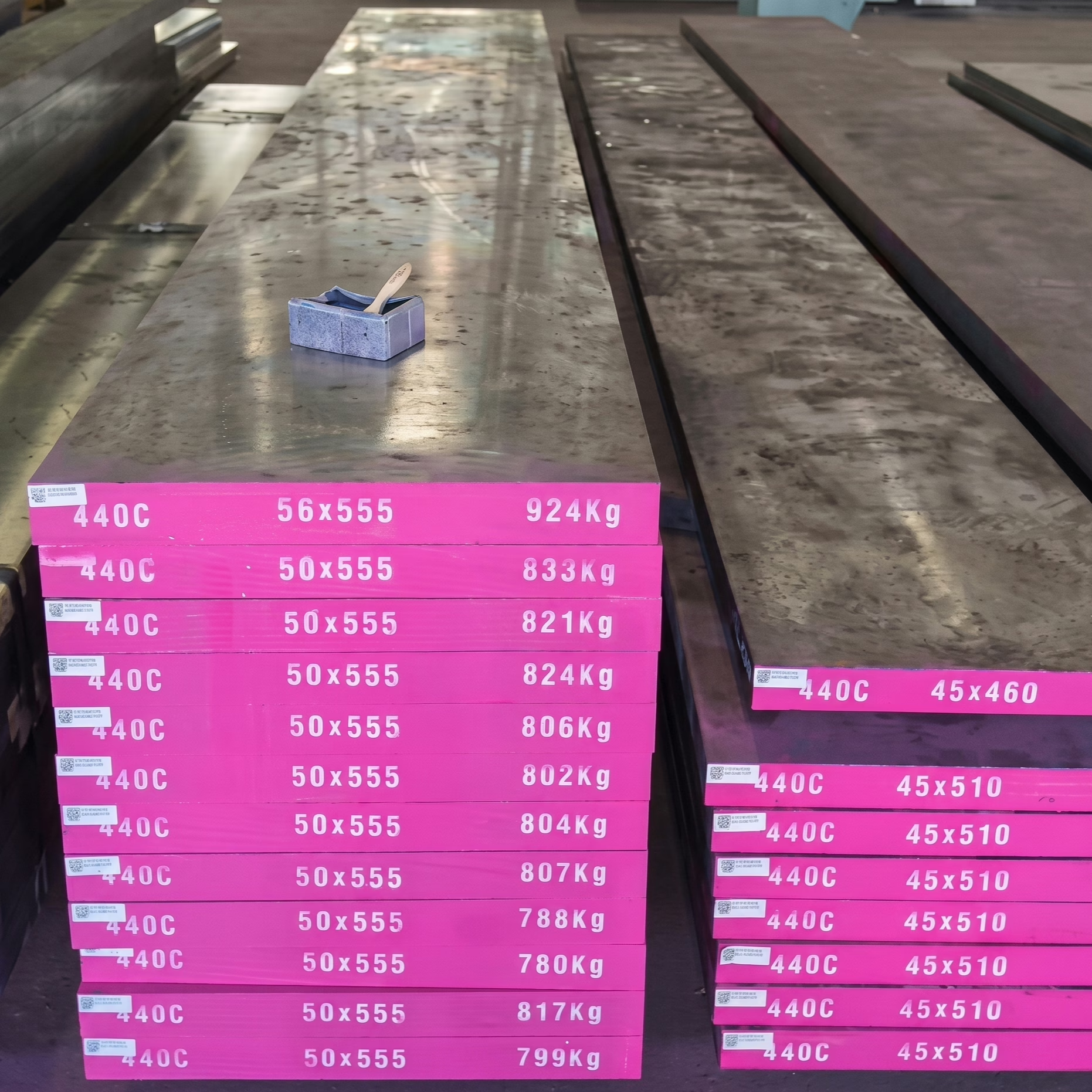
Aobo Steel에서 공급하는 440C 스테인리스강

Need 440C in annealed bar or plate?

Aobo Steel stocks 440C stainless steel to industrial specifications, ready for machining and heat treatment. Send your sizes for a quote, or check our standard supply range first.

440C Stainless Steel Chemical Composition

The composition of 440C (UNS S44004) is set to balance hardenability, carbide formation, and usable corrosion resistance.

Typical composition (wt%):

요소Content (%)
탄소(C)0.95 to 1.20
크롬(Cr)16.00 to 18.00
몰리브덴(Mo)0.75 max
망간(Mn)1.00 max
실리콘(Si)1.00 max
인(P)0.040 max
황(S)0.030 max

The high carbon and chromium levels produce a martensitic matrix carrying a large volume of chromium-rich carbides. That structure is the source of the hardness, wear resistance, and compressive strength, and it is also the reason toughness is low. Reading the rest of these properties through the carbide structure is the fastest way to understand 440C.

440A vs 440B vs 440C: How Carbon Changes the Grade

The 440 family shares a chromium base and is separated mainly by carbon content. Carbon controls how hard the grade can become and how much toughness it sacrifices.

등급Carbon (%)Max Hardness내마모성Relative Toughness
440A0.60 to 0.7556 HRC중간더 높은
440B0.75 to 0.9558 HRCMedium to high중간
440도0.95 to 1.2060 HRC높은낮추다

More carbon forms chromium-rich carbides, which raise hardness and wear resistance but reduce ductility and impact strength. 440A is the choice when corrosion resistance and toughness matter more than edge life. 440C is the choice when hardness and wear resistance are the priority, and the part can be designed around limited toughness. 440B sits between the two.

440C Stainless Steel Equivalent Grades

표준 시스템Designation
AISI/SAE440C / 51440C
유엔S44004
EN / DIN1.4125
EN NameX105CrMo17
ASTMA276 (Bars and Shapes)
Powder MetallurgyMIM 440C

EN grade 1.4125 (X105CrMo17) is the closest European equivalent to AISI 440C, with a carbon range of roughly 0.95 to 1.20% and a chromium range of 16 to 18%.

440C Stainless Steel Mechanical Properties

The mechanical behavior of 440C changes sharply between the annealed and hardened conditions. In practice, it is supplied annealed for machining, then heat-treated to reach its final performance.

재산어닐링 조건Hardened and Tempered Condition
경도About 230 HB (270 HB max)57 to 60 HRC
인장 강도About 758 MPaAbout 1970 MPa
항복 강도About 430 to 450 MPaAbout 1896 to 1900 MPa
Elongation13 to 14%About 2%
Reduction of AreaAbout 25%About 10%
Toughness (Charpy V-notch)Not typically reported3 to 5 ft·lbf
가공성About 40% (vs AISI 1212)Very poor

The modulus of elasticity is about 200 GPa, similar to most steels and not a selection factor. After heat treatment, the steel gains very high strength and hardness, while ductility and impact resistance fall away. The 2% elongation and low Charpy values are the numbers to keep in mind: 440C carries load well but does not redistribute it, so failure under overload or impact is sudden rather than gradual.

440C Stainless Steel Heat Treatment Overview

The performance of 440C depends heavily on heat treatment. Its hardness, wear resistance, and dimensional stability are achieved through controlled hardening and tempering.

프로세스온도 범위Key Purpose
가열 냉각845 to 900°CSoften structure for machining
예열About 790°C (multi-step for large parts)Reduce thermal stress and distortion
오스테나이트화1010 to 1065°C (up to 1095°C)Dissolve carbides and enable hardening
담금질공기 또는 기름Form martensite and reach hardness
Subzero TreatmentAbout -75°C or lowerReduce retained austenite
담금질About 150 to 370°C (typical 315°C)Adjust hardness and relieve stress

Tempering temperature is the main control variable for the final result. For a full breakdown of as-quenched versus tempered values and why reported numbers vary, see the 440C hardened hardness page.

How 440C Properties Translate to Performance

The headline properties only matter in context. In real service, 440C behavior is decided by the trade-off among hardness, wear resistance, corrosion resistance, and toughness. None of these can be read in isolation, because the same carbide structure that raises one usually lowers another.

내마모성

440C delivers high wear resistance through a hard martensitic matrix combined with a high volume of chromium-rich carbides. At 57-60 HRC, it withstands both adhesive and abrasive wear. The hard matrix limits surface deformation, adhesion, scuffing, and galling, while the carbides resist cutting and plowing during sliding or rolling contact. This is why 440C keeps a stable surface and edge longer than most stainless steels.

The same carbides set the limit. When they are coarse or unevenly distributed, they create local stress points that can start microcracks under cyclic or rolling contact. In that situation, the failure mode shifts from steady wear to surface fatigue. Sub-zero treatment improves dimensional stability by reducing retained austenite, but it does not change this mechanism. 440C is reliable under stable loading but becomes less predictable when contact fatigue is the driver.

Corrosion Resistance

440C offers moderate corrosion resistance and is suitable for mild service, such as atmospheric exposure, lubricated systems, and light industrial conditions. The limit again comes from the carbides. Part of the chromium is locked into carbides and cannot support the passive oxide layer, so the protective film is weaker than in austenitic grades.

Heat treatment shifts this further. High austenitizing temperatures put more alloy into solution and improve corrosion resistance, while tempering can reduce it by altering the local composition. Tuning for mechanical performance can therefore come at the expense of corrosion stability. 440C should not be used in chloride-rich environments, aggressive chemical media, or high-temperature corrosion.

Toughness and Mechanical Behavior

In the hardened condition, 440C is strong but very low in ductility, with an elongation of about 2%. Under load, it cannot redistribute stress, so once a local point exceeds its limit, the part fails with little warning. The typical failure modes are edge chipping, crack initiation at stress concentrators, and sudden brittle fracture under impact or bending. These are driven by low ductility and by carbides acting as crack starters.

The practical conclusion is consistent across all three properties. 440C performs well when loading is stable and well distributed, but becomes unreliable when impact, shock, or stress concentration governs the outcome.

440C vs Other Stainless and Tool Steels

Choosing 440C is easier when you see how it balances hardness, wear resistance, corrosion resistance, and toughness against the steels it usually competes with.

재산440도420440A / 440B디2316
강철 종류Martensitic StainlessMartensitic StainlessMartensitic StainlessTool SteelAustenitic Stainless
Max HardnessAbout 60 HRC46 to 54 HRC56 to 58 HRC60 to 62 HRCNot hardenable
내마모성높은중간중간Very High낮은
Corrosion Resistance중간중간Medium to high낮은훌륭한
강인함낮은중간중간Very Low높은
가공성Poor보통의보통의Poor좋은

440C balances wear resistance against corrosion resistance. Against 420 or 440A, it offers higher hardness and longer wear life. Against D2, it trades some wear resistance for corrosion performance. Against 316, it gives far higher strength and hardness but much lower corrosion resistance.

When to Use 440C Stainless Steel

440C is best suited for applications requiring high hardness and wear resistance, moderate corrosion resistance, and stable loading.

It is common in precision cutting tools such as knives, surgical instruments, and fine blades, where edge retention is critical. It performs well in rolling-contact parts such as bearing balls and races, especially where corrosion resistance exceeds that of standard bearing steels. In fluid systems, it is used for valve seats, needle valves, and pump parts running in fresh water or mild industrial media. It also serves as a plastic mold insert for abrasive or mildly corrosive polymers, where surface hardness and dimensional stability matter. For a full breakdown by component type, see the 440C applications page.

When NOT to Use 440C Stainless Steel

440C is the wrong choice when toughness, strong corrosion resistance, or easy manufacturing are the main requirements.

It performs poorly under impact or bending due to its low toughness, making it unsuitable for structural or dynamically loaded parts. Its corrosion resistance is limited in chloride-rich or marine environments, where austenitic grades such as 316 are more reliable. The high carbon content and air-hardening behavior make welding unreliable. It loses hardness at elevated temperatures and is not suited to high-temperature service. Machining is difficult even when annealed, and tool wear is high, so free-machining grades are often more practical for complex or high-volume parts.

440C Applications Based on Properties

The application range follows directly from the mix of high hardness, wear resistance, and moderate corrosion resistance. 440C is mainly used in parts subject to friction, rolling contact, or repeated surface loading, including corrosion-resistant bearings, valve components, precision instruments, cutting tools, and industrial blades. Where both wear resistance and basic corrosion protection are needed, it appears in medical instruments, food-processing equipment, and selected aerospace or petroleum components. Powder metallurgy routes, such as metal injection molding, are used to produce small, complex parts where machining is inefficient, including precision automotive components, locking mechanisms, and miniature wear-resistant assemblies.

Because of its low toughness and limited thermal stability, 440C is generally avoided in impact-loaded, structural, and high-temperature applications.

Need 440C Stainless Steel for Wear-Resistant Parts?

Send your grade, size, quantity, surface condition, and application. Aobo Steel can support annealed 440C stainless steel bar and plate supply for machining, heat treatment, bearings, valves, cutting tools, and precision wear parts.

문의 보내기

자주 묻는 질문

What are the key properties of 440C stainless steel?

440C is characterized by high hardness (58–60 HRC), high wear resistance, moderate corrosion resistance, and low toughness. It is primarily used in wear-dominated applications rather than structural components.

Is 440C stainless steel hard or brittle?

After heat treatment, 440C becomes very hard but also relatively brittle. Its low impact toughness makes it unsuitable for applications involving shock, impact, or bending loads.

Does 440C stainless steel have good corrosion resistance?

440C provides reliable corrosion resistance in mild environments such as fresh water and atmospheric exposure. However, it is less resistant than austenitic stainless steels such as 304 or 316, especially in chloride-rich or marine environments.

Why is 440C used for bearings?

440C is widely used for bearings because it combines high hardness, strong wear resistance, and sufficient corrosion resistance. This makes it suitable for rolling-contact components operating in mildly corrosive environments.

What hardness can 440C reach after heat treatment?

440C can reach a maximum hardness of about 60 HRC after quenching. In practical applications, it is usually tempered to around 57–58 HRC to balance hardness and stability.

Is 440C better than 420 stainless steel?

440C offers significantly higher hardness and wear resistance than 420, but has lower toughness and is more difficult to machine. 420 is preferred when impact resistance and easier processing are required.

Can 440C stainless steel be welded?

440C is generally not recommended for welding due to its high carbon content and tendency to crack. Machining and forming should be completed in the annealed condition before heat treatment.

Is 440C suitable for machining?

440C can be machined in the annealed condition, but it has relatively poor machinability compared to standard carbon steels. After hardening, machining becomes extremely difficult due to high hardness and carbide content.

What are the main limitations of 440C stainless steel?

The main limitations include low toughness, poor weldability, limited corrosion resistance in harsh environments, and poor high-temperature performance.

When should you NOT use 440C stainless steel?

440C should be avoided in applications involving impact loading, severe corrosion (such as seawater), welding requirements, high-temperature exposure, or complex high-volume machining.