
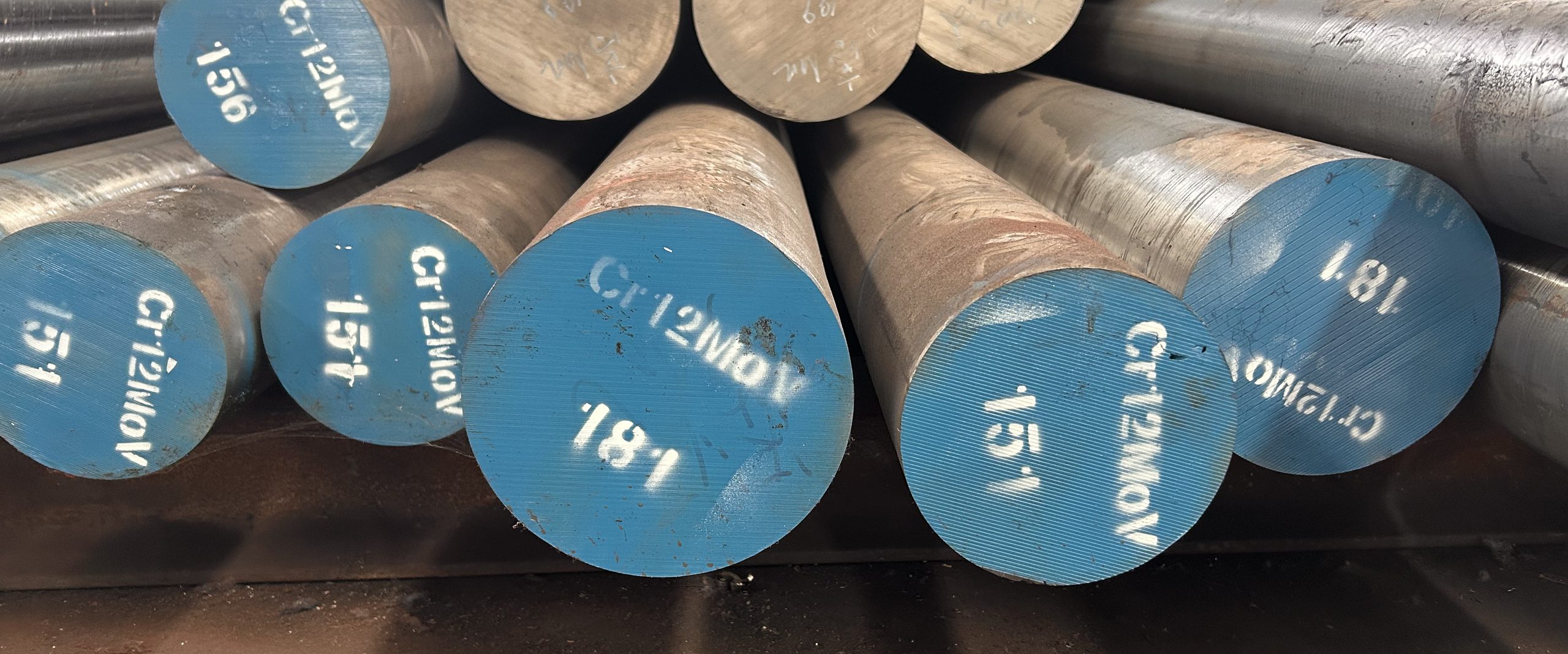
Cr12MoV Tool Steel (D2 / 1.2379 / SKD11 Alternative) Supplier from China
Cost-Effective D2 Alternative | Bulk Supply for Distributors & Stockists
Get a quote in 24 hours
Send the grade, size and quantity. We reply with price, MTC and lead time.
Cr12MoV tool steel is a high-carbon, high-chromium ledeburite cold-work tool steel with high hardness, wear resistance, and minimal quenching distortion. This steel grade is an improved version of Cr12 tool steel, with the addition of molybdenum (Mo) and vanadium (V) elements to enhance its performance characteristics. The DIN grade it is compared with has its own file, 1.2379 tool steel, with the ISO and ASTM ranges set out.
Cr12MoV Tool Steel Supply Overview
| Grade | GB Cr12MoV |
| Equivalent Grades | GB Cr12MoV (GB/T 1299), closest DIN grade 1.2601 (X165CrMoV12). D2, 1.2379 and SKD11 match Cr12Mo1V1. |
| Delivery Condition | Fully Annealed (Soft Condition for Machining) |
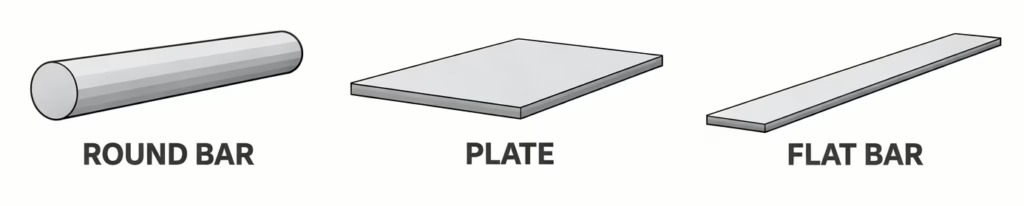
| Available Forms | Round Bar / Flat Bar / Plate / Forged Block |
| Monthly Production Capacity | Approx. 1,200 metric tons |
| Recommended Export Quantity | Full 20GP container (~26 tons) |
| MOQ | 5 tons |
| Lead Time (With Ingot Stock) | Approx. 20 days |
| Lead Time (Fresh Melt) | 30–45 days |
| Lead Time (ESR Grade) | Approx. 60 days |
| Inspection | In-house UT team + Third-party inspection available |
| Documentation | MTC (EN 10204 3.1) + UT Report |
Cr12MoV Material Equivalent and D2 Comparison
Cr12MoV is specified in GB/T 1299, and its closest European designation is DIN 1.2601 (X165CrMoV12). Cr12MoV is not the AISI D2 equivalent. The GB grade that matches D2, 1.2379 and SKD11 is Cr12Mo1V1, which carries more vanadium. Compared with D2, Cr12MoV holds less molybdenum and vanadium, so it costs less while keeping the chromium carbide wear resistance of the Cr12 family. Where a drawing specifies D2, 1.2379 or SKD11, order Cr12Mo1V1 or D2. Where it specifies Cr12MoV, this grade ships annealed as round bar, flat bar, plate or forged block. Material properties are listed in sections 1 and 2 below, and the full side by side breakdown against D2 is on the Cr12MoV vs D2 tool steel page. The Japanese designation of the same steel is set out on the SKD11 tool steel page, with the forms supplied and the documents issued per heat.
Why Global Distributors Source Cr12MoV from Aobo Steel
- Continuous monthly supply of around 1,200 tons
- MOQ from 5 tons for wholesale orders
- Container-optimized bar and plate lengths
- Mixed sizes are supported for export loading
- Annealed delivery for downstream machining
- Stable sourcing through integrated supply chain partners
- UT inspection available to SEP 1921-82 D/d or E/e
- MTC and batch traceability with each shipment
- Heat number tracking for order control
- Black, turned, and polished surface options
- Bulk export packing for sea shipment
- Clear conversion path to the dedicated bulk supply page
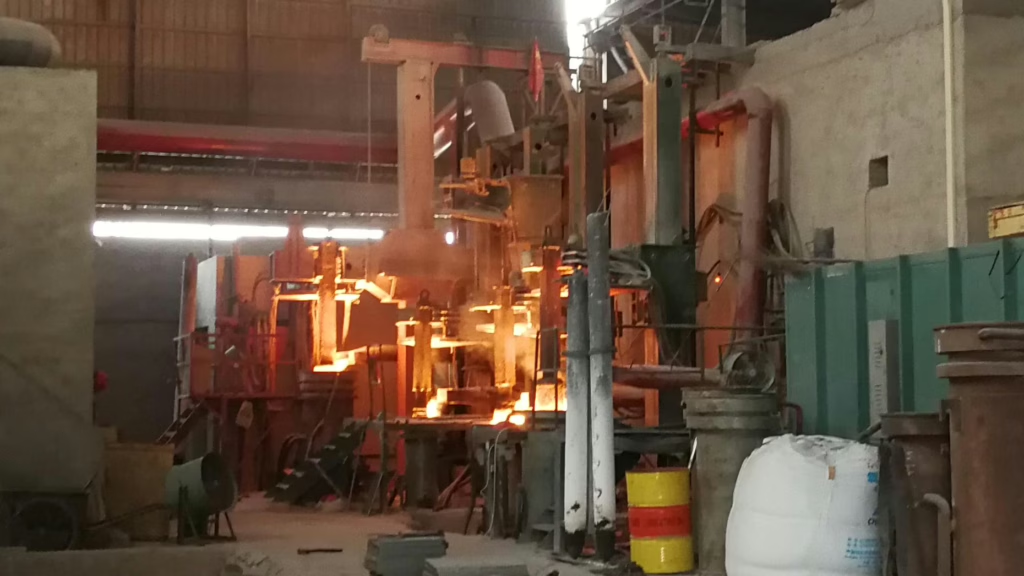
Stable Production for Long-Term Bulk Supply
- Continuous monthly output of around 1,200 tons
- Continuous production cycles for inventory replenishment
- ESR (Electro-Slag Remelting) is available upon request
- Stable alloy sourcing to reduce supply interruption risk
- Full batch traceability linked to the original heat number
Available Cr12MoV Tool Steel Forms
Quality Control for Bulk Orders
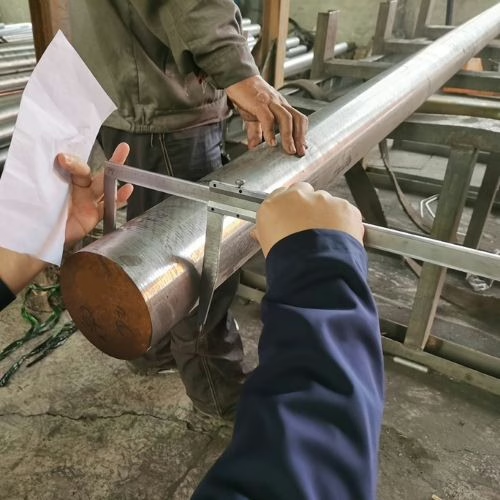
Every batch of tool steel supplied by Aobo Steel is verified before shipment to ensure grade accuracy, internal soundness, and traceability for bulk orders.
- Chemical composition verified by a spectrometer
- Ultrasonic testing available (SEP 1921-82)
- Delivered in spheroidized annealed condition
- Mill Test Certificate (EN 10204 3.1) with heat number
- Dimensional and surface inspection before shipment
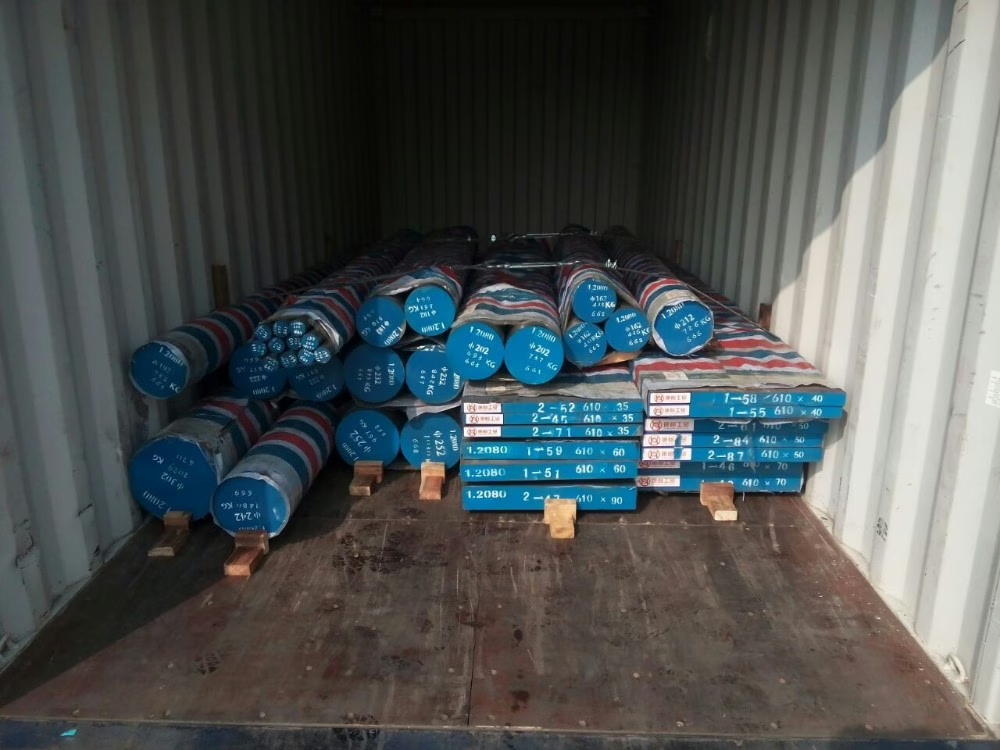
Export Packaging and Container Loading
- Professional seaworthy export packing
- 20GP loading optimized up to ~26 tons
- Mixed grades and mixed sizes supported
- Anti-rust protection for long sea transit
For international shipments, full-container loading is strongly recommended to ensure cost efficiency and smoother customs processing.
1. Composition of Cr12MoV Steel(GB/ T 1299—2000)
| C | Si | Mn | Cr | V | Mo | S | P |
|---|---|---|---|---|---|---|---|
| 1.45 ~ 1.70 | ≤0.40 | ≤0.40 | 11.00 ~ 12.50 | 0.15 ~ 0.30 | 0.40 ~ 0.60 | ≤0.030 | ≤0.030 |
2. Properties of Cr12MoV Steel
Critical Point Temperature
| Critical Point | Ac₁ | Ac₃ | Ar₁ | Ms |
|---|---|---|---|---|
| Temperature / °C | 810 | 1200 | 760 | 185 |
Linear Expansion Coefficient
| Temperature / °C | Linear Expansion Coefficient α / (10⁻⁶ °C⁻¹) |
|---|---|
| 20 ~ 100 | 10.9 |
| 20 ~ 400 | 11.4 |
| 20 ~ 600 | 12.2 |
Cr12MoV is a high-carbon, high-chromium, high-hardenability ledeburitic steel. It is characterized by high hardness, good impact toughness, high hardenability, and low distortion upon quenching.
For cross-sectional dimensions up to 400mm, it can be fully through-hardened. Furthermore, it maintains good hardness and wear resistance at elevated temperatures between 300 and 400 °C.
With minimal volumetric change during quenching and excellent overall mechanical properties, Cr12MoV is considered a representative steel grade for high-end cold-work tooling materials.
3. Forging Process Specification of Cr12MoV Steel
| Item | Heating Temp. / °C | Initial Forging Temp. / °C | Final Forging Temp. / °C | Cooling Method |
|---|---|---|---|---|
| Ingot | 1100 ~ 1150 | 1050 ~ 1100 | 850 ~ 900 | Slow cooling (pit or sand cooling) |
| Billet | 1050 ~ 1100 | 1000 ~ 1050 | 850 ~ 900 | Slow cooling (pit or sand cooling) |
Note: Cr12MoV steel has a low melting point, so the heating temperature should not be too high; it also has poor thermal conductivity, so heating should be slow. After forging, it must be cooled slowly to avoid cracks. It can be placed in a preheated pit and cooled to 400-500°C. Annealing can be performed after cooling.
4. Heat Treatment of Cr12MoV Steel
4.1 Preheating
| Process Parameters | |
|---|---|
| Post-Forging Annealing | Heating temperature 850 ~ 870°C, hold for 1 ~ 2h, furnace cool to 720 ~ 750°C, hold for 3 ~ 4h, furnace cool to below 550°C, then air cool. Hardness after annealing is 207 ~ 255HBW. Microstructure is fine pearlite + carbide. |
| Post-Forging Isothermal Annealing | Heating temperature: 760 ~ 790°C; hold for 2 ~ 3h; furnace cool or air cool. Hardness is 207 ~ 255HBW. |
| High-Temperature Tempering | Heating temperature: 850 ~ 870°C; hold for 1 ~ 2h; furnace cool to 720 ~ 750°C; hold for 3 ~ 4h; furnace cool to below 550°C; then air cool. Hardness after annealing is 207 ~ 255HBW. Microstructure is fine pearlite + carbide. |
4.2 Quenching

(Austenitizing Temperature 980C)
Quenching Process Specifications for Cr12MoV Steel
| Scheme | 1st Preheating Temp./°C | 2nd Preheating Temp./°C | Quenching Temp./°C | Quenching Medium | Quenching Medium Temp./°C | Cooling in Medium | Subsequently | Hardness HRC |
| I | 550 ~ 600 | 840 ~ 860 | 950 ~ 1000 | Oil | 20 ~ 60 | To oil temp | Air cooling | 58 ~ 62 |
| II | 1020 ~ 1040 | Oil | 20 ~ 60 | To oil temp | Air cooling | 62 ~ 63 | ||
| III | 1020 ~ 1040 | Molten nitrate salt | 400 ~ 550 | 5 ~ 10min | Air cooling | 62 ~ 63 | ||
| IV | 1115 ~ 1130 | Oil | 20 ~ 60 | To oil temp | Air cooling | 42 ~ 50 | ||
| V | 1115 ~ 1130 | Molten nitrate salt | 400 ~ 450 | 5 ~ 10min | Air cooling | 42 ~ 50 |
Note: Schemes IV and V are used for molds that require hot hardness and high wear resistance, such as hot-stamping dies operating below 450°C, but their mechanical properties are poor, and dimensional deformation is large. After quenching according to schemes I and II, the microstructural volume fractions are 12% carbides, 68% to 73% martensite, and 20% to 25% retained austenite.
Hardness and Quenching Temperature Under Different Heating and Cooling Conditions
| Heating Conditions | Cooling Method | Quenching Temp./°C | Hardness HRC |
| Heating in carburizing agent | Oil cooling | 930 | 64 |
| 980 | 65 | ||
| 1010 | 65 | ||
| 1030 | 63.5 | ||
| Heating in air furnace | Oil cooling | 930 | 60.2 |
| 980 | 63 | ||
| 1010 | 63.9 | ||
| 1030 | 63.5 | ||
| Heating in air furnace | Air cooling | 930 | 59 |
| 980 | 62.5 | ||
| 1010 | 63.2 | ||
| 1030 | 62 |
4.3 Tempering
Tempering Process Specifications
| Scheme | Quenching Temp./°C | Tempering Purpose | Tempering Temp./°C | Medium | Hardness HRC |
| I | 1020 ~ 1040 | Stress relief | 150 ~ 170 | Oil or nitrate salt | 61 ~ 63 |
| II | Stress relief, reduce hardness | 200 ~ 275 | — | 57 ~ 59 | |
| III | 400 ~ 425 | — | 55 ~ 57 | ||
| IV | 1115 ~ 1130 | Stress relief and secondary hardening | 510 ~ 520℃ Multiple tempering | — | 60 ~ 61 |
| V | -78℃ Cryogenic treatment + 510 ~ 520℃ single tempering | — | 60 ~ 61 | ||
| VI | -78℃ Cryogenic treatment plus one 510 ~ 520℃ tempering, then another -78℃ cryogenic treatment | — | 61 ~ 62 |
Note:
- Workpieces tempered according to Scheme I need to maintain high hardness and high wear resistance, and their dimensional changes are almost independent of the quenching state.
- Scheme II is used to obtain workpieces with good toughness.

(Tempering After 1000℃ Oil Quenching)
Tempering Temperature and Hardness
| Tempering Temp./°C | Untempered | 100 | 200 | 300 | 400 | 500 | 550 | 600 | 650 |
|---|---|---|---|---|---|---|---|---|---|
| Hardness HRC | 63 | 62 | 61 | 59 | 57 | 59 | 53 | 47 | 40 |
Note: Oil-quenched at 1030°C, tempered for 2 hours.
5. Applications
Cr12MoV steel is suitable for manufacturing a wide variety of tools and dies characterized by large cross-sections, complex shapes, and significant impact loads. Examples of such applications include:
- Punching dies with complex geometries
- General stamping dies
- Blanking dies for silicon steel sheets
- Trimming dies
- Edge rolling/curling dies
- Wire drawing dies
- Cold extrusion dies
- Deep drawing dies for steel plate
- Thread rolling plates
- Cold shearing blades
- Circular saws
- Standard tools and gauges