
M2 Tool Steel Hardness: HRC Range, Annealed & Red Hardness
Hardened and tempered M2 tool steel is typically 60–66 HRC, while annealed M2 is usually about 212–248 HB. M2 is also valued for red hardness, meaning it retains hardness at elevated cutting temperatures.
This combination of high hardness and red hardness makes M2 suitable for high-speed cutting, where the edge must resist wear and avoid plastic deformation under severe machining conditions.
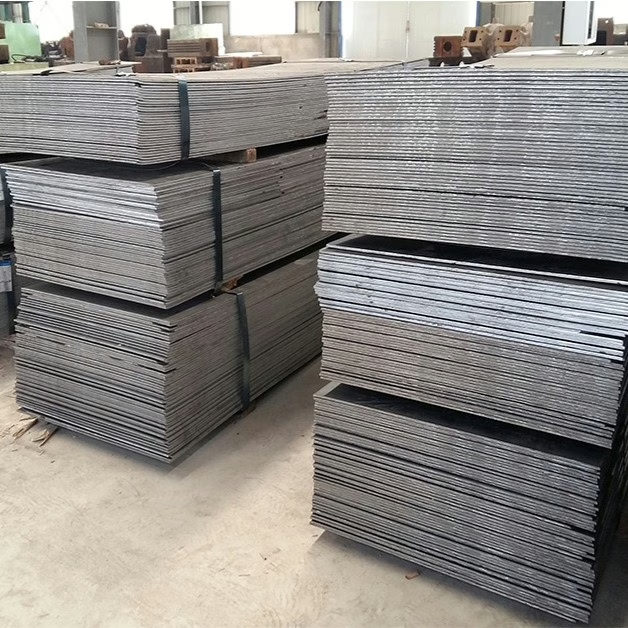
Need M2 Tool Steel for Your Hardness Spec?
Aobo Steel supplies annealed M2 in bulk, MOQ 5 tons, so your shop can machine and harden it to the HRC you need. Send your sizes and quantities for a quote, or view full specifications and equivalent grades.
What Is the Hardness of M2 Tool Steel?
The typical working hardness range for hardened M2 tool steel is 60–66 HRC. The final hardness depends mainly on the austenitizing and tempering temperatures, and on overall heat-treatment control.
This range provides the abrasion resistance and strength required for high-speed cutting tools and demanding cold work applications.
M2 Hardness in HRC (Hardness Chart)
The final hardness of M2 tool steel varies with its thermal processing. The table below outlines typical hardness values for different heat treatment conditions.
| Column 1 | Column 2 | Column 3 |
|---|---|---|
| Condition | Typical HRC Range | Notes |
| As-quenched | 64–66 HRC | Highly stressed and brittle state before tempering. |
| Tempered (optimum toughness) | 58–60 HRC | Lower austenitizing, about 1175–1190°C, for tools needing shock resistance. |
| Tempered (good toughness and wear) | 60–62 HRC | Standard austenitizing, about 1190–1210°C, for balanced strength. |
| Tempered (maximum wear and cutting) | 64–66 HRC | Highest austenitizing, about 1220–1230°C, with multiple tempering for full secondary hardening. |
For high-speed cutting tools, the 64–66 HRC range is most common because it maximizes wear resistance and edge retention. Applications that require greater impact toughness, such as certain punches or forming tools, typically target the 58–62 HRC range.
M2 Annealed Hardness (Supply Condition)
Annealed M2 tool steel typically ranges from 212 to 248 HB. This soft condition improves machinability before hardening, allowing manufacturers to form, machine, or grind the material into complex shapes before it is hardened and tempered into the final tool.
Aobo Steel supplies M2 in the annealed condition for bulk orders, with material certificates available.
M2 Red Hardness (Hot Hardness)
M2 tool steel is widely used for its red hardness, also called hot hardness, which is the ability to keep high hardness and cutting performance at elevated temperatures. Tungsten, molybdenum, vanadium, and chromium support secondary hardening and hot hardness retention.
During tempering, these alloying elements precipitate as finely dispersed, stable complex carbides that resist softening even when the tool runs red hot.
In practice, M2 performs well as a cutting tool, where the edge can become hot during service. It retains roughly 52 HRC measured at about 540°C / 1000°F. This is hot hardness, measured at a temperature separate from the room-temperature hardness reached after tempering.
Red hardness is a key difference between M2 and cold work tool steels such as D2 or A2, which lack this high-temperature stability and soften quickly under intense machining friction.
What Affects M2 Hardness?
Austenitizing temperature: Higher austenitizing temperatures dissolve more alloy carbides and enrich the austenite, which strengthens secondary hardening. High temperatures lead to excess carbon in solution and excessive retained austenite, both of which lower the as-quenched hardness.
Tempering temperature: M2 relies on a secondary hardening peak. Tempering in the range of about 540–565°C (1000–1050°F) precipitates fine alloy carbides and transforms retained austenite, pushing the steel to its peak hardness.
Section size: Larger cross-sections cool more slowly during quenching. This can stabilize the austenite and alter the martensitic transformation, so larger sections need careful soak time and temperature control to reach uniform hardness.
Retained austenite: High-alloy steels like M2 retain untransformed austenite after quenching. This must be converted into fresh martensite through double or triple tempering to reach stable, peak hardness.
Heat-treatment control: Vacuum furnaces or neutral salt baths are required to prevent surface decarburization. Decarburization depletes carbon at the surface and can sharply lower the surface hardness of the finished tool.
Final hardness depends on the entire heat-treatment cycle. For detailed procedures for austenitizing, quenching, and tempering, see our M2 tool steel heat-treatment guide.
Need M2 Steel With the Right Hardness Requirement?
Send your grade, size, quantity, application, and target hardness. Aobo Steel can help supply annealed M2 material and support heat-treatment discussions for cutting tools, punches, knives, dies, and wear parts.