
Special Purpose Tool Steel Heat Treatment
Two small tool steel families sit outside the main groups and both are made for one job each. The low-alloy special-purpose grades of the L group are low-carbon, chromium-bearing steels close in composition to the bearing steel 52100, and they are used where a tool needs wear resistance and hardenability rather than hot hardness. The carbon-tungsten grades of the F group are shallow hardening, water quenched steels that harden to a very hard case and take a mirror polish, which is what a drawing die and a moulding die need. This page carries the consolidated practice tables for both families from the source article and the tempering response curves that go with them.
Low-alloy special-purpose tool steels
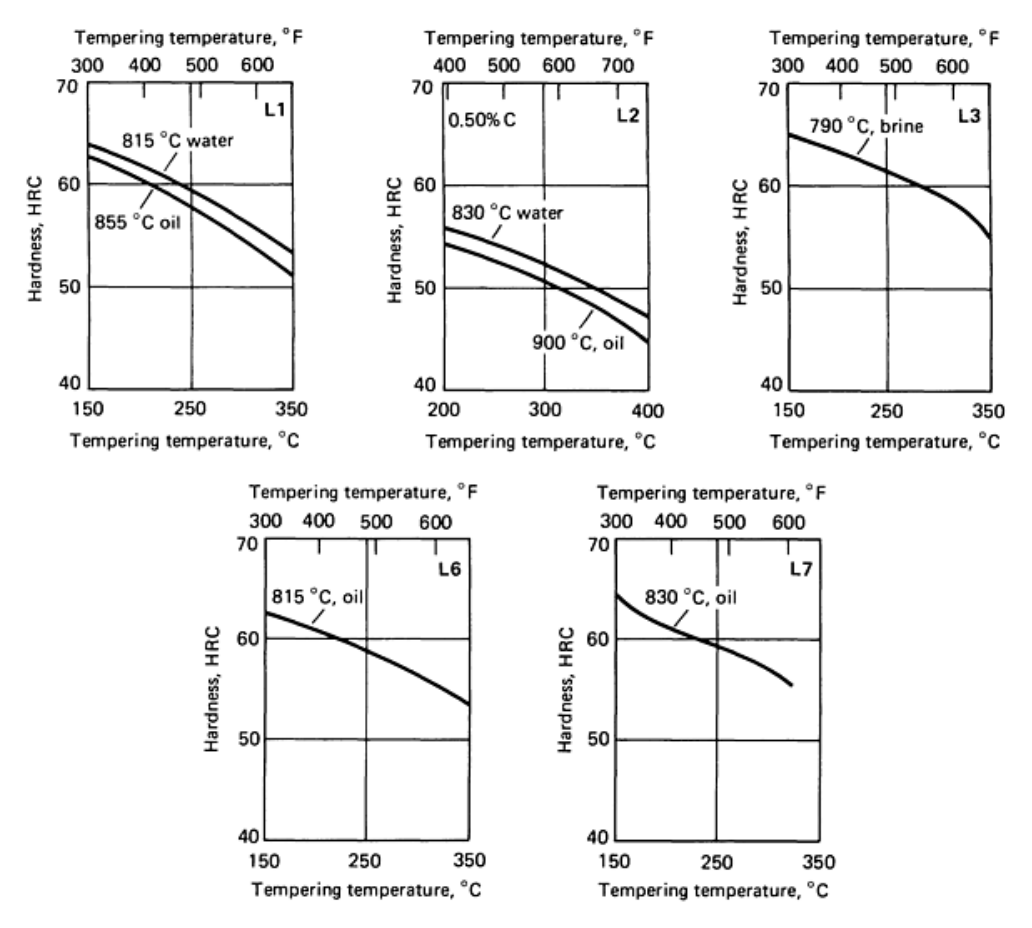
The L steels are the easy half of the family. Their austenitizing temperatures are low enough that preheating is seldom used at all, and the addition of chromium and the other alloying elements gives them more wear resistance and more hardenability than the plain water hardening grades they resemble. Types L1, L3, L4 and L7 are close to the production bearing steel 52100 and are used for similar work. Table 1 is the source summary for the group, and Fig. 1 shows what the temper does to the hardness of five of them.
| Steel | Normalizing temperature (a), °C | Normalizing temperature (a), °F | Annealing | Hardening | |||||||
|---|---|---|---|---|---|---|---|---|---|---|---|
| Temperature (b) | Cooling rate (c) | Annealed hardness, HB | Austenitizing temperature (d) | Holding time, min | Quenching medium | Quenched hardness, HRC (e) | |||||
| °C | °F | °C/h | °F/h | °C | °F | ||||||
| L1 | 900 | 1650 | 775-800 | 1425-1475 | 22 | 40 | 179-207 | 790-845 / 1450-1550 | 10-30 | O, W | 64 |
| L2 | 870-900 | 1600-1650 | 760-790 | 1400-1450 | 22 | 40 | 163-197 | 790-845 / 1450-1550 | 10-30 | W | 63 |
| L3 | 900 | 1650 | 790-815 | 1450-1500 | 22 | 40 | 174-201 | 845-925 / 1550-1700 | 10-30 | O | 63 |
| L6 | 870 | 1600 | 760-790 | 1400-1450 | 22 | 40 | 183-212 | 790-845 / 1450-1550 | 10-30 | O | 62 |
| L7 | 900 | 1650 | 790-815 | 1450-1500 | 22 | 40 | 183-212 | 815-870 / 1500-1600 | 10-30 | O | 64 |
Source, Table 16 of Heat Treating of Specific Classes of Tool Steels. O, oil; W, water. (a) Holding time, after uniform through heating, varies from about 15 min for small sections to about 1 h for large sections, and the work is cooled from temperature in still air. (b) Use the lower limit for small sections and the upper limit for large sections, holding about 1 h for light sections and small charges to about 4 h for heavy sections and large charges, or 1 h per inch of pack cross section for pack annealing. (c) Maximum rate, and the rate is not critical after cooling to below 540 °C (1000 °F). (d) These steels are seldom preheated. (e) Typical average values, subject to variation with the austenitizing temperature and the quenching medium used. The source also lists two further austenitizing options for L3, 775-815 °C (1425-1500 °F) with a water quench to 64 HRC and 815-870 °C (1500-1600 °F) with an oil quench to 64 HRC.
Carbon-tungsten special-purpose tool steels
The F steels are shallow hardening as a group, and they are normally quenched in water or brine, with F3 the highest in hardenability because of its chromium addition. They should be normalized after forging or after any operation that took them above their hardening temperature, and the normalizing and annealing practice follows the L steels. Preheating at 650 °C (1200 °F) is recommended before austenitizing, and austenitizing sits in the 790 to 870 °C (1450 to 1600 °F) band depending on the grade.
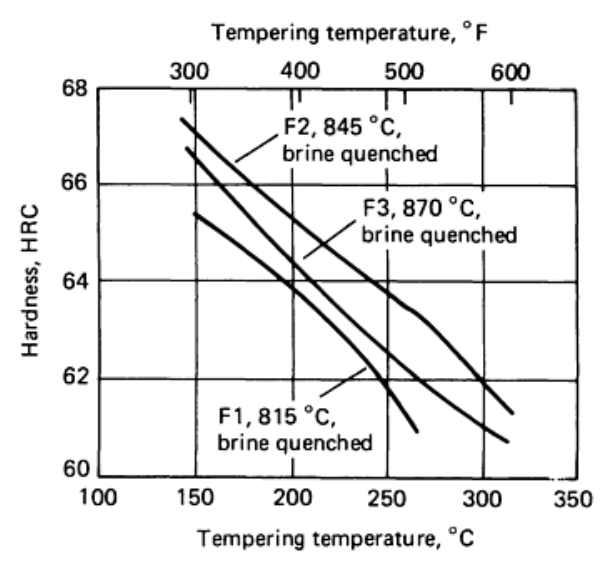
Water and brine quenching cause a lot of distortion in these parts, and that distortion is put to work in one application. Cold drawing dies that have worn oversize are rehardened and flush quenched, which means directing a spout of water into the bore, so the bore shrinks and the die can go back into service on the same product size. Because tools made of the F steels are used mainly where wear resistance is the requirement, they go into service at or near their maximum hardness, and tempering temperatures above 205 °C (400 °F) are seldom used. Table 2 is the practice table and Fig. 2 is the tempering response.
| Steel | Normalizing temperature (a), °C | Normalizing temperature (a), °F | Annealing | Hardening | ||||||||||
|---|---|---|---|---|---|---|---|---|---|---|---|---|---|---|
| Temperature (b) | Cooling rate (c) | Annealed hardness, HB | Preheat | Austenitizing | Holding time, min | Quenching medium | Quenched hardness, HRC (d) | |||||||
| °C | °F | °C/h | °F/h | °C | °F | °C | °F | |||||||
| F1 | 900 | 1650 | 760-800 | 1400-1475 | 22 | 40 | 183-207 | 650 | 1200 | 790-870 | 1450-1600 | 15 | W, B | 64 |
| F2 | 900 | 1650 | 790-815 | 1450-1500 | 22 | 40 | 207-235 | 650 | 1200 | 790-870 | 1450-1600 | 15 | W, B | 66 |
| F3 | 900 | 1650 | 790-815 | 1450-1500 | 22 | 40 | 212-248 | 650 | 1200 | 790-870 | 1450-1600 | 15 | W, B, O | 66 |
Source, Table 17 of Heat Treating of Specific Classes of Tool Steels. W, water; B, brine; O, oil. (a) Holding time, after uniform through heating, varies from about 15 min for small sections to about 1 h for large sections, and the work is cooled from temperature in still air. (b) Use the lower limit for small sections and the upper limit for large sections, holding about 1 h for light sections and small charges to about 4 h for heavy sections and large charges, or 1 h per inch of pack cross section for pack annealing. (c) Maximum cooling rate, and the rate is not critical after the steel has cooled below 540 °C (1000 °F). (d) Typical average hardness values, subject to variation with the austenitizing temperature and the quenching medium used.
Why these two families exist
Neither family is a general purpose tool steel and neither is a substitute for a D2 or an M2. The L steels are chosen when a shop wants a tough, hardenable, low-cost steel that takes a modest amount of wear and is easy to heat treat, which is why the bearing industry uses the same chemistry at volume. The F steels are chosen when the wear is abrasive and the load is light, and where a hard, polished surface matters more than toughness at the edge. In both cases the whole point of the grade is lost if the quench is chosen for convenience, so the medium in the table is a requirement rather than a suggestion, and the L3 and F1 grades in particular show how far the hardness moves when the same steel is quenched two different ways.
Source: ASM Handbook, Volume 4, Heat Treating, ASM International, 1991.