Home > Tool Steel Catalog > L6 Tool Steel
Aobo Steel | Global Tool Steel Supplier in China
AISI L6 Tool Steel | 1.2714 | SKT4 Chrome-Nickel Alloyed Cold Work Steel
✓100% UT Tested Quality Assurance | SEP 1921-82 Class D/d Guaranteed
✓Superior Toughness & Hardenability | High Nickel Content for Shock Resistance
✓Annealed State Delivery
✓Surface: Black Scale, Turned, Mill Finish, or Polished
L6 tool steel is a low-alloy hot work tool steel valued for its excellent toughness and good hardenability. It has a long history of use and remains a solid choice for specific tooling and component needs where impact resistance and strength are critical.
1. Applications
- Blanking Dies
- Punches
- Press-Brake Dies
- Cold Rolling Rolls
- Shear Blades
- Forming & Drawing Dies
- Massive Forging Dies
Machine part applications for L6 tool steel include:
- Arbors
- Cams and Cam Followers
- Chucks and Collets
- Spindles
- Gears and Pinions
- Clutch Parts and Ratchets
- Jigs and Drift Pins
2. L6 steel Composition
- Carbon (C): 0.65-0.75%
- Manganese (Mn): 0.25-0.80%
- Silicon (Si): 0.25%
- Chromium (Cr): 0.60-1.20%
- Nickel (Ni): 1.25-2.00%
- Molybdenum (Mo): Up to 0.50% (in some variants)
3. L6 Tool Steel Properties
L6 tool steel is categorized as a low-alloy special-purpose tool steel, belonging to the “L” series in the American Iron and Steel Institute (AISI) classification system. Its specific UNS (Unified Numbering System) designation is T61206.
3.1 Mechanical Properties
- Hardness
It has a flexible range of hardness depending on its condition and treatment:
The hardness range in the annealed state is 183-212 HB, with good machinability. After heat treatment (working hardness), the hardness is 45-62 HRC, and after quenching, it can reach a hardness of approximately 64 HRC. The hardness required for woodworking saws is 45-50 HRC, while the hardness of general-purpose tools after low-temperature tempering ranges from 58 to 62 HRC.
- Toughness
L6 material has better toughness compared to many high-carbon oil-hardening grades. This high toughness makes it an excellent choice for tools and components subjected to shock or impact loading. While tensile ductility might be lower at lower tempering temperatures, it significantly improves when tempered above 315°C (600°F). L6 also has excellent torsional ductility after appropriate heat treatment.
- Wear Resistance
The wear resistance is moderate, lower than that of other tool steels, such as O1 or W1.
- Hot Hardness and Resistance to Softening:
L6 tool steel has low hot hardness and low resistance to softening when tempered. Consequently, it is generally not recommended for applications involving service at elevated temperatures. For high-heat environments, dedicated hot-work steels would be more suitable.
3.2 Machinability
The machinability is medium. The presence of nickel, while beneficial for toughness, makes it slightly less machinable than comparable grades without nickel, such as L2 tool steel.
Interested in L6 tool steel? Please fill out the form below to contact us now!
4. Heat Treatment of L6 Tool Steel
L6 tool steel heat treatment process involves four primary steps: preheating, austenitizing (hardening), quenching, and tempering.
4.1 Preheating
The preheating temperature for L6 tool steel is 1200°F (650°C), with a holding time of 10 to 15 minutes, or until the material is uniformly heated. Avoid prolonged soaking, as it can disrupt molecular structure and cause adverse effects in subsequent processes. For large or complex L6 components, it is recommended to heat slowly within the range of 650–760°C (1200–1400°F). If placing the material directly into a furnace already heated to the preheating temperature, it is advisable to first position the material above the furnace to remove chill.
4.2 Hardening (Austenitizing)
The hardening temperature is 1525°F (830°C). Some sources list it as 790–870°C (1450–1600°F) or 790–845°C (1454–1553°F). This process is influenced by both time and temperature. The soaking time should be sufficiently long to ensure the workpiece is fully heated. During this process, the steel’s microstructure transitions from ferrite-pearlite to austenite, and the alloy carbides dissolve.
4.3 Quenching
The objective of quenching is to cool the austenite rapidly enough to transform it into a hardened martensitic structure. L6 tool steel is primarily an oil-hardened steel. It has good hardenability and achieves the required hardness through oil quenching. After quenching, parts should be cooled to 125-150°F (52-65°C).
4.4 Tempering
When the part temperature drops to 125-150°F (52-65°C), tempering can be performed. Tempering reduces internal stresses, improves steel’s toughness, and adjusts its hardness. L6 is often tempered once, but multiple tempering is recommended to reduce residual austenite and relieve stress. The holding time is 2 hours per inch (25mm) of cross-section.
The resulting hardness can be controlled by varying the tempering temperature.
Hardness-Tempering Temperature Relationship Table for L6 Steel
| Tempering Temperature | Rockwell C |
| As quenched | 64 |
| 300°F/150°C | 63 |
| 400°F/205°C | 63 |
| 500°F/260°C | 61 |
| 600°F/315°C | 59 |
4.5 Forging
The forging temperature for L6 steel is 980 to 1090°C (1800 to 2000°F). The forging temperature must not fall below 845°C (1550°F).
L6 steel must never be normalized after forging; instead, it should be annealed. L6 tool steel has good hardenability, so it should be cooled from the forging temperature more slowly than by air cooling. L6 steel can be buried in heat-insulating media such as lime, mica, or diatomaceous earth to slow cooling, prevent cracking, and keep the steel in a semi-soft state for subsequent processing.
4.6 Annealing and Stress Relieving
L6 steels should not be normalized due to their high hardenability, but instead, they should be annealed after forging and before hardening. The annealing temperature for L6 is 870°C (1598°F). Stress relieving is sometimes performed after rough machining and before final machining, usually by heating to 650-730°C (1200-1350°F) to minimize distortion during hardening.
5. How L6 tool steel compares to Other Steels
Selecting the right steel is crucial. Here’s how L6 compares:
- vs. O1 Tool Steel: L6 offers significantly higher toughness but exhibits lower abrasion resistance compared to O1.
- vs. L2 Tool Steel: L6 generally offers better hardenability due to its nickel content.
- vs. P-Type Mold Steels: For plastic injection molds, specialized P-type steels are usually the preferred choice.
- vs. 4140/4150 Alloy Steels: While 4140/4150 are sometimes used for simpler fixtures or short-run dies, L6 is a dedicated tool steel grade that offers superior performance for more demanding tooling.
- vs. 1095: L6 steel is an alloy tool steel engineered to balance hardness, toughness, and wear resistance due to its nickel, chromium, and molybdenum content, making it suitable for various dies and cutting tools. 1095 is a simpler, high-carbon plain-carbon steel, relying primarily on its carbon content for hardness, and may be superseded by alloy steels for more demanding applications.
6. Equivalent grades of L6 Tool Steel
- Germany: DIN 1.2714/DIN 55NiCrMoV7 (older designation, but still sometimes used)
- Japan: JIS SKT4
- China: GB/T 1299: 5CrNiMo
7. Supply forms and dimensions
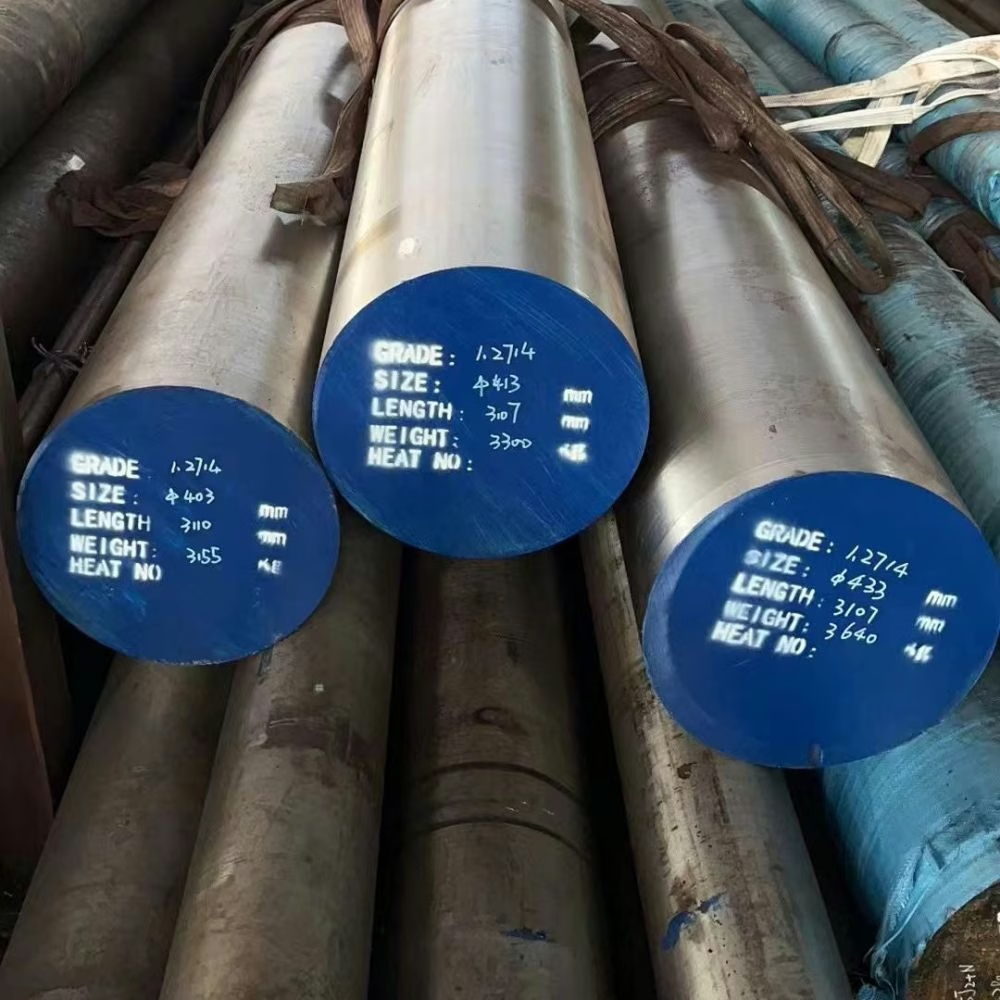
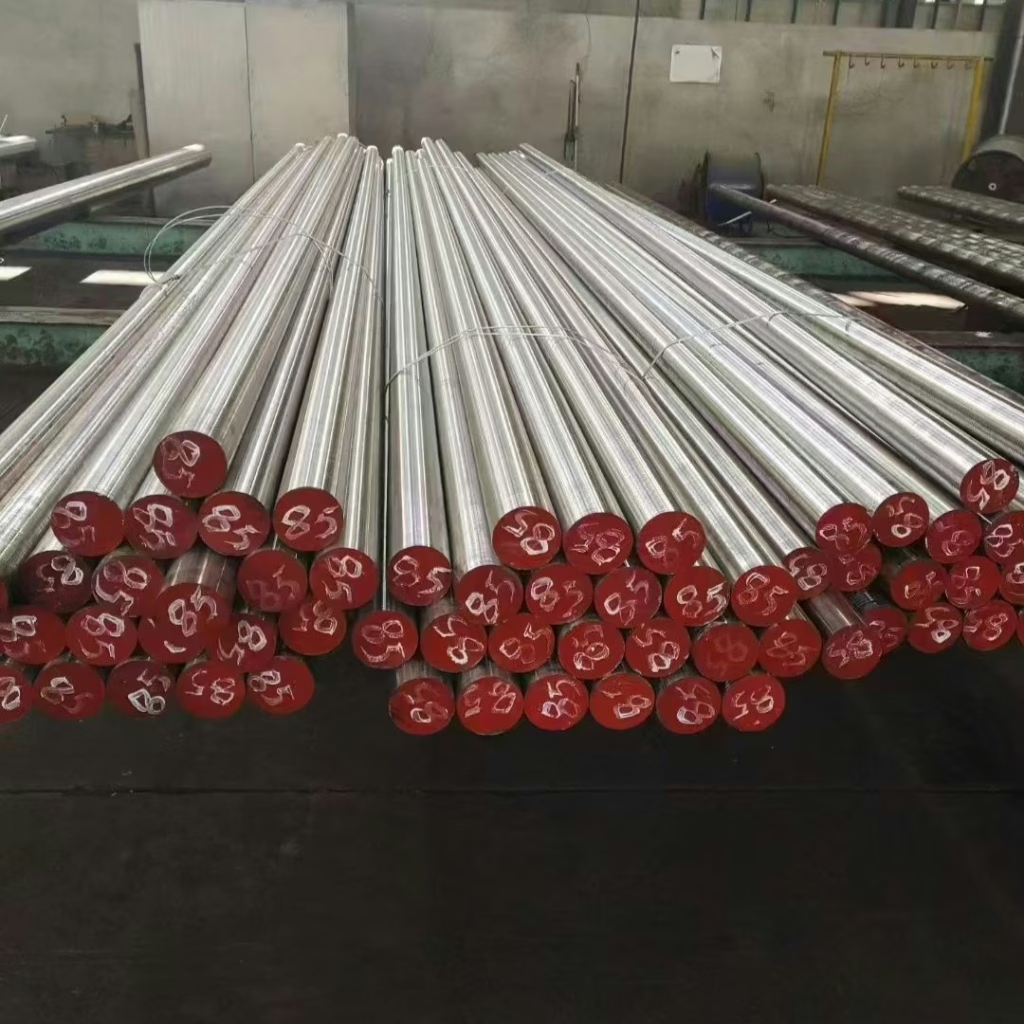
The L6 tool steel we supply is available in various shapes, including round bars, sheet plates, slabs, flat bars, square bars, and blocks. The dimensions of the flat bar range from: width 20–600 mm × thickness 20–400 mm × length 1,000–5,500 mm. The dimensions of the round bar range from a diameter of 20–400 mm × a length of 1,000–5,500 mm. The block dimensions are obtained by cutting the flat bar.
UT testing: Sep 1921-84 D/d, E/e.
Surface Treatment: original black, peeled, machined/turned, polished, grounded, or milled surface finishes.
Inventory Status: We do not maintain a stock of L6 steel. We arrange production based on customer orders.
Delivery time: Electric Arc Furnace (EAF) materials are 30-45 days.