
Aobo Steel · Tool Steel Supplier · Huangshi, China
H13 Mold Steel for Injection Mold Inserts and Dies
AISI H13 / DIN 1.2344 / X40CrMoV5-1 — JIS SKD61 equivalent · annealed for machining
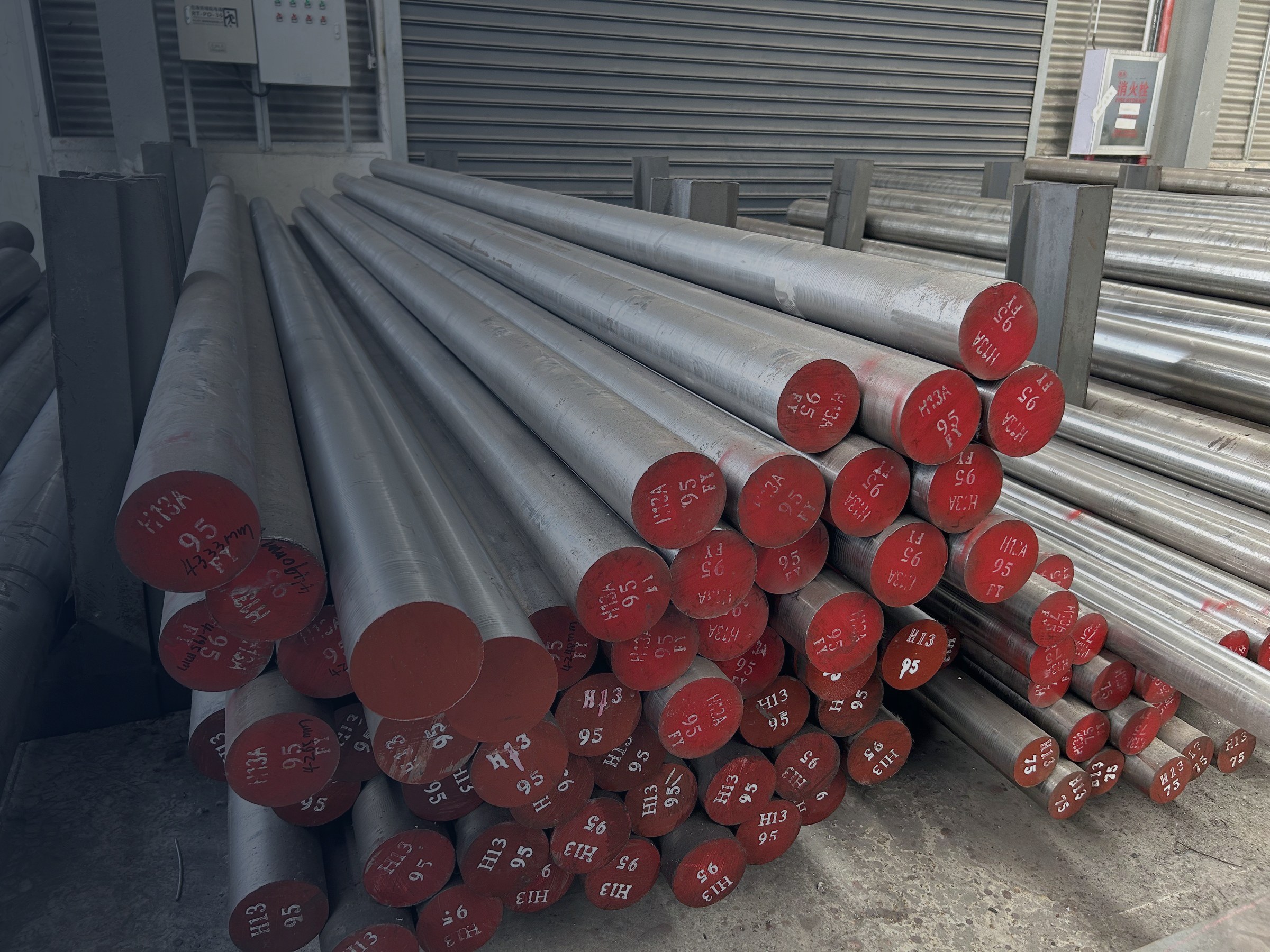
H13 mold steel for cavity and core inserts, slides and small mold components. Supplied annealed and cut to size, with the heat number on every batch. The insert is machined in the annealed condition and hardened and tempered by the toolroom afterwards, because the working hardness a plastic mold needs is set by that second step.
Also supplied: plastic mold steels, P20 tool steel for prehardened cavity blocks, and 420 stainless steel where the resin is corrosive.
Request price & delivery
Tell us the insert sizes, quantity and destination port. We confirm price, sizes and delivery within one working day.
H13 mold steel is the AISI designation for a chromium hot work tool steel also sold as DIN 1.2344, EN X40CrMoV5-1 and JIS SKD61. It arrives mill annealed, at 229 HBW maximum in the ISO 4957 delivery condition, and every cavity, core and insert is machined in that state [ISO 4957, Table 6]. The finished part is then hardened and tempered, and that second step is what puts the working surface at 45 to 50 HRC, the range the sources give for plastic injection molds [Tool Steels, Roberts and Krauss, p. 233]. A prehardened mold steel arrives already at its working hardness and never takes that step [Tool Steels, Properties and Performance, Mesquita, p. 212].
Where H13 Belongs in a Mold
A mold is not one block of one steel. The mold base and the general cavity usually come from a prehardened grade that is machined and put to work as delivered. H13 takes the positions where the surface has to survive heat, abrasive fillers or a long run of parts, and where a working hardness above 40 HRC is written on the drawing. The ranges below are the ones the sources give for this grade by position. They are starting points for a drawing, not a tempering schedule for the furnace.
| Mold position | What H13 does there | Hardness |
|---|---|---|
| Plastic injection mold cavities and cores | Carries the working hardness the source data gives for plastic molds | 45 to 50 HRC |
| Aluminium die casting dies | Meets molten aluminium where heat checking is the usual failure | 44 to 48 HRC |
| White metal die casting dies | Runs harder because the casting temperature is lower | 47 to 49 HRC |
| Brass die casting dies, medium runs | Takes the heavier thermal load at a lower hardness | 38 to 43 HRC |
| Mold and die tooling that must resist shock | Keeps toughness where impact is the failure mode | 40 to 44 HRC |
Working Hardness for Mold Work
Out of the quench the steel is harder than any mold runs it. An austenitizing treatment at 1010 °C with an air or oil quench gives 48 to 56 HRC, and one table records 53 HRC for the same cycle [Heat Treaters Guide, pp. 604 and 613]. Tempering brings it down to the working figure. A double temper at 595 °C leaves 47 to 48 HRC. A triple temper at 540 °C still holds 53 HRC. Two tempers between 560 and 580 °C give 47 to 49 HRC, and a range from 595 to 675 °C walks the hardness from 52 down to 39 HRC [Heat Treaters Guide, p. 604; 模具热处理常见缺陷与对策, Table 2]. Pick the temper by the way the tool fails and by the section. Air cooling a 150 mm round leaves a lower tempered hardness at midradius than a 12.5 mm specimen, and a 300 mm round is lower again [Tool Steels, p. 235; Heat Treatment Selection and Application, p. 67].
H13 Mold Steel Against a Prehardened Mold Steel
A prehardened mold steel such as P20 mod, 1.2738 or 1.2311 is delivered at about 300 HBW, which is 40 HRC or less, and the cavity is machined and used at that hardness [Tool Steels, Properties and Performance, p. 212]. H13 is delivered annealed and takes the opposite route. The block is rough machined first, vacuum heat treated and tempered, and the finishing cuts follow the treatment [Tool Steels, Properties and Performance, p. 213]. That route costs two things. The steel itself costs more, and the vacuum treatment after rough machining adds a step and a schedule to the mold build. It buys a working surface above 40 HRC, higher polishability and etchability in the ESR refined blocks used for automotive lenses, and better corrosion resistance than P20 mod [Tool Steels, Properties and Performance, pp. 212 to 213, Fig. 6.13].
What H13 Mold Steel Does Not Cover
Three limits come out of the source data. Wear resistance is medium, so a position where abrasion is the only failure mode belongs to a cold work grade [Tool and Die Making Troubleshooter, Appendix A, p. 220]. The steel softens quickly above 540 °C, which rules it out of tooling that runs hotter than that and points to a higher alloyed hot work grade [Heat Treaters Guide, p. 602]. Section size also works against it. An air cooled round of 150 mm and one of 300 mm both finish below a 12.5 mm specimen of the same steel, and a large block may not reach full hardness at all [Tool Steels, p. 235; Heat Treatment Selection and Application, p. 67]. A very large general purpose mold pays for the treatment step without needing it.
Ordering H13 Mold Steel for Insert Work
We supply H13 in round bar, flat bar, plate and forged block, cut to the insert size on the order. The delivery condition is annealed, at 229 HBW maximum under ISO 4957, so the block machines before it is hardened [ISO 4957, Table 6]. Send the finished insert size rather than the size you machine from, since the section decides how much the mill has to take off and how long the delivery runs. Every batch travels with a mill test certificate to EN 10204 3.1 carrying the heat number, and the ultrasonic test follows the class named on the drawing. The H13 tool steel supply page carries the forms, tolerances and packing.
The Data Behind H13 in Mold Work
The composition, the mechanical and physical figures, the full heat treatment cycle and the nitriding procedure each have their own page. This page stays on the mold side, on which position takes the grade and which hardness it runs at.
Source, Tool Steels (Roberts and Krauss), pp. 233 to 239. Tool Steels, Properties and Performance (Mesquita), pp. 212 to 213. Heat Treaters Guide, Tool Steels, pp. 602 to 613. Heat Treatment Selection and Application. Tool and Die Making Troubleshooter (Leed), Appendix A, pp. 220 to 223. ISO 4957:2018, Table 6. 模具热处理常见缺陷与对策, Tables 1 and 2.
FAQ
The sources give 45 to 50 HRC for plastic injection molds, with one table listing 47 to 49 HRC. Both sit well below the 48 to 56 HRC the steel reaches out of the quench, so the temper is what sets the working figure. [Tool Steels, p. 233; Heat Treaters Guide, p. 604]
No. It is supplied mill annealed at 229 HBW maximum under ISO 4957, with other tables listing 220 to 241 HB maximum. The insert is machined in that condition, then hardened from about 1010 °C and tempered to the working hardness. [ISO 4957, Table 6; Tool and Die Making Troubleshooter, Appendix A, pp. 221 and 223]
Air cooling a 150 mm round leaves a lower tempered hardness at midradius than a 12.5 mm specimen, and a 300 mm round is lower again. A large block may not reach full hardness when it is air cooled. [Tool Steels, p. 235; Heat Treatment Selection and Application, p. 67]
Yes. Gas nitriding for 15 hours at 510 °C gives a case depth of 0.152 mm, and the sources note that preheating plus nitriding or a CVD coating improves resistance to heat checking. [Heat Treaters Guide, p. 604; Tool Steels, p. 239]