
Vickers to Rockwell C Hardness Conversion for Tool Steels
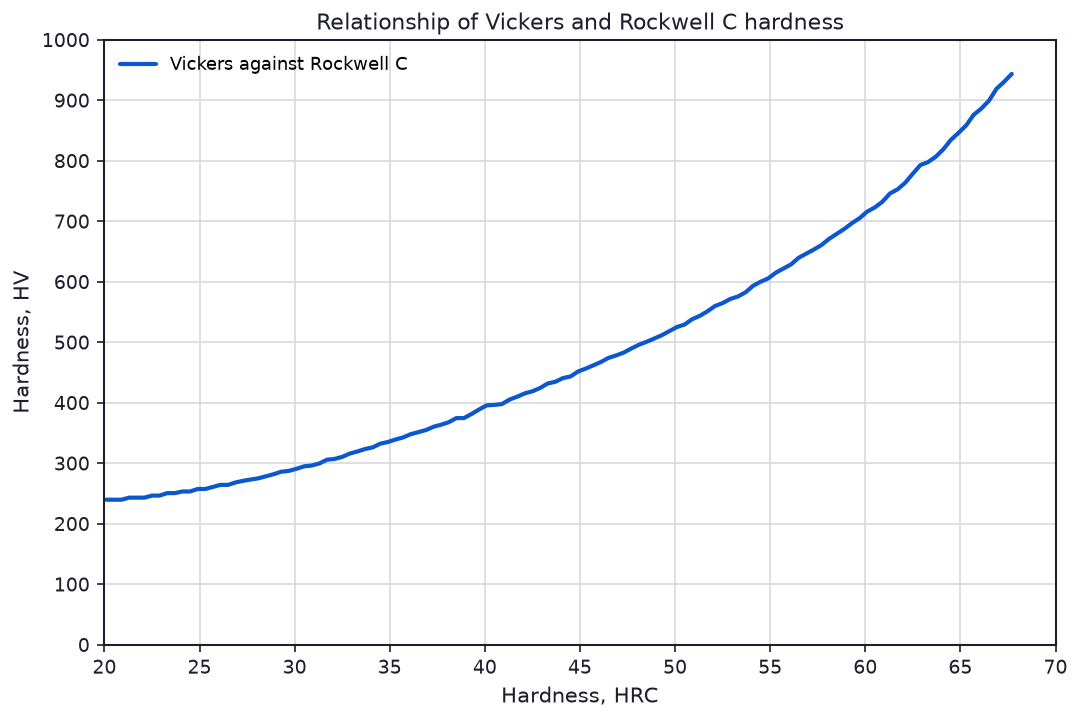
Tool steel is bought and sold in Rockwell C, tested in Vickers, and specified in whichever one the customer’s drawing happens to use, so the conversion between the two is a shop floor number rather than an academic one. The chart on this page is the published Vickers against Rockwell C relationship, redrawn from the source figure, and the table underneath it is read off the same curve at every point from 20 to 68 HRC. Above about 60 HRC the Rockwell C scale becomes coarse while Vickers keeps resolving, which is why hard tool steel is so often reported in HV, and below about 20 HRC the Vickers scale is the one that gets awkward.
The conversion chart
The relationship is a curve and not a table of even steps, and it bends upward at both ends. From 20 to 40 HRC, forty points of Vickers covers about fifteen points of Rockwell. From 60 to 68 HRC, eight points of Rockwell covers almost 250 points of Vickers. That shape is the practical content of the chart. A one-point disagreement in Rockwell C at the hard end of the scale is a disagreement of roughly twenty five to thirty Vickers points, and it is the reason a tool steel specification written only in HRC leaves room for argument on a 65 HRC tool.
The conversion in numbers
The table gives the same curve at whole Rockwell C points. It is rounded to the nearest Vickers point, and the last entry is 68 HRC because that is where the source curve stops. Reading it in either direction gives the same answer, so it can be used from a Vickers test result back to a Rockwell C value as easily as the other way round.
| HRC | HV | HRC | HV |
|---|---|---|---|
| 20 | 240 | 45 | 453 |
| 21 | 241 | 46 | 466 |
| 22 | 243 | 47 | 480 |
| 23 | 248 | 48 | 495 |
| 24 | 253 | 49 | 508 |
| 25 | 258 | 50 | 524 |
| 26 | 264 | 51 | 540 |
| 27 | 269 | 52 | 558 |
| 28 | 275 | 53 | 573 |
| 29 | 283 | 54 | 591 |
| 30 | 290 | 55 | 608 |
| 31 | 297 | 56 | 627 |
| 32 | 307 | 57 | 648 |
| 33 | 317 | 58 | 669 |
| 34 | 326 | 59 | 690 |
| 35 | 336 | 60 | 713 |
| 36 | 347 | 61 | 736 |
| 37 | 356 | 62 | 761 |
| 38 | 367 | 63 | 794 |
| 39 | 377 | 64 | 816 |
| 40 | 394 | 65 | 849 |
| 41 | 400 | 66 | 884 |
| 42 | 414 | 67 | 922 |
| 43 | 426 | 68 | 944 |
| 44 | 439 |
Read off the redrawn curve above at whole HRC values, rounded to the nearest HV.
Why tool steel is specified in both
The Rockwell C test is fast, uses a portable machine and leaves a small enough impression to be used on a finished tool, so it is what a hardening shop reports and what a customer’s drawing usually carries. The Vickers test is slower but it keeps its resolution at hardnesses where Rockwell C does not, and it can be run at a low load on a thin section or a case depth where the Rockwell C load would punch through the layer being measured. For a tool steel above 62 HRC, and for any measurement of a nitrided or induction hardened layer, Vickers is the test that produces a number worth quoting.
Two practical cautions belong with any conversion. The first is that the two scales measure different things. Rockwell C measures depth of penetration and Vickers measures the size of an impression, and the conversion between them is an empirical relationship rather than a physical one, so a conversion is not a measurement and a certificate should not be written from one. The second is that the conversion depends on the material class. The curve on this page is the tool steel relationship; the same conversion for a plain carbon steel or an austenitic stainless steel runs slightly differently, and the standards publish separate tables for those groups for that reason.
Where to go next
The measurement methods themselves are described on the hardness testing methods page, the hardness each tool steel grade is supplied at is on the tool steel properties chart and the hot hardness of the same grades, which is also quoted in HRC, is on the tool steel hot hardness chart. Aobo Steel supplies every order with a mill test certificate to EN 10204 3.1 carrying the hardness of the actual piece.
Source: ASM Handbook, Vol 1, Properties and Selection: Irons, Steels and High-Performance Alloys.