
S7 Tool Steel Hardness
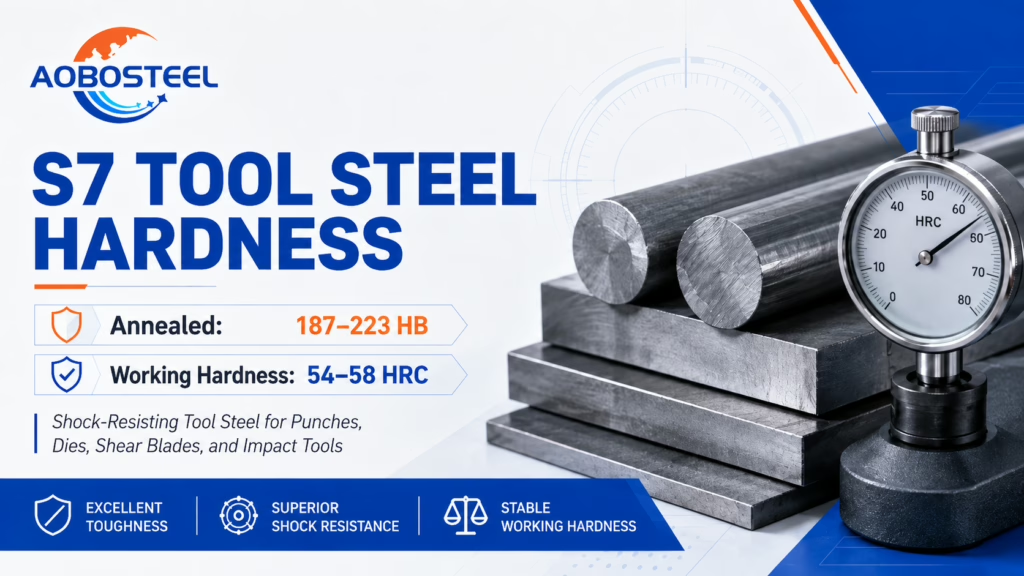
S7 tool steel is normally supplied in the annealed condition at about 187–223 HB, with many specifications allowing a maximum annealed hardness of about 230 HB. After hardening and tempering, S7 is commonly used at 54–58 HRC. For many punches, dies, forming tools, chisels, shear blades, and other shock-loaded components, 56–58 HRC is often the most practical working range.
S7 can reach about 60–61 HRC after quenching, but this is not usually the best service condition. At maximum hardness, S7 loses part of the toughness that makes it useful as a shock-resisting tool steel. In real tooling use, the correct hardness is not the highest possible HRC. It is the hardness range that gives enough strength and wear resistance while still allowing the tool to absorb impact without cracking or chipping.
For a quick numerical table of annealed hardness, as-quenched hardness, working hardness, and HRC-to-HB conversion, see our S7 Tool Steel Rockwell Hardness Chart.
Aobo Steel can supply S7 round bar, flat bar, and plate in bulk. We support hardness inspection, chemical composition verification, ultrasonic testing when required, and MTC documentation for each order. Contact [email protected] for S7 tool steel size availability and quotation.
How Hard Is S7 Tool Steel?
S7 tool steel is usually supplied soft in an annealed condition at about 187–223 HB. After heat treatment, it is commonly used at around 54–58 HRC. A practical target for many impact-loaded cold-work tools is 56–58 HRC.
The important point is that S7 hardness must be evaluated alongside toughness. S7 is not selected mainly to achieve the highest Rockwell hardness. It is selected when a tool requires useful hardness, good strength, and much better shock resistance than that of more brittle high-carbon cold-work steels.
| S7 Hardness Point | Significado práctico |
| 187–223 HB annealed | Normal machinable supply condition |
| About 230 HB max | Common upper reference for annealed material |
| 60–61 HRC as quenched | Possible maximum stage before tempering |
| 54–58 HRC after tempering | Common working hardness range |
| 56–58 HRC | Practical range for many shock-loaded tools |
The as-quenched hardness of S7 may look attractive, but the steel should not be used in an untempered condition. Untempered S7 carries high internal stress and is more likely to crack or chip under impact. Tempering is necessary to convert high hardness into usable tool performance.
S7 Tool Steel Hardness in Annealed Condition
S7 tool steel is usually purchased from the steel supplier in the annealed condition. In this state, the hardness is typically 187–223 HB, with a maximum acceptable value often around 230 HB.
This soft condition is intentional. It allows the material to be cut, drilled, milled, ground, and prepared before final heat treatment. For incoming material inspection, Brinell hardness is more useful than Rockwell C because annealed S7 is too soft for HRC to describe accurately.
A buyer should not treat annealed S7 as defective simply because it is much softer than the final working hardness. The supplier provides S7 in a machinable condition. The buyer or heat-treatment facility then produces the final hardness according to the tool design and service requirement.
For raw material purchasing, annealed hardness is mainly used to confirm machinability and supply conditions. Final Rockwell C hardness belongs to the later heat-treatment stage, not the original steel supply condition.
S7 Tool Steel Hardness After Heat Treatment
S7 hardness after heat treatment depends on austenitizing temperature, quenching method, tempering temperature, section size, and final application. A common hardening process includes preheating at about 1200–1300°F (650–705°C), followed by austenitizing at about 1695–1750°F (925–955°C).
After quenching, S7 can reach about 60–61 HRC. This condition is mainly a heat-treatment stage, not a normal working condition. Without tempering, the steel has high internal stress and reduced safety under shock loading.
After tempering, S7 is normally adjusted to a safer working range. For most shock-resisting tools, the practical range is 54–58 HRC. When the tool needs both edge strength and impact resistance, 56–58 HRC is usually a better target than maximum hardness.
| Heat Treatment Stage | Dureza típica | Significado práctico |
| Annealed before hardening | 187–223 HB | Suitable for machining |
| A medida que se apaga | 60–61 HRC | High hardness with high internal stress |
| Tempered around 400–450°F / 205–230°C | about 57–58 HRC | Common high-strength working condition |
| Higher-temperature tempered | about 45–57 HRC | Used when toughness or heat exposure is more important |
| Tempered around 1100°F / 595°C | about 46 HRC | Lower hardness for specific service conditions |
The final hardness must match the tool’s failure mode. A punch that chips under impact may need lower hardness. A tool edge that rolls or deforms may need higher hardness, better heat treatment, or a different steel grade.
Recommended Working Hardness for S7 Applications
S7 hardness should be selected according to the tool’s service risk. If the tool primarily fails due to cracking, chipping, or impact-induced breakage, toughness is more important than maximum hardness. If the tool primarily fails due to edge wear or surface deformation, a slightly higher hardness may be useful, but it should not compromise the shock resistance required for the application.
For many S7 tools, 56–58 HRC is a practical target. A broader range of 54–58 HRC is also common when impact resistance is more important than wear resistance.
| Solicitud | Suggested S7 Hardness | Lógica de selección |
| General punches and blanking dies | 56–58 HRC | Balances edge strength and shock resistance |
| Punzones de alta resistencia | 56–58 HRC, sometimes higher with caution | Higher hardness increases cracking risk |
| Embossing punches | about 58–60 HRC | Used when surface detail and edge strength matter |
| troqueles de acuñación | about 57–59 HRC | Needs hardness but still carries impact load |
| Cold swaging dies | 56–60 HRC | Depends on forming load and wear requirement |
| Wood and metal cutting tools | 55–60 HRC | Higher hardness may improve edge retention |
| Medium and large molds | 53–56 HRC | Larger sections usually need more toughness |
| Plastic mold applications | around 58 HRC | Useful where polishability and strength are required |
| Insert holders or structural holders | 28–32 HRC | Used as a support component, not a cutting surface |
| Moderate hot-work tools | about 45–57 HRC | Tempering must match service temperature |
For moderate hot-work use, S7 is usually tempered to a higher temperature than cold-work tools. This reduces hardness but improves stability when the tool is exposed to heat. If the application involves severe heat checking, thermal fatigue, or prolonged exposure to high temperatures, H13 is generally a better choice than S7.
S7 Hardness and Toughness Balance
S7 is a shock-resisting tool steel. Its hardness should always be understood together with toughness. A tool at 60–61 HRC may be very hard but too brittle for impact service. A tool at 56–58 HRC may have slightly lower wear resistance, but it is usually much safer under repeated shock loading.
This is the main reason S7 is used for punches, chisels, shear blades, forming tools, swaging dies, and other impact tools. It is not chosen to replace D2 in severe abrasive wear. It is chosen when harder steels chip, crack, or break.
The practical advantage of S7 is that it can keep useful hardness while offering much better impact resistance than many higher-carbon cold-work tool steels. When the primary failure mode is breakage, S7 often performs better than a harder, more brittle grade.
Hardness gives the tool resistance to indentation, deformation, and edge collapse. Toughness gives the tool resistance to cracking and sudden fracture. S7 works best when these two properties are balanced, not when one property is pushed to the limit.
Why S7 Should Not Always Be Hardened to Maximum HRC
A maximum hardness of 60–61 HRC can look attractive on a hardness report, but it is usually not the best target for S7 tools. At this level, the tool has less ability to absorb impact, and the risk of chipping, cracking, or sudden fracture increases.
This is especially important for punches, blanking tools, chisels, forming tools, and components exposed to concentrated loading. These tools do not only need a hard surface. They need enough toughness to survive repeated impact.
Pushing S7 to maximum hardness can also create heat-treatment problems. Excessive austenitizing temperature, long soaking time, severe quenching, or insufficient tempering may leave high residual stress in the tool. The part may pass a hardness test but still fail early in service.
For most S7 tools, 56–58 HRC is more reliable than maximum hardness. The purpose is to match hardness with the working load, not to chase the highest HRC number.
Practical Hardness Selection Rules for S7 Tool Steel
S7 hardness should be selected based on the failure mode. The correct hardness is the range that solves the real service problem.
| Failure Risk | Better S7 Hardness Strategy |
| Tool breaks, cracks, or chips | Reduce hardness toward 54–56 HRC |
| Edge rolls or deforms | Increase hardness carefully toward 57–58 HRC |
| Surface wears too quickly | Consider 58 HRC, surface treatment, or a more wear-resistant grade |
| Tool sees repeated impact | Avoid maximum hardness and prioritize toughness |
| Tool works at elevated temperature | Use higher tempering temperature and accept lower hardness |
| Tool needs maximum abrasive wear resistance | Consider A2 or D2 instead of S7 |
| Tool sees severe hot-work conditions | Consider H13 instead of S7 |
This is the most practical way to use S7. It is not the best steel for every hard tool. It is the better choice when the tool must stay hard enough to work, but tough enough not to break.
S7 Hardness Compared with D2, A2, O1, and H13
S7, D2, A2, O1, and H13 are not selected by hardness alone. Each grade is designed for a different balance of wear resistance, toughness, dimensional stability, and heat resistance.
| Steel Grade | Typical Working Hardness | Main Strength | Compared with S7 |
| S7 | 54–58 HRC | Shock resistance and impact toughness | Best when breakage is the main risk |
| A2 | 57–62 HRC | Balanced wear resistance and dimensional stability | Harder and more wear-resistant, but less tough |
| D2 | 54–61 HRC | High abrasive wear resistance | Better wear resistance, but more brittle |
| O1 | 57–62 HRC | General cold-work use and machinability | Can run harder, but has lower shock resistance |
| H13 | about 38–53 HRC | Hot strength and thermal fatigue resistance | Better for severe hot-work conditions |
Compared with A2, D2, and O1, S7 is not normally chosen for the highest working hardness or the strongest abrasive wear resistance. A2 and O1 are often used around 57–62 HRC, while D2 is commonly used around 58–60 HRC for wear-dominated cold-work tooling. S7 is usually selected when cracking, chipping, or impact breakage is a bigger risk than wear. H13 is different because it is a hot-work steel, often used at lower hardness levels for thermal fatigue and heat-checking resistance rather than cold-impact service.
When S7 Hardness Is Not the Right Solution
S7 should not be selected only because it can reach high hardness. If the application primarily requires severe abrasive-wear resistance, D2 or A2 may be more suitable. If the tool operates at high temperatures, H13 may be safer. If the application needs simple machining and moderate duty, O1 may be enough.
S7 is strongest when impact failure is the main risk. If a tool made from D2, A2, or O1 cracks, chips, or breaks under shock loading, S7 becomes a strong candidate. If the tool only wears out slowly from abrasion, S7 may not solve the real problem.
This is why hardness alone is not enough for tool steel selection. A steel with higher HRC may still fail faster if its toughness, heat resistance, or wear mechanism does not match the application.
Aobo Steel supplies S7 tool steel in the annealed condition for further machining and heat treatment. For S7 round bar, flat bar, or plate used in punches, dies, impact tools, forming tools, or shock-loaded components, contact [email protected] with your required size, quantity, tolerance, destination port, and inspection requirements. Aobo Steel can help confirm whether S7 is suitable for your application or whether A2, D2, O1, or H13 is a better choice.
Preguntas frecuentes
S7 tool steel is usually supplied in the annealed condition, with a hardness of about 187–223 HB. After hardening and tempering, it is commonly used at about 54–58 HRC, with 56–58 HRC being a practical working range for many shock-loaded tools
Annealed S7 tool steel is commonly supplied at a hardness of about 187–223 HB. Some supplier references may use 200–225 HBW or about 230 HB as an upper annealed hardness reference.
The typical hardness of S7 tool steel after heat treatment is 54–58 HRC. For punches, dies, chisels, shear blades, and other impact-loaded tools, 56–58 HRC is often a practical target because it balances hardness and toughness.
Yes. S7 can reach about 59–61 HRC after hardening. However, this is not always the best working condition. For impact-loaded tools, S7 is often tempered to a slightly lower hardness to reduce the risk of chipping, cracking, or impact breakage.
No. Higher hardness may improve edge strength and wear resistance, but it can reduce impact toughness. If the tool primarily fails due to cracking or breakage, a lower hardness range is usually safer. If the tool primarily fails due to deformation or wear, a higher hardness may help.
Annealed S7 is relatively soft and machinable before final heat treatment, so Brinell hardness, HB, or HBW is more suitable. Rockwell C hardness is more useful after S7 has been hardened and tempered.