Case Hardening Compared: Carburizing, Nitriding, Carbonitriding and Pack Diffusion
Every case hardening process puts a hard surface on a softer core, and the differences between them are what decide whether a tool can be used as it comes out of the furnace. One family austenitizes the surface and has to be quenched, which is where distortion enters. The other runs below the austenitizing temperature and needs no quench at all. This page puts the processes side by side with their temperatures, case depths, case hardness and the base metals each one runs on, and lists the tool steel grades the source clears for nitriding and for the pack diffusion coatings.
Carburizing, nitriding, carbonitriding and nitrocarburizing side by side
The table below is the master comparison. Read down the process temperature column first, because it splits the field in two: everything above the austenitizing temperature has to be quenched, and everything below it does not. Then read the case depth column, because it decides which process can be used on a finished tool and which one has to be planned into the machining allowance.
| Process | Name of case | Process temperature | Typical case depth | Case hardness, HRC | Typical base metals | Process characteristics |
|---|---|---|---|---|---|---|
| Carburizing | ||||||
| Pack | Diffused carbon | 815-1090 °C (1500-2000 °F) | 125 µm to 1.5 mm (5-60 mils) | 50-63(a) | Low carbon steels, low carbon alloy steels | Low equipment cost, difficult to control case depth accurately |
| Gas | Diffused carbon | 815-980 °C (1500-1800 °F) | 75 µm to 1.5 mm (3-60 mils) | 50-63(a) | Low carbon steels, low carbon alloy steels | Good control of case depth, suitable for continuous operation, good gas controls required, can be dangerous |
| Liquid | Diffused carbon and possibly nitrogen | 815-980 °C (1500-1800 °F) | 50 µm to 1.5 mm (2-60 mils) | 50-65(a) | Low carbon steels, low carbon alloy steels | Faster than pack and gas, salt disposal problem, salt baths need frequent maintenance |
| Vacuum | Diffused carbon | 815-1090 °C (1500-2000 °F) | 75 µm to 1.5 mm (3-60 mils) | 50-63(a) | Low carbon steels, low carbon alloy steels | Excellent process control, bright parts, faster than gas carburizing, high equipment cost |
| Nitriding | ||||||
| Gas | Diffused nitrogen, nitrogen compounds | 480-590 °C (900-1100 °F) | 125 µm to 0.75 mm (5-30 mils) | 50-70 | Alloy steels, nitriding steels, stainless steels | Hardest cases from nitriding steels, no quench required, low distortion, slow, usually a batch process |
| Salt | Diffused nitrogen, nitrogen compounds | 510-565 °C (950-1050 °F) | 2.5 µm to 0.75 mm (0.1-30 mils) | 50-70 | Most ferrous metals including cast iron | Usually used for thin hard cases under 25 µm (1 mil), no white layer, most are proprietary processes |
| Ion | Diffused nitrogen, nitrogen compounds | 340-565 °C (650-1050 °F) | 75 µm to 0.75 mm (3-30 mils) | 50-70 | Alloy steels, nitriding steels, stainless steels | Faster than gas nitriding, no white layer, high equipment cost, close case control |
| Carbonitriding | ||||||
| Gas | Diffused carbon and nitrogen | 760-870 °C (1400-1600 °F) | 75 µm to 0.75 mm (3-30 mils) | 50-65(a) | Low carbon steels, low carbon alloy steels, stainless steels | Lower temperature than carburizing so less distortion, slightly harder case than carburizing, gas control critical |
| Liquid (cyaniding) | Diffused carbon and nitrogen | 760-870 °C (1400-1600 °F) | 2.5 to 125 µm (0.1-5 mils) | 50-65(a) | Low carbon steels | Good for thin cases on noncritical parts, batch process, salt disposal problems |
| Ferritic nitrocarburizing | Diffused carbon and nitrogen | 480-590 °C (900-1090 °F) | 2.5 to 25 µm (0.1-1 mil) | 40-60(a) | Low carbon steels | Low distortion process for a thin case on low carbon steel, most processes are proprietary |
Typical characteristics of carburizing, nitriding, carbonitriding and nitrocarburizing treatments, reproduced from the source table. (a) Requires a quench from the austenitizing temperature. The rows without that marker, which are all the nitriding and nitrocarburizing rows, need no quench and are the low distortion processes.
The same five treatments are laid out below as a process tree, from the medium each one uses to the case depth it reaches.
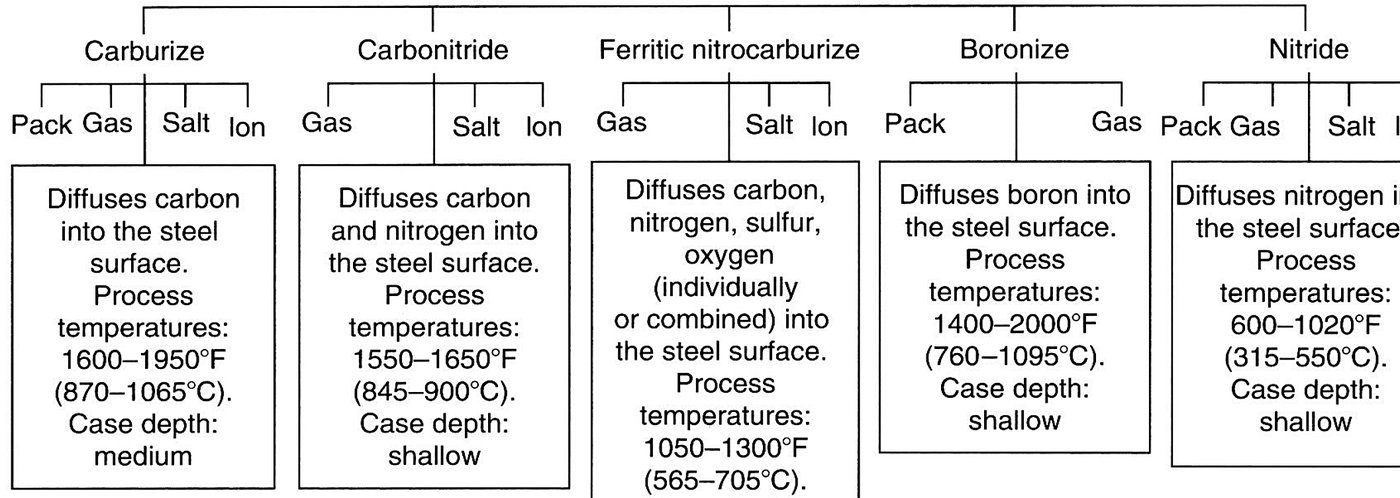
The quench is what separates the families
Carburizing and carbonitriding harden by diffusing carbon, or carbon and nitrogen, into the surface at 760 to 1090 °C and then quenching. Carburizing raises the surface carbon of a low carbon steel from a base of about 0.2 wt% to a case of 0.8 to 1.0 wt% C, and the case becomes high carbon martensite over a tough low carbon core. Carbonitriding adds nitrogen to the same idea at a lower temperature, 760 to 870 °C, which is the reason the source gives it less distortion than carburizing and a slightly harder case.
Nitriding goes a different way. Nitrogen is introduced between 500 and 550 °C, which is below the Ac1 for ferritic steels, so the steel is never austenitized, nothing has to be quenched, and distortion and dimensional control are correspondingly better. The price is time: the source calls the process slow and usually a batch operation. Nitriding is applied to steel that has already been quenched and tempered, and it raises wear resistance, fatigue resistance and, except in stainless steel, corrosion resistance.
The case structure explains which grades respond best. Nitriding produces a diffusion zone, which is the original core structure with nitride precipitates and nitrogen in solid solution, and optionally a compound zone of the intermetallics γ′-Fe4N and ε-Fe2-3N on top. Steels containing aluminium, chromium, vanadium, tungsten or molybdenum form nitrides that are stable at the nitriding temperature, which is why the nitriding steels give the hardest cases and why most tool steels respond well.
Nitriding itself comes in five shop-floor variants, and the choice between them is about equipment and control rather than about the layer that forms.

Which tool steels are nitrided
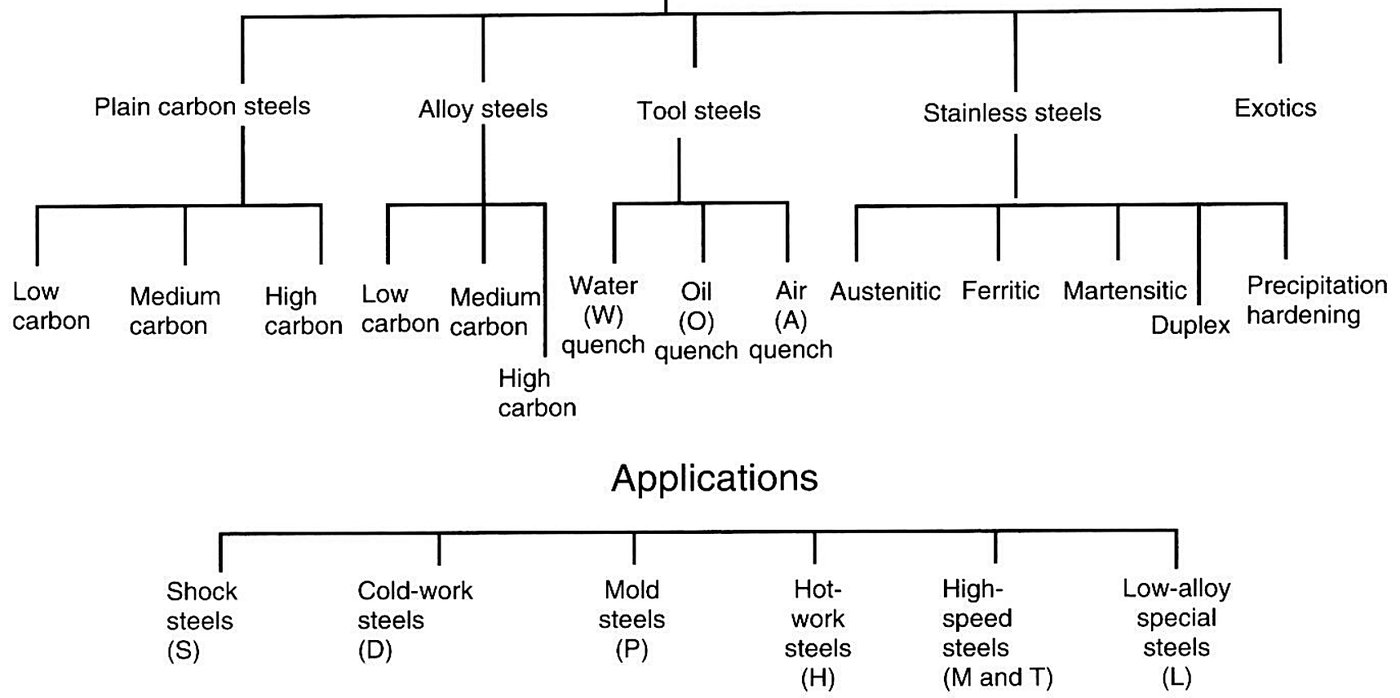
The source lists the grades that are nitrided for specific applications. The tool steel entries are the 5% chromium hot work die steels H11, H12 and H13, the air hardening tool steels A2, A6, D2, D3 and S7, and the high speed tool steels M2 and M4. Every one of them is quenched and tempered first, and the nitriding cycle follows the tempering temperature rather than the other way round.
| Grade family | Grades the source lists |
|---|---|
| Aluminium containing low alloy steels | Nitralloy grades |
| Medium carbon chromium low alloy steels | 4100, 4300, 5100, 6100, 8600, 8700 and 9800 series |
| Low carbon chromium low alloy steels | 3300, 8600 and 9300 series |
| Hot work die steels with 5% Cr | H11, H12 and H13 |
| Air hardening tool steels | A2, A6, D2, D3 and S7 |
| High speed tool steels | M2 and M4 |
| Nitronic stainless steels | 30, 40, 50 and 60 |
| Ferritic and martensitic stainless steels | 400 and 500 series |
The steels named in the source as nitridable for specific applications. All hardenable steels must be quenched and tempered before nitriding, and the process is carried out below the temperature at which the previous heat treatment set the core properties.
The steels that are nitrided for specific applications are listed below, and the tool steel families are on the list.
Effective case depth is measured at 50 HRC
One definition settles most arguments about case depth. The diffused species does not stop abruptly, so the source defines the effective case depth as the depth at which the hardness falls below 50 HRC. When a customer asks for a 0.5 mm case, that is the number being quoted, and it is the number to ask for when the case is inspected.
Carburizing methods differ in how well they hold that number. Gas carburizing is how the vast majority of carburized parts are made, using natural gas, propane or butane, with the carbon potential held constant by measuring the CO and CO2 content of the atmosphere. Pack and salt bath carburizing are still done occasionally but have little commercial importance. Vacuum carburizing gives excellent uniformity, bright parts and shorter cycles, with high equipment cost as the trade off. Plasma carburizing runs in an oxygen free vacuum and, at the same temperature, produces a greater carburized case than either atmospheric gas or vacuum carburizing.
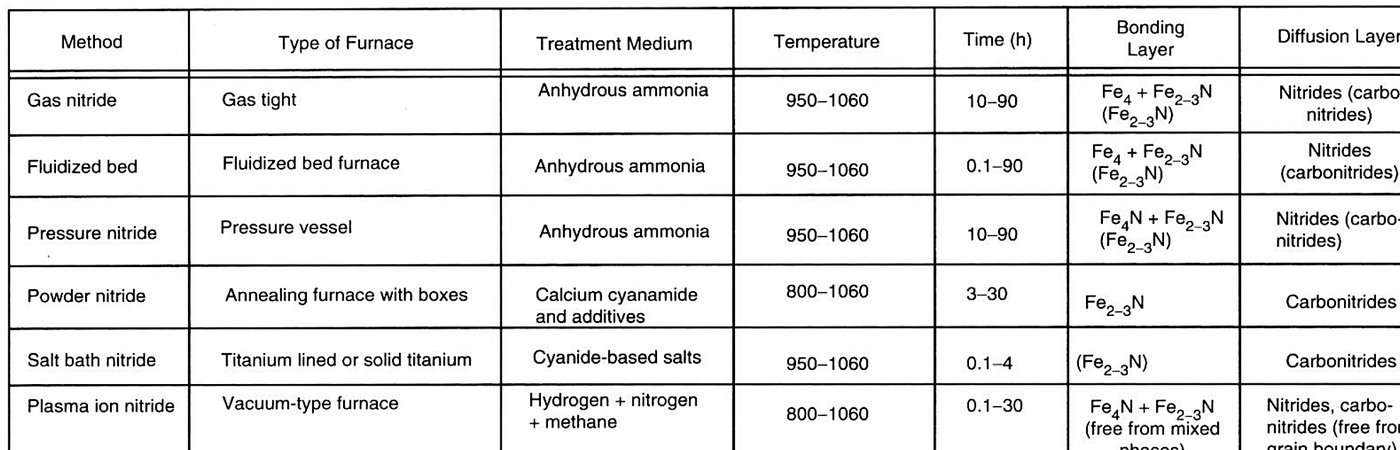
For the nitriding methods themselves, the published cycle data run as follows.
Pack diffusion coatings, where tool steel is the main customer
The same pack cementation process that started as pack carburizing gave rise to the diffusion coatings: aluminizing, siliconizing, chromizing and boronizing, plus titanium carbide (TiC) which is the coating known in the die shop as TD. A sealed or vented pack is charged with a master alloy, a halide salt activator and an inert filler, and held at temperature for hours, typically 1050 °C for 16 h in the source example, while the element diffuses into the surface.
Two rows of the table below are tool steel work. Titanium carbide (TiC) is applied to alloy steels and tool steels as a 2.5 to 12.5 µm case above 70 HRC, and the source warns that the compound temperature can cause distortion. Boriding is applied to alloy steels, tool steels and cobalt and nickel alloys, mostly over already hardened tool steels, for a 12.5 to 50 µm compound layer of 40 to 70 HRC, and it carries the same distortion warning for the high end of its process range. Both cases are thin, hard and shallow, which is why they are specified on tools that wear at the surface rather than on tools that take impact.
| Process | Nature of case | Process temperature | Typical case depth | Case hardness, HRC | Typical base metals | Process characteristics |
|---|---|---|---|---|---|---|
| Aluminizing (pack) | Diffused aluminum | 870-980 °C (1600-1800 °F) | 25 µm to 1 mm (1-40 mils) | <20 | Low carbon steels | Diffused coating for oxidation resistance at elevated temperature |
| Siliconizing by CVD | Diffused silicon | 925-1040 °C (1700-1900 °F) | 25 µm to 1 mm (1-40 mils) | 30-50 | Low carbon steels | For corrosion and wear resistance, atmosphere control is critical |
| Chromizing by CVD | Diffused chromium | 980-1090 °C (1800-2000 °F) | 25 to 50 µm (1-2 mils) | Low carbon steel <30, high carbon steel 50-60 | High and low carbon steels | Chromized low carbon steels yield a low cost stainless steel, high carbon steels develop a hard corrosion resistant case |
| Titanium carbide (TiC) | Diffused carbon and titanium, TiC | 900-1010 °C (1650-1850 °F) | 2.5 to 12.5 µm (0.1-0.5 mil) | >70(a) | Alloy steels, tool steels | Produces a thin TiC case for high wear resistance, compound temperature may cause distortion |
| Boriding | Diffused boron, boron compounds | 400-1150 °C (750-2100 °F) | 12.5 to 50 µm (0.5-2 mils) | 40-70 | Alloy steels, tool steels, cobalt and nickel alloys | Produces a hard compound layer, mostly applied over hardened tool steels, high process temperature can cause distortion |
Typical characteristics of the pack cementation processes, reproduced from the source table. (a) Requires a quench from the austenitizing temperature. The boronized and TiC coated cases do not need a quench to reach their hardness, but a tool steel processed in the austenitizing temperature range still has to be quenched to harden the substrate.
Choosing between a quenched case and a diffused case
Four questions decide it. What hardness the surface has to hold, because only the carburized and carbonitrided cases and the TiC layer reach past 60 HRC with a real depth. How deep the case has to be, because nitriding and the pack coatings stop well under 1 mm and usually under 100 µm. How much the part can move, because everything that is quenched can distort a finished tool. And whether the tool is already hardened, because nitriding and boriding are routinely run on hardened tool steel while carburizing cannot be.
The single process pages behind this comparison are the tool steel nitriding guide, boriding on tool steel, TD coating on die steel and gas carburizing and carbon penetration. Where the surface is hardened by heat alone, without diffusing an element, the processes are on surface hardening of tool steel, and what the surface then has to resist is set out on the wear design page.
Before you use these values
This page is a reference summary of published practice and it is not an Aobo Steel specification. The temperatures, case depths and case hardness ranges are reproduced from the source, and the case a particular part reaches depends on the grade, the atmosphere, the time at temperature and the section. The source itself notes that a heat treater usually works from empirical data on exposure time rather than from a chart. Final selection is confirmed on the job.
Source: ASM Handbook, Volume 20, Materials Selection and Design, ASM International, 1997. Process characteristics from the article on the effects of surface treatments on materials performance (Table 19 for the diffusion treatments, Table 14 for the pack cementation processes).
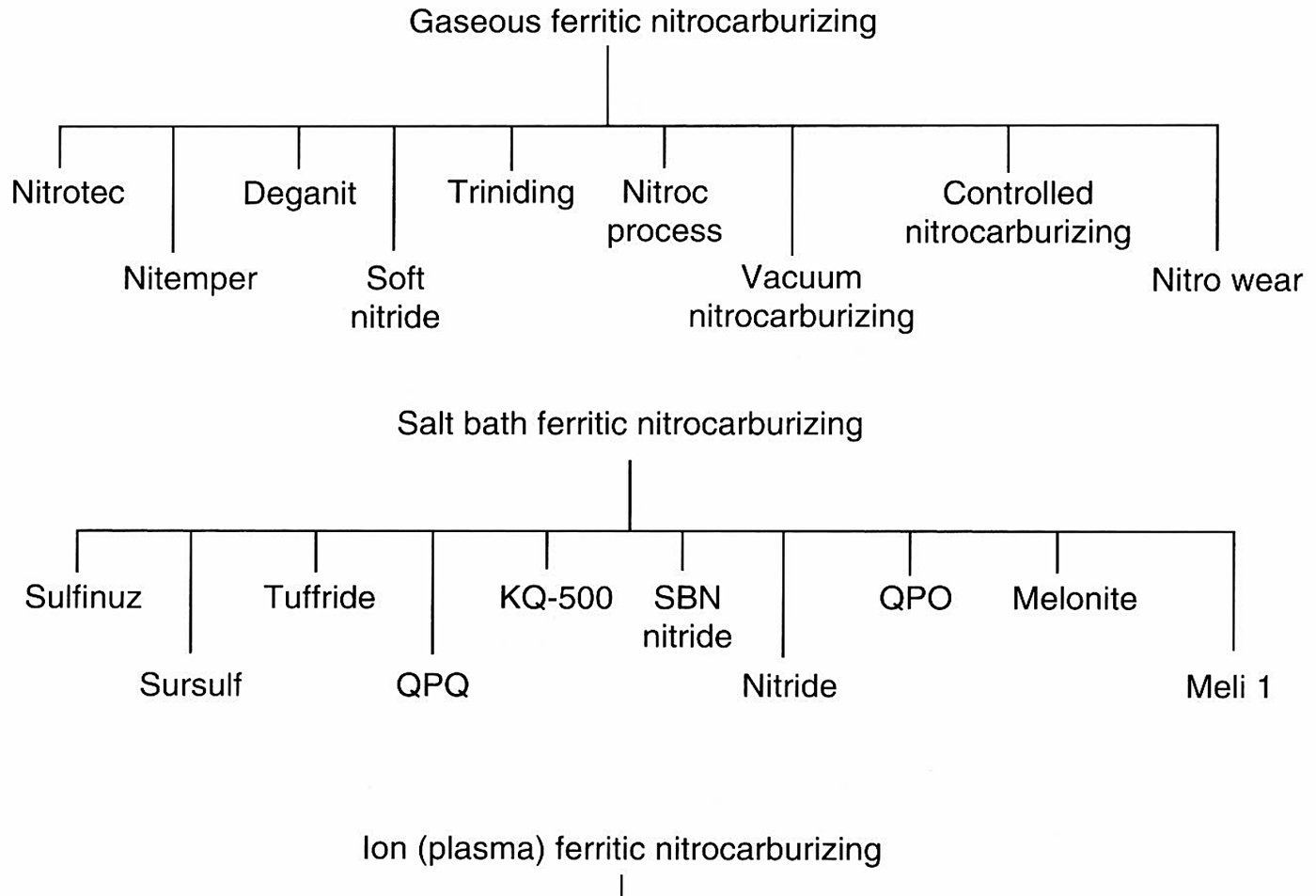
Ferritic nitrocarburizing in particular is sold under a long list of trade names, which makes quotations hard to compare.