

Cr12Mo1V1 (D2 / 1.2379 / SKD11) Tool Steel Supplier from China
Standard D2 Grade | Bulk Supply for Distributors & Stockists
Cr12Mo1V1 steel is a high-carbon, high-chromium ledeburitic cold-work mold steel widely adopted internationally. It is also known by the American AISI/ASTM designation D2, the Japanese JIS designation SKD10 or SKD11, the German DIN designation X153CrMoV12-1 or 1.2379, and the Austrian Bohler designation K110.
Cr12Mo1V1 Tool Steel Supply Overview
| Grade | GB Cr12Mo1V1 / AISI D2 / DIN 1.2379 / JIS SKD11 |
| Delivery Condition | Fully Annealed (Soft Condition for Machining) |
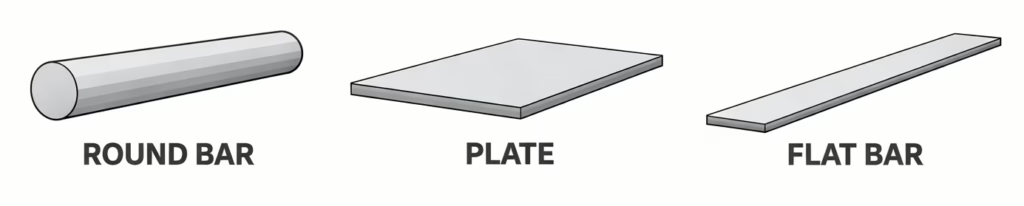
| Available Forms | Round Bar / Flat Bar / Plate / Forged Block |
| Monthly Production Capacity | Approx. 1000 metric tons |
| Recommended Export Quantity | Full 20GP container (~26 tons) |
| MOQ | 5 tons |
| Lead Time (With Ingot Stock) | Approx. 20 days |
| Lead Time (Fresh Melt) | 30–45 days |
| Lead Time (ESR Grade) | Approx. 60 days |
| Inspection | In-house UT team + Third-party inspection available |
| Documentation | MTC (EN 10204 3.1) + UT Report |
Why Global Distributors Source Cr12Mo1V1 from Aobo Steel
- Continuous monthly supply of around 1000 tons
- MOQ from 5 tons for wholesale orders
- Container-optimized bar and plate lengths
- Mixed sizes are supported for export loading
- Annealed delivery for downstream machining
- Stable sourcing through integrated supply chain partners
- UT inspection available to SEP 1921-82 D/d or E/e
- MTC and batch traceability with each shipment
- Heat number tracking for order control
- Black, turned, and polished surface options
- Bulk export packing for sea shipment
- Clear conversion path to the dedicated bulk supply page
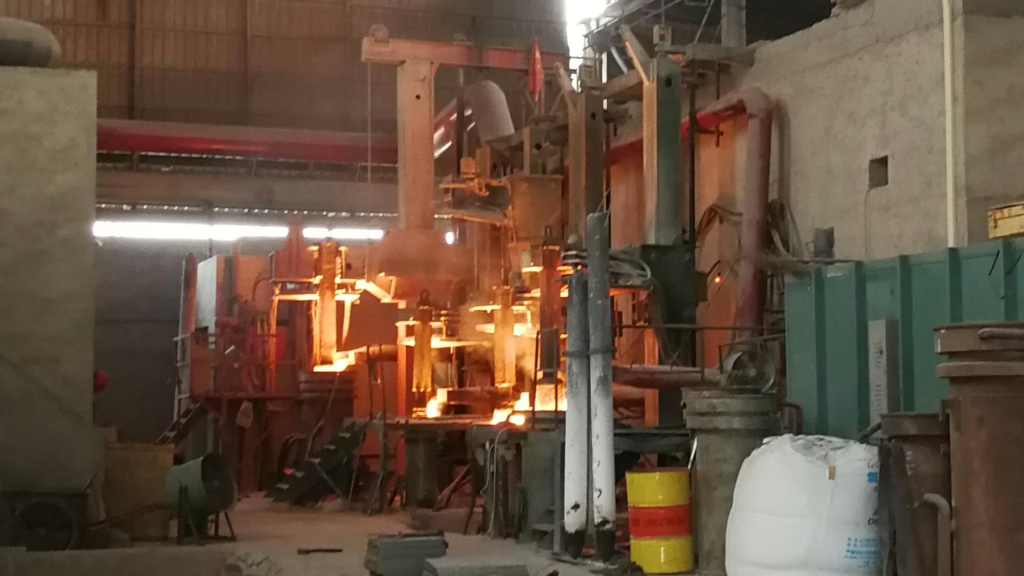
Stable Production for Long-Term Bulk Supply
- Continuous monthly output of around 1000 tons
- Continuous production cycles for inventory replenishment
- ESR (Electro-Slag Remelting) is available upon request
- Stable alloy sourcing to reduce supply interruption risk
- Full batch traceability linked to the original heat number
Available Cr12Mo1V1 Tool Steel Forms
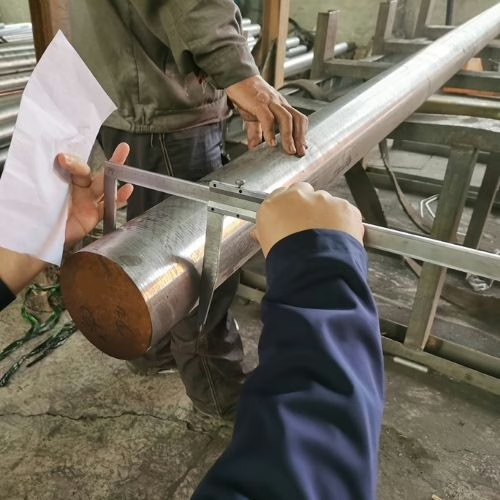
Quality Control for Bulk Orders
Every batch of tool steel supplied by Aobo Steel is verified before shipment to ensure grade accuracy, internal soundness, and traceability for bulk orders.
- Chemical composition verified by a spectrometer
- Ultrasonic testing available (SEP 1921-82)
- Delivered in spheroidized annealed condition
- Mill Test Certificate (EN 10204 3.1) with heat number
- Dimensional and surface inspection before shipment
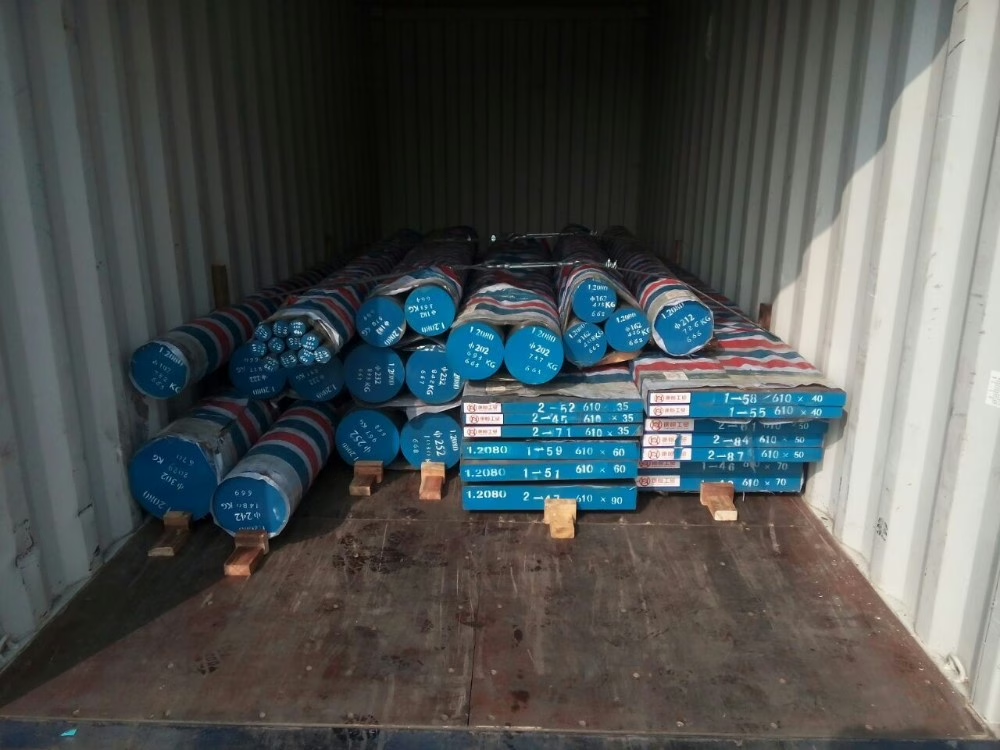
Export Packaging and Container Loading
- Professional seaworthy export packing
- 20GP loading optimized up to ~26 tons
- Mixed grades and mixed sizes supported
- Anti-rust protection for long sea transit
For international shipments, full-container loading is strongly recommended to ensure cost efficiency and smoother customs processing.
Composition(GB / T 1299—2000)
| C | Si | Mn | Cr | Mo | V | P | S | Other |
| 1.40 – 1.60 | ≤0.60 | ≤0.60 | 11.0 – 13.0 | 0.70 – 1.20 | 0.50 – 1.10 | ≤0.030 | ≤0.030 | Co ≤1.00 |
Physical Properties of Cr12Mo1V1 Steel
Critical Point Temperature
| Critical Point | Ac₁ | Acₑₘ | Ar₁ | Arₑₘ | Ms |
| Temperature (Approx. value) /°C | 810 | 875 | 695 | 750 | 190 |
Linear Expansion Coefficient
| Temperature/°C | 20 ~ 100 | 20 ~ 200 | 20 ~ 300 | 20 ~ 400 |
| Linear Expansion Coefficient α /× 10⁻⁶°C⁻¹ | 10.5 | 11.5 | 11.9 | 12.2 |
Other Physical Properties
| Modulus of Elasticity E/MPa | Specific Heat Capacity cₚ/[J/(kg·K)] |
| 207000 | 461 |
Forging Process Specification of Cr12Mo1V1 Steel
| Item | Heating Temperature/°C | Initial Forging Temperature/°C | Final Forging Temperature/°C | Cooling Method |
| Steel Ingot | 1120 ~ 1160 | 1050 ~ 1090 | ≥850 | High-temperature annealing |
| Steel Billet | 1120 ~ 1140 | 1050 ~ 1070 | ≥850 | High-temperature annealing, pit cooling, or sand cooling |
Heat Treatment of Cr12Mo1V1 Steel
Preheating
| Plan | Process Parameters |
| Forging blank, steel ingot annealing process | Heating temperature is 840 ~ 860°C, hold for 2h; furnace cool to 720 ~ 740°C, hold for 4h, furnace cool to below 550°C, then air cool. Annealed hardness is 205-255 HBW. |
| Steel material isothermal annealing process | Heating temperature is 840 ~ 860°C, hold for 2h; furnace cool to 720 ~ 740°C, hold for 4h, furnace cool to below 550°C, then air cool. Annealed hardness is 205 ~ 255 HBW. |
Quenching
| Heating Temperature/°C | Cooling | Hardness HRC | |
| Plan | 1st Preheat | 2nd Preheat | Quench Heating |
| Ⅰ | 500 ~ 600 | 820 ~ 860 | 980 ~ 1040 |
| Ⅱ | 500 ~ 600 | 820 ~ 860 | 1060 ~ 1100 |
Relationship between Quenching Temperature, Hardness, and Retained Austenite Content
| Quenching Temperature/°C | 900 | 950 | 980 | 1000 | 1030 | 1050 | 1080 | 1100 | 1130 |
| Hardness HRC | 52.5 | 57.5 | 60 | 63.5 | 64 | 63 | 62.5 | 62 | 60 |
| Retained Austenite Content (Volume fraction, %) | — | 4 | 4 | 4.5 | 6 | 10 | 13 | 24 | — |
Tempering
| Quenching Plan | Tempering Temperature/°C | Number of Tempering Cycles | Hardness HRC |
| Ⅰ | 180 ~ 230 | 1 | 60 ~ 64 |
| Ⅱ | 510 ~ 540 | 2 | 60 ~ 64 |
The effect of tempering temperature on hardness
| Quenching condition | Tempering Temperature | Untempered (HRC) | 200°C | 250°C | 300°C | 350°C | 400°C | 450°C | 500°C | 550°C | 600°C | 650°C | 700°C |
| 1010℃/air cooled | Harndness(HRC) | 62 | 60.5 | 59.5 | 58.5 | 58 | 58 | 58 | 58 | 56 | 48 | 42 | 36.5 |
| 1010℃/oil quenched | Harndness(HRC) | 62.5 | 61.5 | 60 | 58.5 | 58.5 | 58.5 | 58.5 | 59.5 | 56 | 48 | 42 | 36.5 |
| 1066℃/air cooled | Harndness(HRC) | 63 | 61.5 | 60.5 | 60 | 59.5 | 59.5 | 59.5 | 60.5 | 61.5 | 51 | 43 | 40.5 |
| 1066℃/oil quenched | Harndness(HRC) | 63 | 61.5 | 60 | 59.5 | 59.5 | 59.5 | 60 | 61 | 62.5 | 51 | 44 | 38 |
| 1121℃/air cooled | Harndness(HRC) | 60.5 | 59.5 | 58 | 57.5 | 57 | 57 | 57 | 59.5 | 62 | 51.5 | 44 | 40.5 |
| 1121℃/oil quenched | Harndness(HRC) | 60 | 58 | 58.5 | 56 | 54 | 54.5 | 56.5 | 58 | 61 | 57 | 44 | 38 |
Cr12Mo1V1 Steel Impact Toughness vs. Tempering Temperature
Cr12Mo1V1 Steel Impact Toughness vs. Tempering Temperature
Effect of Tempering Temperature on the Torsional Impact Energy of Cr12Mo1V1 Steel
Effect of Tempering Temperature on the Torsional Impact Energy of Cr12Mo1V1 Steel
Mechanical Properties of Cr12Mo1V1 Steel
Cr12Mo1V1 steel is a high-carbon, high-chromium steel with high hardenability and wear resistance. Due to the higher content of Molybdenum (Mo) and Vanadium (V) elements compared to Cr12MoV steel, the as-cast structure within the steel is improved, the crystal grains are refined, and the carbide morphology is enhanced. Consequently, the steel exhibits superior mechanical properties, including tensile strength, hardness, and impact toughness, along with good wear resistance and higher tempering resistance. A comparison of the mechanical properties between Cr12Mo1V1 steel and Cr12MoV steel is shown in the Table.
Comparison of Mechanical Properties between Cr12Mo1V1 and Cr12MoV Steel
| Quenching Temperature/°C | Steel Grade | Bending Strength (σb)/MPa | Impact Toughness (aK)/J/cm² | Hardness HRC |
| 1020 | Cr12Mo1V1 | 3262 | 40 | 59.3 |
| Cr12MoV | 2888 | 40 | 61.0 | |
| 1060 | Cr12Mo1V1 | 1550 | 35.5 | 61.0 |
| Cr12MoV | 796 | 10 | 61.5 |
Applications
Cr12Mo1V1 steel is primarily used to manufacture various high-precision, long-life cold-work molds, tools, and measuring instruments. Specific applications include:
- Complex-shaped punching dies/cavity dies.
- Silicon steel sheet blanking dies.
- Trimming dies, rolling dies.
- Wire drawing dies.
- Cold extrusion dies.
- Steel plate deep drawing dies.
- Thread rolling dies/plates.
- Cold shearing blades/circular saws.
- Standard tools and gauges.
- Plastic molds require high precision, long life, and wear resistance.
- Used for heavy-duty, high-impact cold working applications.
Equivalent Grades
- USA (ASTM/UNS): D2 / T30402
- Japan (JIS): SKD11
- Germany (DIN): 1.2379 / X155CrVMo12-1