
Surface Hardening of Tool and Die Steels: Flame, Induction, Electron Beam and Laser
Localized surface hardening raises the hardness of the working surface of a tool while the core keeps the toughness it had, and it does it without adding any alloying element to the steel. That is the whole appeal and the whole limitation: because the chemistry does not change, the hardness you can reach is fixed by the carbon and alloy content the grade already has. This page sets out the four processes, the case depth and hardness each one gives, the tool steel grades the source clears for each process, and the flame hardening response of the grades that surround tool steel in a tool room.
Four processes that harden a surface without changing its chemistry
Surface hardening in this sense is a localized heat treatment. The surface is austenitized and quenched, no element is diffused in, and the result is hard martensite over a core of softer structure. The four processes in commercial use are flame, induction, electron beam and laser hardening. Flame and induction are the two that have been around longest and they are the two the source compares directly; electron beam and laser are the two that harden a chosen spot without a quenchant at all.
| Process | Feed to the tool | Depth of hardening | Applicable material | Speed of heating | Processing | Part size | Where it fits |
|---|---|---|---|---|---|---|---|
| Flame | Oxyfuel torch with a special head, plus a quench system | 1.2 to 6.2 mm (0.050 to 0.250 in.) | Ferrous alloys, carbon steels, alloy steels, cast irons | A few seconds to a few minutes per part | One part at a time | No size limit | Low equipment cost, best for large work, significant operator skill required, hot work with eye protection |
| Induction | Power supply, water cooled copper inductor, quench system | 0.4 to 1.5 mm (0.015 to 0.060 in.); 0.1 mm (0.004 in.) for impulse | The same steels as flame hardening | 1 to 10 s | One part at a time | The part must fit inside the coil | High equipment cost, best for small work, very precise control, little skill needed after setup |
Flame hardening and induction hardening compared. Depth, speed, part size and cost are reproduced from the comparison table in the source. Flame hardening reaches deeper, induction is faster and more precise, and the two are used on the same steels.
Two features of the table decide most jobs. Flame hardening reaches 1.2 to 6.2 mm deep and has no limit on part size, which is why it is used on large work such as rolls, guide ways and the edges of big die blocks. Induction hardening reaches 0.4 to 1.5 mm, or 0.1 mm with impulse heating, and the part has to fit inside the coil, which is why it suits production parts of moderate size. Induction is the more precise of the two and takes far less operator skill once the setup is made, but the equipment costs more.
In induction hardening the depth increases as the frequency of the alternating current falls, and the electrical resistivity and magnetic properties of the steel change the heating behaviour, so different steels need different heating parameters. That is a practical point when a part moves from a carbon steel to a tool steel: the same coil and the same frequency are not automatically the same result.
Electron beam and laser: self quenching, no quenchant
Electron beam and laser hardening heat a selected area very fast and let the mass of the workpiece conduct the heat away. The part is its own quench, so there is no oil, water or polymer to manage, the workpiece barely moves, and the surrounding material is left untouched. Because the heating is so rapid, the carbon and alloy content has to be in a form that dissolves in the austenite quickly, and the part has to be thick enough to carry the heat away.
The source gives three conditions for electron beam hardening that are worth checking before a job is quoted. The part thickness must be at least ten times the depth of hardening. Hardened areas must be spaced so that the beam does not temper an area that was hardened earlier. And the surface to be hardened must be in line of sight of the beam, either in a hard vacuum of 10-5 torr or in a shrouded partial vacuum of 10-2 torr.
Laser hardening works on the same principle and reaches case depths of 0.75 to 1.3 mm (0.030 to 0.050 in.) depending on the power, with hardness up to 60 HRC. It does not need a vacuum, it can be shaped into wider hardening profiles than an electron beam, and the beam can be steered by optics into areas that are awkward to reach. Its main disadvantage is optical: the surface often has to be treated first so that it does not reflect the beam away.
Which tool steels these processes are cleared for
The material list is the same for flame, induction and electron beam hardening. The source names plain carbon steels from 1045 to 1080, medium to high carbon alloy steels such as 4140, 4340, 8645 and 52100, pearlitic matrix cast irons, and these tool steels: W1, W2, O1, O2, L2, L6, S1 and S2. All eight are grades whose carbon and alloy content is already high enough to harden from the heat of the beam or the torch with no further addition.
Laser hardening is described as producing hardening depths and material constraints similar to electron beam hardening, but with one difference that matters for the lower alloyed grades: the thin surface zone is heated and cooled so rapidly that it produces a very fine martensitic structure even in steels of relatively low hardenability. That is the process to look at when the grade is right for the tool but marginal for a conventional quench.
How much carbon the surface needs
Because surface hardening does not add carbon, the carbon content of the grade sets the ceiling on the hardness the surface can reach. The source plots this for flame and induction heating followed by a water quench: the attainable minimum surface hardness climbs steeply from about 39 HRC at 0.20% C to roughly 50 HRC at 0.30% C and 60 HRC near 0.45% C, and then flattens, reaching only about 62 HRC at 0.60% C. The practical reading is that a plain carbon or low alloy grade needs on the order of 0.40 to 0.50% C before a 60 HRC surface is realistic, and that below about 0.30% C the process cannot reach 50 HRC no matter how the quench is done.
That rule explains the shape of the table below. Every grade with a realistic hardened surface in the 60 HRC range is either a medium to high carbon steel or a carburized grade whose case has been brought to 0.90 to 1.10% C. The 5% chromium hot work grades and the higher alloy tool steels sit well above that carbon level, which is why a torch or a coil can harden them, and why their hardened depth is decided by the hardenability of the grade rather than by the heating equipment alone.
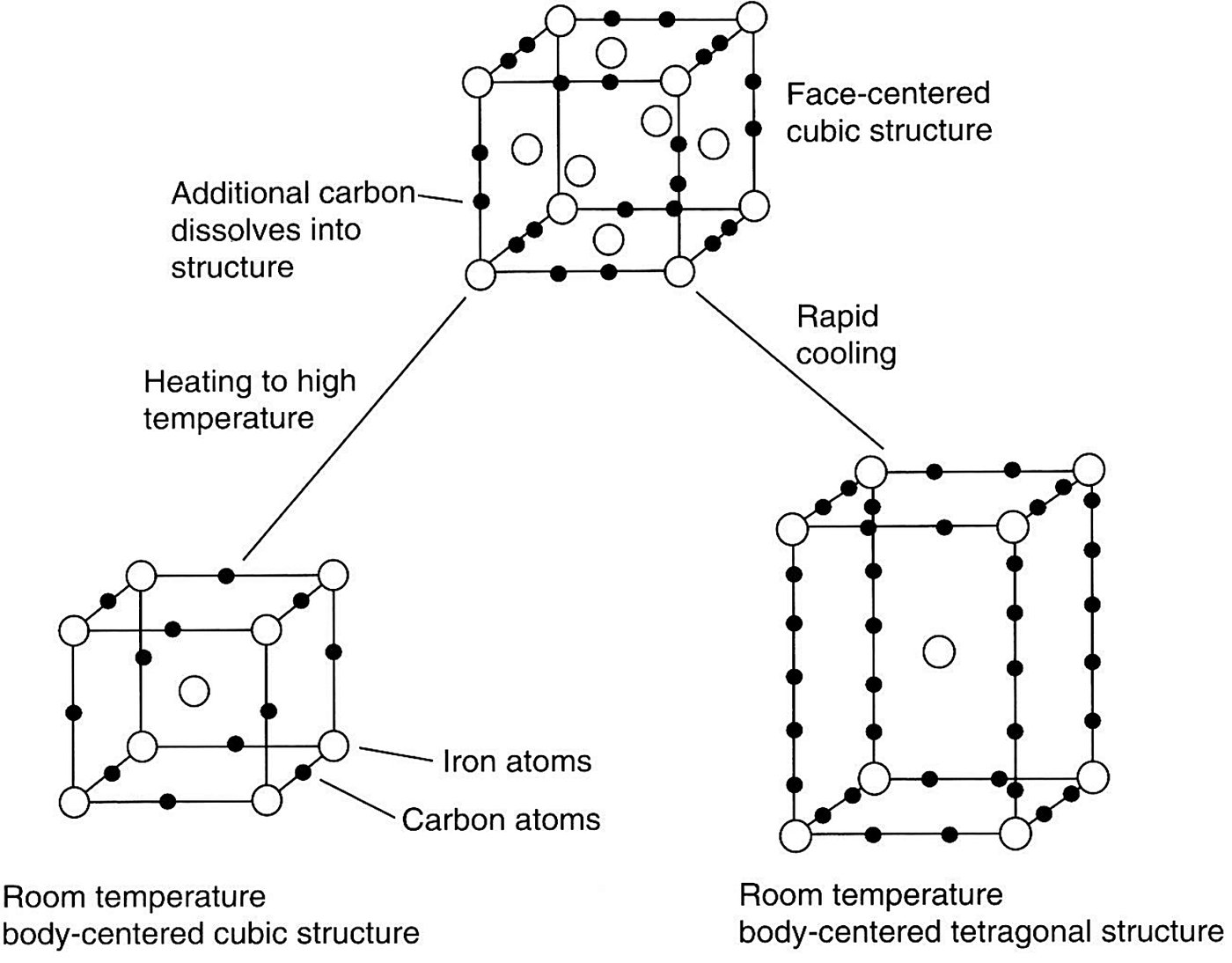
What the carbon does to the lattice is the reason a carburized surface hardens at all.
Typical hardness after flame hardening, by grade and quenchant
The table below is the flame hardening response of the steels and irons the source covers. It is worth reading in two directions. Across a row, the three columns show how much the quenchant adds: for 52100, air and oil both give 55 to 60 HRC and water lifts the surface to 62 to 64 HRC. Down a column, it shows what the carbon content buys, from the 33 to 50 HRC band of a 1025 to 1035 steel quenched in water to the 62 to 65 HRC of a 1080 to 1095 steel in the same quench.
For tool steel work the rows to note are the last four stainless grades and 52100. Type 420 reaches 49 to 56 HRC and type 440 (typical) 55 to 59 HRC in both air and oil, and the source gives no water quench figure for the martensitic stainless grades at all, which is consistent with the footnote that thin sections of these steels are susceptible to cracking when quenched in oil or water. Induction hardening uses the same grade list and the same response as flame hardening, with the shallower depths of the comparison table above.
| Material | Air(a) | Oil(b) | Water(b) |
|---|---|---|---|
| Plain carbon steels | |||
| 1025-1035 | . . . | . . . | 33-50 |
| 1040-1050 | . . . | 52-58 | 55-60 |
| 1055-1075 | 50-60 | 58-62 | 60-63 |
| 1080-1095 | 55-62 | 58-62 | 62-65 |
| 1125-1137 | . . . | . . . | 45-55 |
| 1138-1144 | 45-55 | 52-57(c) | 55-62 |
| 1146-1151 | 50-55 | 55-60 | 58-64 |
| Carburized grades of plain carbon steels(d) | |||
| 1010-1020 | 50-60 | 58-62 | 62-65 |
| 1108-1120 | 50-60 | 60-63 | 62-65 |
| Alloy steels | |||
| 1340-1345 | 45-55 | 52-57(c) | 55-62 |
| 3140-3145 | 50-60 | 55-60 | 60-64 |
| 3350 | 55-60 | 58-62 | 63-65 |
| 4063 | 55-60 | 61-63 | 63-65 |
| 4130-4135 | . . . | 50-55 | 55-60 |
| 4140-4145 | 52-56 | 52-56 | 55-60 |
| 4147-4150 | 58-62 | 58-62 | 62-65 |
| 4337-4340 | 53-57 | 53-57 | 60-63 |
| 4347 | 56-60 | 56-60 | 62-65 |
| 4640 | 52-56 | 52-56 | 60-63 |
| 52100 | 55-60 | 55-60 | 62-64 |
| 6150 | . . . | 52-60 | 55-60 |
| 8630-8640 | 48-53 | 52-57 | 58-62 |
| 8642-8660 | 55-63 | 55-63 | 62-64 |
| Carburized grades of alloy steels(d) | |||
| 3310 | 55-60 | 58-62 | 63-65 |
| 4615-4620 | 58-62 | 62-65 | 64-66 |
| 8615-8620 | . . . | 58-62 | 62-65 |
| Martensitic stainless steels | |||
| 410, 416 | 41-44 | 41-44 | . . . |
| 414, 431 | 42-47 | 42-47 | . . . |
| 420 | 49-56 | 49-56 | . . . |
| 440 (typical) | 55-59 | 55-59 | . . . |
| Cast irons (ASTM classes) | |||
| Class 30 | . . . | 43-48 | 43-48 |
| Class 40 | . . . | 48-52 | 48-52 |
| Class 45010 | . . . | 35-43 | 35-45 |
| 50007, 53004, 60003 | . . . | 52-56 | 55-60 |
| Class 80002 | 52-56 | 56-59 | 56-61 |
| Class 60-45-15 | . . . | . . . | 35-45 |
| Class 80-60-03 | . . . | 52-56 | 55-60 |
Response of steels and cast irons to flame hardening, by quenchant, reproduced from the source table. (a) To obtain the hardness shown, areas not directly heated must be kept relatively cool during heating. (b) Thin sections are susceptible to cracking when quenched with oil or water. (c) Hardness is slightly lower for material heated by spinning or combined progressive-spinning methods than for progressive or stationary heating. (d) Hardness values of carburized cases containing 0.90 to 1.10% C. Induction hardening uses the same steels and the same response.
Where each process belongs on a tool steel order
The choice usually comes down to three questions rather than four. How deep does the hardened zone have to be, because only flame hardening reaches past 2 mm and only induction and the beam processes stay under 1.5 mm. How big is the part, because a die block that will not fit in a coil is a flame hardening job by default. And how much distortion the finished tool can absorb, because all four processes quench the surface and the tempering step that follows is part of the cycle, not an option.
The heat treatment practice that surrounds the process is on the tool steel heat treatment guide, and the quench severity of the media involved is compared on the quenching media cooling rates page. Where the surface is modified with a diffused element instead of heat alone, the choice between carburizing, nitriding and the pack diffusion coatings is on the case hardening process comparison page, and the erosion and abrasion side of surface performance is on the wear design page.
Before you use these values
This page is a reference summary of published practice and it is not an Aobo Steel specification. The case depths, quenchants and hardness ranges are reproduced from the source, and the hardness a particular part reaches depends on the grade, the section, the heating equipment and the tempering cycle that follows. Where a value is shown as a dash in the source table it is reproduced here as a dash rather than filled in from another grade. Final selection is confirmed on the job.
Source: ASM Handbook, Volume 20, Materials Selection and Design, ASM International, 1997. Surface hardening and flame hardening response from the article on the effects of surface treatments on materials performance (Tables 17 and 18, and Fig. 14).