
Hot Work Tool Steel Heat Treatment
Hot work tool steels are the chromium, tungsten and molybdenum grades that hold their hardness while the tool face runs hot, and they are the easiest of the tool steel families to harden and the easiest to ruin by careless heating. Almost all of them harden in still air, none of them is ever water quenched, and every one of them has to be protected from carburization and decarburization through the whole austenitizing range. This page carries the consolidated practice table for the family from the source article, the annealing, preheating, austenitizing and quenching rules that go with it, and the two figures on cooling rate that decide what the structure will be.
Recommended practices for hot work tool steels
The table below is the source summary for the whole family, and it covers the chromium grades H10 to H19, the tungsten grades H20 to H26 and the molybdenum grades H41 to H43, together with the alloy grades 6G, 6F2 to 6F7 and 6H1 to 6H2 that the source groups with them because they are also used for hot work. The normalizing column is short because the group is partly or fully air hardening, and normalizing is not recommended for any of them except 6F7.
| Steel | Normalizing temperature (a), °C (°F) | Annealing | Hardening | |||||||||
|---|---|---|---|---|---|---|---|---|---|---|---|---|
| Temperature (b) | Cooling rate (c) | Annealed hardness, HB | Preheat, °C (°F) | Austenitizing | Holding time, min | Quenching medium | Quenched hardness, HRC | |||||
| °C | °F | °C/h | °F/h | °C | °F | |||||||
| Chromium hot-work tool steels | ||||||||||||
| H10 | Not rec | 845-900 | 1550-1650 | 22 | 40 | 192-229 | 815 (1500) | 1010-1040 | 1850-1900 | 15-40 (d) | A | 56-59 |
| H11 | Not rec | 845-900 | 1550-1650 | 22 | 40 | 192-229 | 815 (1500) | 995-1025 | 1825-1875 | 15-40 (d) | A | 53-55 |
| H12 | Not rec | 845-900 | 1550-1650 | 22 | 40 | 192-229 | 815 (1500) | 995-1025 | 1825-1875 | 15-40 (d) | A | 52-55 |
| H13 | Not rec | 845-900 | 1550-1650 | 22 | 40 | 192-229 | 815 (1500) | 995-1040 | 1825-1900 | 15-40 (d) | A | 49-53 |
| H14 | Not rec | 870-900 | 1600-1650 | 22 | 40 | 207-235 | 815 (1500) | 1010-1065 | 1850-1950 | 15-40 (d) | A | 55-56 |
| H16 | Not rec | 870-900 | 1600-1650 | 22 | 40 | 212-241 | 815 (1500) | 1120-1175 | 2050-2150 | 2-5 | A, O | 55-58 |
| H19 | Not rec | 870-900 | 1600-1650 | 22 | 40 | 207-241 | 815 (1500) | 1095-1205 | 2000-2200 | 2-5 | A, O | 52-55 |
| Tungsten hot-work tool steels | ||||||||||||
| H20 | Not rec | 870-900 | 1600-1650 | 22 | 40 | 207-235 | 815 (1500) | 1095-1205 | 2000-2200 | 2-5 | A, O | 53-55 |
| H21 | Not rec | 870-900 | 1600-1650 | 22 | 40 | 207-235 | 815 (1500) | 1095-1205 | 2000-2200 | 2-5 | A, O | 43-52 |
| H22 | Not rec | 870-900 | 1600-1650 | 22 | 40 | 207-235 | 815 (1500) | 1095-1205 | 2000-2200 | 2-5 | A, O | 48-57 |
| H23 | Not rec | 870-900 | 1600-1650 | 22 | 40 | 212-255 | 815 (1500) | 1205-1260 | 2200-2300 | 2-5 | O | 33-35 (e) |
| H24 | Not rec | 870-900 | 1600-1650 | 22 | 40 | 217-241 | 815 (1500) | 1095-1230 | 2000-2250 | 2-5 | A, O | 44-55 |
| H25 | Not rec | 870-900 | 1600-1650 | 22 | 40 | 207-235 | 815 (1500) | 1150-1260 | 2100-2300 | 2-5 | A, O | 46-53 |
| H26 | Not rec | 870-900 | 1600-1650 | 22 | 40 | 217-241 | 870 (1600) | 1175-1260 | 2150-2300 | 2-5 | A, O, S | 63-64 |
| Molybdenum hot-work tool steels | ||||||||||||
| H41 | Not rec | 815-870 | 1500-1600 | 22 (f) | 40 (f) | 207-235 | 730-845 (1350-1550) | 1095-1190 | 2000-2175 | 2-5 | A, O, S | 64-66 |
| H42 | Not rec | 845-900 | 1550-1650 | 22 | 40 | 207-235 | 730-845 (1350-1550) | 1120-1220 | 2050-2225 | 2-5 | A, O, S | 54-62 |
| H43 | Not rec | 815-870 | 1500-1600 | 22 (g) | 40 (g) | 207-235 | 730-845 (1350-1550) | 1095-1190 | 2000-2175 | 2-5 | A, O, S | 54-58 |
| Other alloy tool steels | ||||||||||||
| 6G | Not rec | 790-815 | 1450-1500 | 22 (h) | 40 (h) | 197-229 | Not req | 845-855 | 1550-1575 | . . . | O (i) | 63 min (j) |
| 6F2 | Not rec | 780-795 | 1440-1460 | 22 (k) | 40 (h) | 223-235 | Not req | 845-870 | 1550-1600 | . . . | O (i) | 63 min (j) |
| 6F3 | Not rec | 760-775 | 1400-1425 | 22 (l) | 40 (h) | 235-248 | Not req | 900-925 | 1650-1700 | . . . | A (m) | 63 min (j) |
| 6F4 | Not rec | 705 | 1300 | (n) | (n) | 262-285 | 815 (1500) | 1010-1020 | 1850-1870 | . . . | O, A | 38-41 (e) |
| 6F5 | Not rec | 845 | 1550 | (o) | (o) | 262-285 | Not req | 870 | 1600 | . . . | O, A | 58-59 |
| 6F6 | Not rec | 845 (pack) | 1550 (peak) | (p) | (p) | 196 | 650-705 (1200-1300) (q) | 925-955 (q) | 1700-1750 (q) | . . . | O (r) | (s) |
| 6F7 | 845-870 (1550-1600) | 670 | 1240 | 22 | 40 | 260-300 | 730 (1350) | 915 | 1675 | . . . | A | 54-55 |
| 6H1 | Not rec | 845 | 1550 | 22 (t) | 40 (t) | 202-235 | 760-790 (1400-1450) | 900-940 | 1650-1725 | . . . | A | 48-49 |
| 6H2 | Not rec | 815-845 | 1500-1550 | 22 | 40 | 202-235 | 705-760 (1300-1400) | 980-1065 | 1800-1950 | . . . | O, A | 52-55 |
Source, Table 9 of Heat Treating of Specific Classes of Tool Steels. A, air; O, oil; S, salt; Not rec, not recommended; Not req, not required. (a) Holding time, after uniform through heating, varies from about 15 min for small sections to about 1 h for large sections, and the work is cooled from temperature in still air. (b) Use the lower limit for small sections and the upper limit for large sections, holding about 1 h for light sections and small charges to about 4 h for heavy sections and large charges, or 1 h per inch of pack cross section for pack annealing. (c) Maximum rate, to 425 °C (800 °F) unless a footnote says otherwise. (d) For open furnace heat treatment, or ½ h per inch of pack cross section for pack hardening. (e) Temper to precipitation harden. (f) To 540 °C (1000 °F). (g) To 480 °C (900 °F). (h) To 370 °C (700 °F). (i) To 205 to 175 °C (400 to 350 °F), then air cool. (j) Temper immediately. (k) For isothermal annealing, furnace cool to 650 °C (1200 °F), hold for 4 h, furnace cool to 425 °C (800 °F), then air cool. (l) For isothermal annealing, furnace cool to 670 °C (1240 °F), hold for 4 h, furnace cool to 425 °C (800 °F), then air cool. (m) and (p) Cool with a forced-air blast to 205 to 175 °C (400 to 350 °F), then cool in still air. (n) Air cool from the annealing temperature. (o) Furnace cool at 22 °C (40 °F) per hour maximum to 425 °C (800 °F), reheat to 595 ± 14 °C (1100 ± 25 °F), furnace cool to 425 °C (800 °F), then air cool. (p) Furnace cool at 17 °C (30 °F) per hour to 540 °C (1000 °F), reheat to 790 °C (1450 °F), furnace cool at 11 °C (20 °F) per hour to 540 °C (1000 °F), then air cool. (q) Heat in pack or in a controlled atmosphere. (r) To 50 °C (125 °F). (s) Pack heating 59 to 60 HRC, atmosphere heating 54 to 55 HRC. (t) For isothermal annealing, hold at 845 °C (1550 °F) for 2 h, furnace cool to 745 °C (1375 °F), hold for 4 to 6 h, then air cool. The source prints the 6F6 annealing temperature as 1550 (peak); it is reproduced here exactly as printed.
Annealing practice
Heating for annealing has to be slow and uniform, and it matters most when a hardened tool is being annealed for reworking, because a hard tool that is pushed into a hot furnace can crack. In practice the cooling rate is set by the furnace rather than by the operator, since a large load cools more slowly than a light one. Furnace cooling to 425 °C (800 °F) at no more than 22 °C (40 °F) per hour and then air cooling is enough for most of these steels. Types 6F2, 6F3 and 6H1 can be isothermally annealed as an alternative, which pays off on small tools that fit a salt or lead bath or on small batch furnace loads, and offers no advantage at all on a large die block.
Small parts are usually pack annealed to keep the scale and the decarburization down, and large die blocks are usually annealed in a controlled atmosphere. The packing material should be spent cast iron chips or spent pitch coke and petroleum coke that has been heated to 1205 °C (2200 °F) in a semiclosed container to drive off gas and moisture. Lime, sand and mica are sometimes used, but a hard steel packed in those materials with a little charcoal can decarburize instead of being protected. The packing has to be dry, free of anything oxidizing, and it has to separate every metal surface and fill the container. The hold is 1 hour per inch of container thickness. The H steels need a neutral packing material in particular, because they are extremely susceptible to both carburization and decarburization.
Stress relieving, preheating and austenitizing
Stress relieving after rough machining and before final machining is worth doing on any tool with a major change of section or a deep cavity. Heat to 650 to 730 °C (1200 to 1350 °F). There is a more accurate alternative for a tool whose final hardness stays inside the machinable range, which is to harden and temper after rough machining and then finish machine.
Preheating before austenitizing is recommended for every hot work steel except 6G, 6F2, 6F3 and 6F5, which may or may not need it depending on size and shape. A die block for open furnace treatment goes into a furnace that is no hotter than 260 °C (500 °F), while work packed in a container can go into a furnace at 370 to 540 °C (700 to 1000 °F). Once the work is at furnace temperature it is heated at 65 to 110 °C (150 to 200 °F) per hour to the preheat temperature and held for 1 hour per inch of thickness. Thermocouples belong next to the work inside the container. Above 650 °C (1200 °F) a controlled atmosphere or another protective medium is required.
Austenitizing from the preheat should be a rapid push rather than a slow climb for H16 to H43 and for 6F4. Time at the austenitizing temperature only needs to be long enough to heat the work right through, except for H10 to H14 where the table gives a range of 15 to 40 minutes. Prolonged soaking is not recommended. The protective medium matters most here, because a carburized surface on a die casting die is highly susceptible to heat checking, and a decarburized surface is worse in a quieter way. The decarburized skin reads soft, so the tool gets tempered at too low a temperature to bring that skin into range, and then it runs with an over-hard core and breaks at the first application of load. An endothermic atmosphere from a generator is the usual answer, with the dew point held at 2 to 7 °C (35 to 45 °F), and 3 to 4 °C (38 to 40 °F) is about right for H11 or H13 austenitized at 1010 °C (1850 °F).
Quenching
Hot work steels run from high to extremely high in hardenability, and most of them reach full hardness in still air. A die block can still be thick enough that air will not do it, and then an air blast or an oil quench is needed. Hot work steel is never water quenched. An air blast has to be dry and it has to hit the surface to be hardened evenly, and a die that is air cooling must not sit on a concrete floor or anywhere water vapour can reach it.
The tungsten and molybdenum types scale heavily while they cool to room temperature in air. An interrupted quench cuts that scaling by removing the long hold in air at temperature, at the price of more distortion. The usual form is a salt quench at 595 to 650 °C (1100 to 1200 °F), holding in the salt until the work reaches bath temperature, then out into air. Steel H23 needs a different interrupted quench because ferrite precipitates in it rapidly at 595 °C (1100 °F) and its Ms is below room temperature, so H23 is quenched in molten salt at 165 to 190 °C (325 to 375 °F) and then air cooled; it does not harden on quenching at all and reaches its hardness by secondary hardening in the temper. Oil quenched work is fully immersed, held until it reaches bath temperature and then transferred straight to the tempering furnace, with the oil between 55 and 150 °C (130 and 300 °F) and always below its flash point.
What the cooling rate does to the structure
Tempering follows immediately after the quench, and the sensitivity to cracking during that interval varies a lot across the family. An air quenched 6F4 can stand several hours at room temperature, while 6G, 6F2 and 6F3 can crack if they are cooled much below 175 °C (350 °F) before the temper. Tempering is normally done in a forced-convection air furnace, and salt baths work for small parts but can shock a large complex one hard enough to crack it.
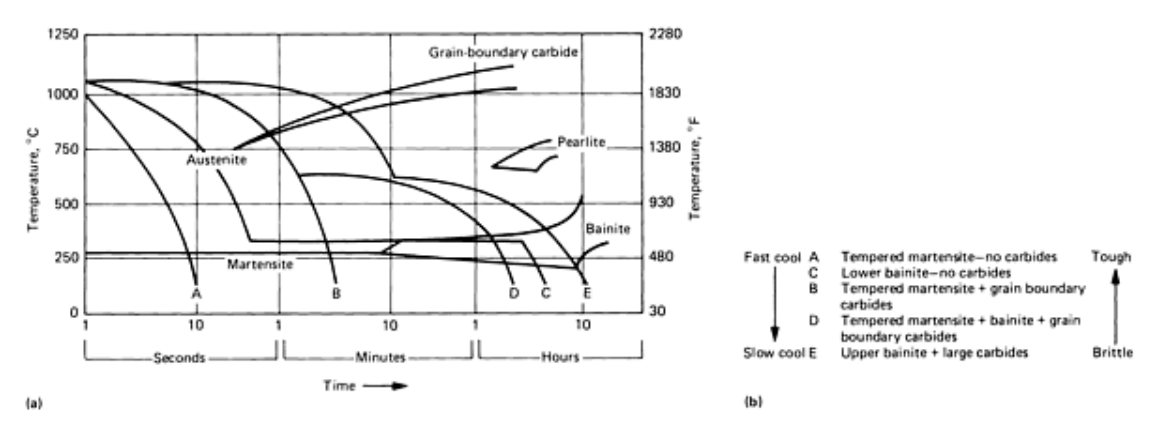
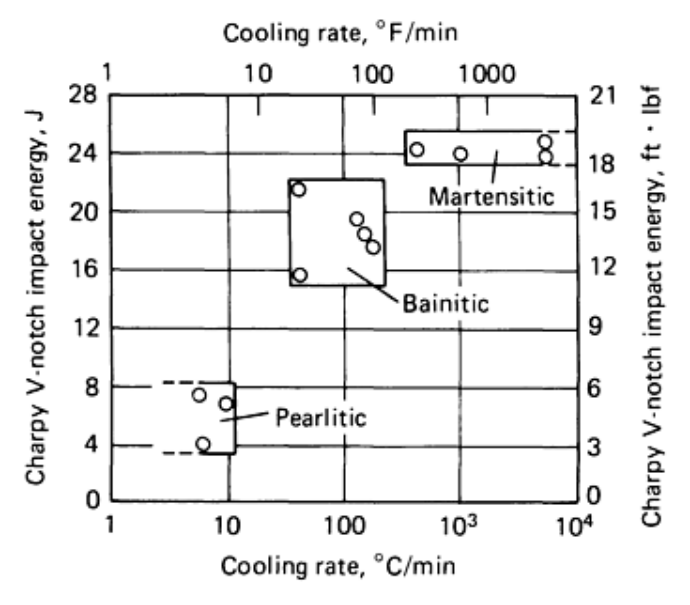
On H13 the cooling rate between the quench and the temper is what decides the structure, and the two figures below show why. Too slow a cool lets pearlite form, and the drop in toughness is out of proportion to the drop in hardness that goes with it. Fig. 1 pairs the continuous cooling diagram for H13 austenitized at 1075 °C (1970 °F) with the toughness that follows from each microstructure, and Fig. 2 plots impact energy against cooling rate and shows the three toughness bands the source measured over twelve treatments.
A worked example, the H13 die block
The source gives a full pack hardening procedure for an H13 die block that shows how the rules above turn into steps. An eyebolt goes into the block for handling, the block is packed in spent pitch coke and the cover is sealed with asbestos paste, with the packing worked into any opening more than 75 to 100 mm (3 to 4 in.) deep. The container goes cold into the furnace and is heated to the preheat temperature and held for 4 h, then taken up to the austenitizing temperature for 6 h. The block is taken out by the eyebolt and cooled in air to 40 °C (100 °F), then tempered twice, with an air cool to room temperature between the tempers, and the hardness checked after the final air cool. That sequence gives the 46 to 49 HRC the source quotes for the block.
What to check before release
The table is the practice of the source, not a released cycle, and hot work steels punish two mistakes more than any others. The first is a soak that runs long at the austenitizing temperature, which grows the grain and costs toughness that the temper cannot put back. The second is an unprotected surface, which either carburizes and heat checks or decarburizes and misleads the hardness reading. Hold the dew point, keep the soak to the time it takes to heat through, and temper straight out of the quench.
Source: ASM Handbook, Volume 4, Heat Treating, ASM International, 1991.