
A Batch of Cr12MoV Milled Plates Heads to Peru
Last week, we received an order for Cr12MoV milled plates from a customer in Peru. Coincidentally, we had the material in stock, and within less than a week, we arranged the shipment, and it was on its way.
We take South America seriously, and Peru in particular is one we’ve been actively working to grow. On-the-ground conditions make it a natural fit. Import duties on tool steel under HS codes 72284000 and 72283000 are currently zero, and under the China-Peru Free Trade Agreement, we can issue a Form R certificate of origin for shipments like this one, which helps our customers clear customs smoothly and keep landed costs down.
The video below shows that shipment being lifted and loaded, with Cr12MoV milled plates heading to Peru. It’s a quick turnaround story, but it also shows why Cr12MoV remains a steady seller in this market, and what buyers should know about the grade.
What Cr12MoV Is
Cr12MoV is a high-chromium cold-work tool steel defined by the Chinese GB/T 1299 national standard. It belongs to the same broad family as AISI D2, JIS SKD11, and DIN 1.2379, and in practice we position it as a cost-effective substitute for D2. The chemistries aren’t identical, D2 typically runs a bit higher in molybdenum and vanadium, but the overall performance profile is close enough that Cr12MoV covers the large majority of applications where D2 would traditionally be specified, at a meaningfully lower cost.
The standard reference chemistry is shown below.
| Element | Carbon (C) | Chromium (Cr) | Molybdenum (Mo) | Vanadium (V) |
|---|---|---|---|---|
| Weight % | 1.45–1.70% | 11.00–12.50% | 0.40–0.60% | 0.15–0.30% |
These figures represent standard reference ranges. The Mill Test Certificate, or Aobo Steel’s direct confirmation, is the authoritative source for quality assurance.
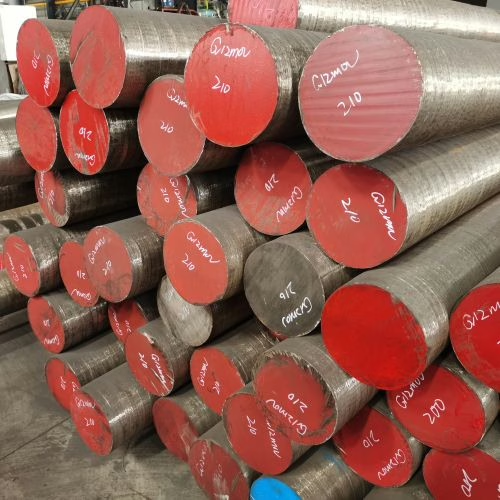
Core Performance Strengths
Cr12MoV owes its wear resistance to a dense chromium carbide network throughout its microstructure, which withstands severe abrasive loading. The molybdenum and vanadium additions give the steel good hardenability for its alloy class, capable of developing a solid hardness profile in medium- to large-cross-section dies, though buyers working with very heavy sections should still confirm hardenability against their specific geometry, since Cr12MoV’s Mo and V content runs lower than D2. It also holds its shape well after heat treatment, with minimal volume change during quenching and tempering, which matters for complex tool geometries that need to stay dimensionally accurate.
Cr12MoV sits in the middle of a well-defined performance gradient within the Cr12 family. Cr12 itself carries the highest carbon content, between 2.00 and 2.30 percent, but without molybdenum or vanadium, it suffers from carbide segregation and comes out brittle with limited toughness. Cr12MoV lowers carbon to 1.45 to 1.70 percent and adds Mo and V, which refine the carbide structure and significantly improve toughness and hardenability while keeping wear resistance intact. For readers doing deeper grade comparisons, Cr12Mo1V1 sits a step above Cr12MoV in this same family, with higher Mo and V content and a chemistry that tracks even closer to D2, though it’s a less commonly stocked grade for standard tooling work.
Typical Applications
Cr12MoV is widely used for cold stamping dies, cold heading dies, drawing dies, blanking dies, and shearing blades. For shipments like the recent Peru order, this makes it a strong fit for the region’s metalworking sector. Stamping plants across Latin America often run high-cycle operations on heavy-duty sheet metals, sometimes with heat-treating infrastructure that varies from shop to shop. Cr12MoV’s toughness and quench stability help these tools resist premature cracking and edge chipping, resulting in more reliable production runs for the buyer.
The Value of Milled Plate
Black surface, or hot-rolled raw plate, retains the rough, oxidized, decarburized scale left by the mill. Milled plate has been precision face-milled to strip that layer away entirely, exposing clean, sound tool steel underneath.
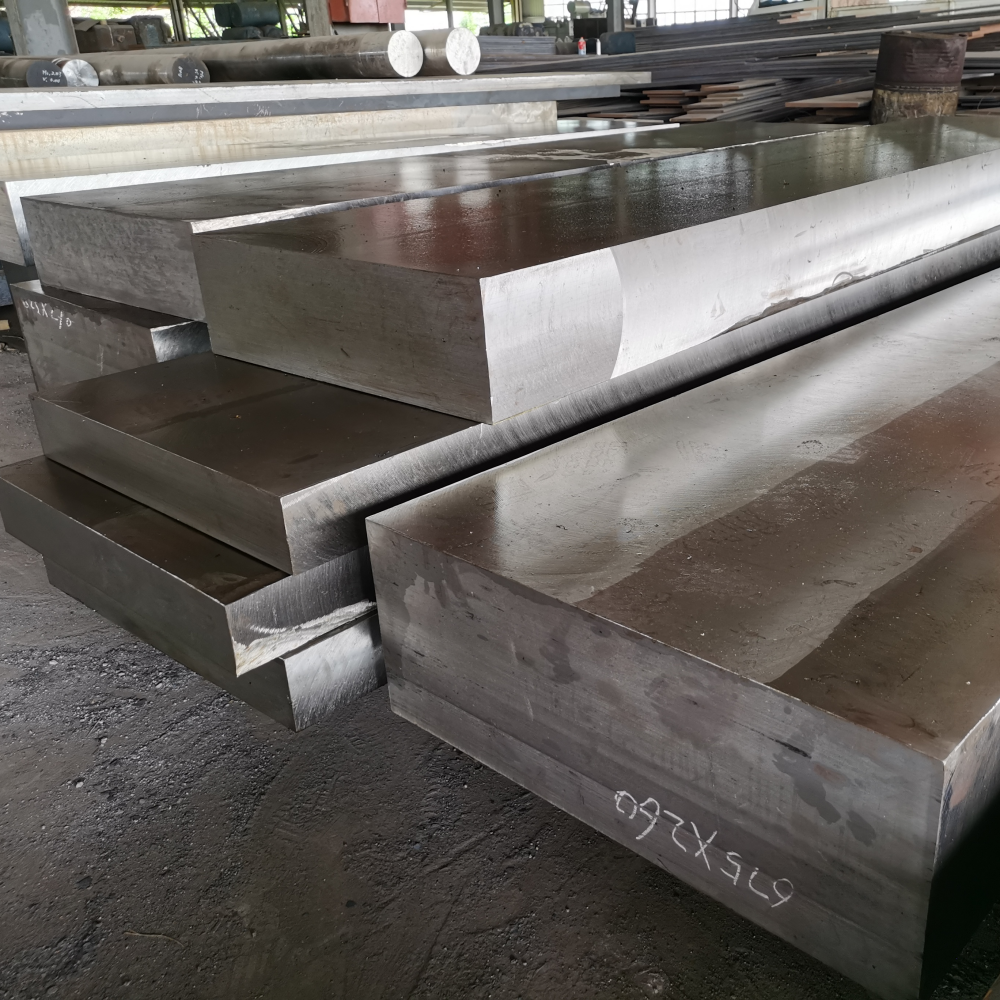
Buyers who choose milled plate get material that is flat, planar, and parallel from the start. That cuts down raw material waste, shortens setup time on magnetic chucks, and lets the machinist skip roughing and move straight to finish machining. Aobo Steel supplies milled plate to a thickness tolerance of 0/+1mm, tight enough to leave just enough stock for a final grind to precision size without paying for excess weight that never gets used.
Heat Treatment Guidance
Standard quenching for Cr12MoV is carried out at 950°C to 1000°C in oil, followed by tempering. GB/T 1299 sets a minimum post-treatment hardness of 58 HRC, and in practice this route commonly achieves 58 to 61 HRC, covering most stamping, blanking, and shearing die applications.
A high-temperature quench followed by multiple tempering cycles in the 510°C to 520°C range, the secondary-hardening route typically associated with higher-alloy grades like D2, can also be applied to Cr12MoV, but the hardness gain from secondary carbide precipitation will be less pronounced given its lower Mo and V content. Buyers targeting hardness above 61 HRC or planning to use this route should confirm feasibility with their heat treater or with Aobo Steel before committing to a die design around it.
As always, adjust actual parameters for the specific die geometry, section thickness, design complexity, and the mechanical stresses the tool will face in service.
Why Aobo Steel
Cr12 and Cr12MoV are among our most established products, backed by more than 20 years in the domestic Chinese market alongside our growing export business. Every batch ships with a Mill Test Certificate covering chemical composition, hardness, and UT test results, and for markets like Peru, we’re able to provide FTA certificates of origin that support duty-free import under current trade terms.