

Aobo Steel | Global Tool Steel Supplier in China
AISI O1 Tool Steel | 1.2510 | SKS3
Oil-Hardening Cold Work Steel for Bulk Supply
- 100% UT Tested Quality Assurance
- SEP 1921-82 Class D/d Guaranteed
- Annealed State Delivery
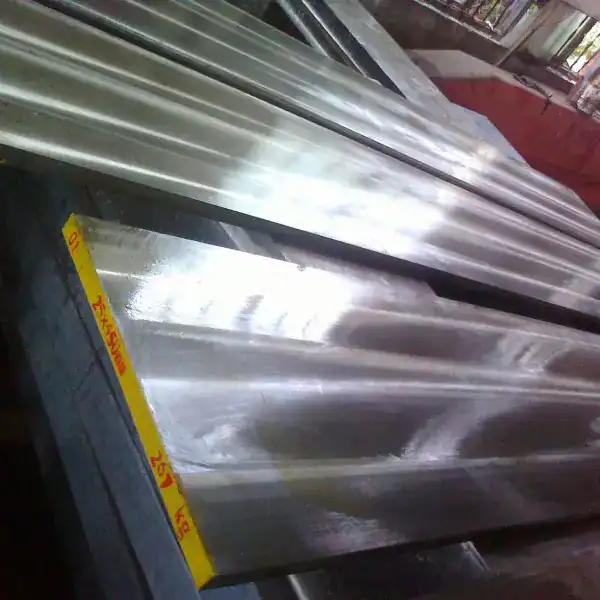
- Surface: Black Scale, Turned, Mill Finish, or Polished
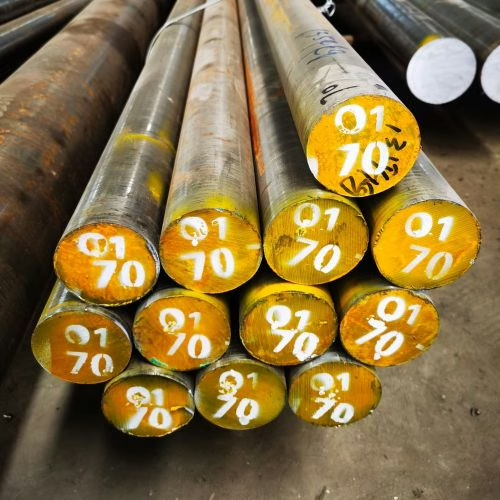
O1 tool steel is a low-alloy cold-worked tool steel. It has a certain degree of hardenability and wear resistance, with minimal quenching deformation. The carbide distribution is uniform, and the particles are fine. Manufacturers typically use tool steel O1 to produce cold-punching dies with small cross-sections, complex shapes, and various gauges, as well as measuring tools. The equivalent grades of O1 are DIN 1.2510 (Germany), JIS SKS3 (Japan), and GB 9CrWMn (China).
Supply Overview
| Grade | AISI O1 / DIN 1.2510 / JIS SKS3 |
| Delivery Condition | Fully Annealed (Soft Condition for Machining) |
| Available Forms | Round Bar / Flat Bar / Plate / Forged Block |
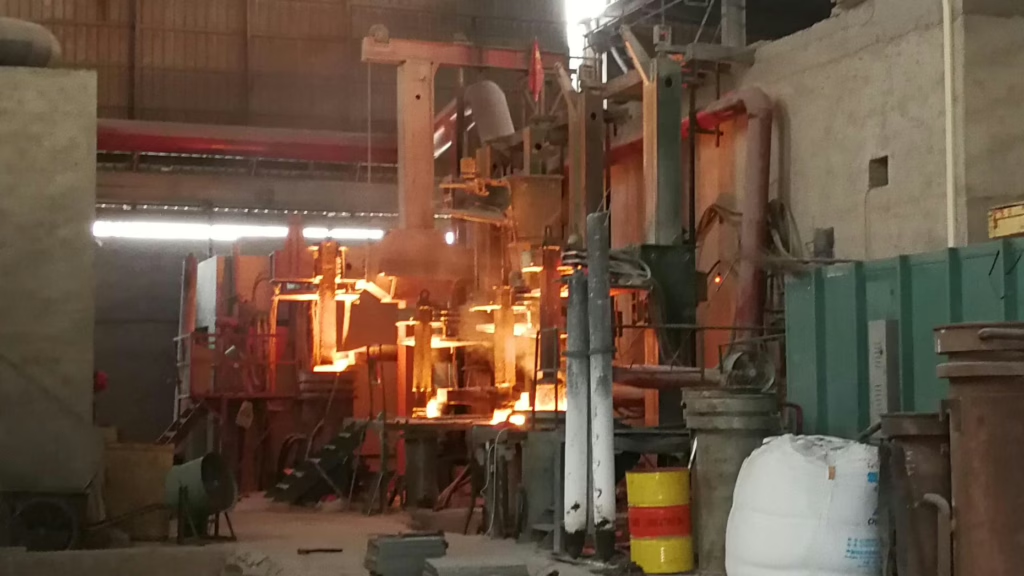
| Monthly Supply Capacity | Stable bulk supply via integrated partner mills (container-level export) |
| Recommended Export Quantity | Full 20GP container (~26 tons) |
| MOQ | 5 tons |
| Lead Time (With Stock) | Approx. 15–25 days |
| Lead Time (Fresh Melt) | 30–45 days |
| Lead Time (Special Route / Higher Cleanliness) | Approx. 45–60 days (upon request) |
| Inspection | In-house UT + Third-party inspection available |
| Documentation | MTC (EN 10204 3.1) + UT Report (if UT is required) |
Production Stability
- Stable bulk supply for distributor replenishment (MOQ 5 tons)
- Annealed-state delivery for reliable machining and scheduling
- Flexible production routing for different section sizes
- Stable alloy sourcing to reduce supply interruption risk
- Full batch traceability linked to the original heat number
Packaging and Shipping
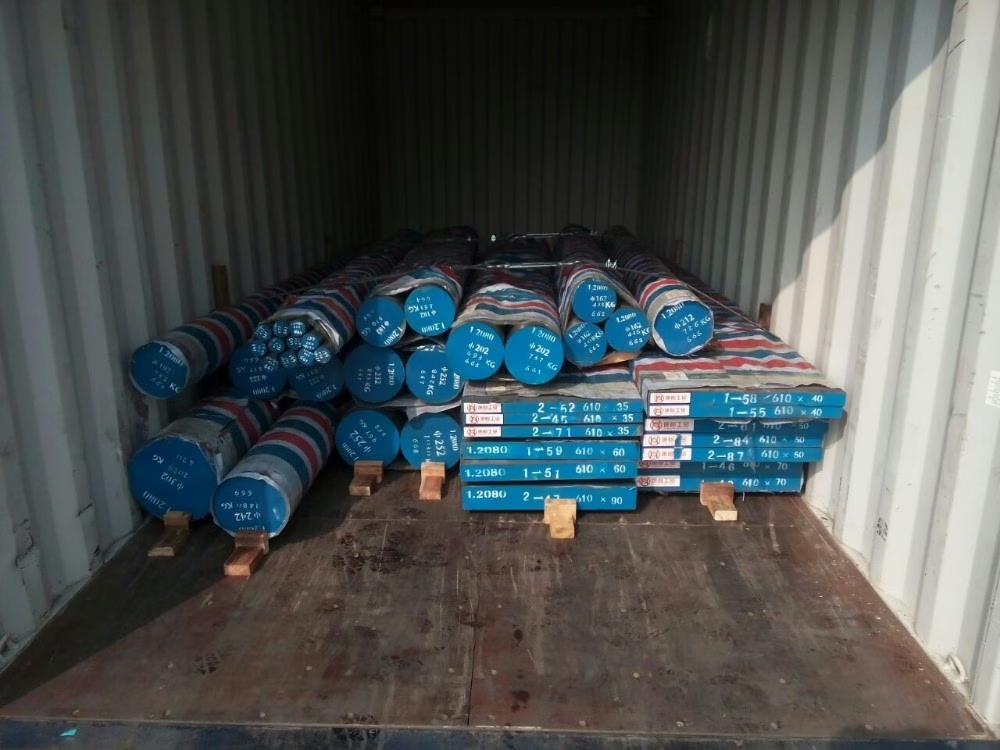
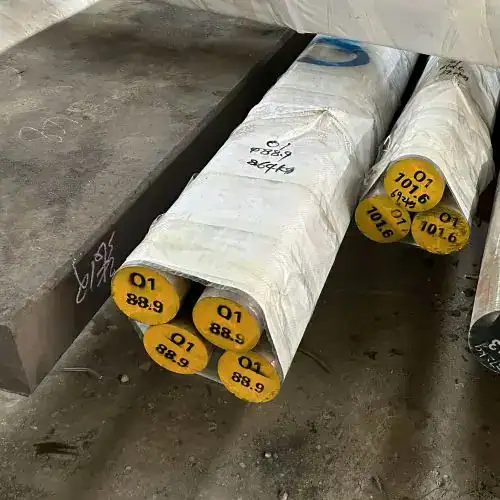
- Seaworthy export packing for long sea transit
- 20GP loading optimized up to ~26 tons
- Mixed sizes supported for stocking orders
- Anti-rust protection available upon request
For international orders, full container loading is recommended for better freight efficiency and smoother customs clearance.
AISI A2 Tool Steel | 1.2363 | SKD12 Gallery
Applications
- Dies & Punches: Blanking dies, Coining dies, Drawing dies, Forming dies, General Stamping (punches & dies for short/moderate runs), Thread-rolling dies, Cold-trimming dies
- Cutting & Machining Tools: General shop tool bits (economical choice), Shear blades (especially smaller ones), Taps, Reamers, Hobs, Slitting saws, Circular cutters, Drills
- Molds & Precision Parts: Plastic mold components (inserted cavities, master hubs), Gauges, Master tools
- General Tooling & Wear Parts: Cams, Bushings, Guides, Plain sliding bearings, Cam followers, Burnishing tools, Knurling tools, Feed rolls, Roll forming tooling (moderate runs)
O1 Steel and Its Equivalent Grades’ Composition
| C | Mn | Si | Cr | W | V | Ni | Mo | P | S |
| 0.85 – 1.00% | 1.00 – 1.40% | Max 0.50% | 0.40 – 0.60% | 0.40 – 0.60% | Max 0.30% | Max 0.30% | Max 0.30% | Max 0.03% | Max 0.03% |
The O1 tool steel equivalent grades’ composition
| Grade | Standard | C (%) | Si (%) | Mn (%) | Cr (%) | W (%) | V (%) |
| 1.2510 | DIN | 0.90-1.05 | 0.15-0.35 | 1.00-1.20 | 0.50-0.70 | 0.50-0.70 | 0.05-0.15 |
| SKS3 | JIS | 0.90-1.00 | ≤0.35 | 0.90-1.20 | 0.50-1.00 | 0.50-1.00 | – |
| 9CrWMn | GB | 0.85-0.95 | ≤0.40 | 0.90-1.20 | 0.50-0.80 | 0.50-0.80 | – |
All O1 materials are produced in strict accordance with the specified chemical composition requirements of AISI O1, DIN 1.2510, and JIS SKS3 standards.
Properties
- Strength (Tensile and Yield): Tool steel O1 exhibits a tensile strength of 846 MPa and a 0.2% Offset Yield Strength of 829 MPa, with a general yield strength of 758 MPa. For a specific O1 composition, tensile strength can reach 1725 MPa (250 ksi) when tempered at 800°F (425°C), decreasing with higher tempering temperatures.
- Ductility and Toughness: O1 steel exhibits noticeable necking before fracture, with a substantial area reduction at fracture of nearly 20%. Its fracture surface typically displays a cup–cone mode. While generally medium-tough, it shows superior impact strength compared to other O-type steels within the common working hardness range of 57 to 64 HRC. Ductility usually increases with increasing tempering temperature.
- Modulus of Elasticity: 211 GPa.
- Dimensional Stability: Good dimensional stability during heat treatment. When oil-quenched from the correct hardening temperature, it typically expands by about 0.0015 inches per inch (0.0015 mm/mm). However, factors like part geometry and distortion (bending, bowing, or twisting) can influence the final dimensional changes.
- Machinability: Very good machinability. If the machinability of steel with 1% carbon content is set at 100, the machinability of O1 steel is 90.
O1 Heat Treatment Overview
O1 is an oil-hardening cold work tool steel supplied in the fully annealed condition. Proper heat treatment is required to achieve its typical working hardness and dimensional stability.
Typical Heat Treatment Parameters (Reference)
| Process Step | Typical Temperature | Notes |
|---|---|---|
| Preheating | 600–650°C (1110–1200°F) | Equalize temperature, reduce thermal shock |
| Austenitizing | 800–820°C (1470–1500°F) | Soak ~5 min per inch (25 mm) section |
| Quenching | Oil | Quench to 50–65°C (120–150°F) before tempering |
| Tempering | 150–200°C (300–390°F) | 2 hours per inch (25 mm) section |
Typical Achievable Hardness
- As-quenched: 62–64 HRC
- After tempering: 57–62 HRC
Hardness will vary depending on section size and tempering temperature.
O1 is less distortion-sensitive than water-hardening grades but requires controlled oil quenching to minimize the risk of cracking. Double tempering may be recommended for improved dimensional stability in precision tooling applications.