
Aobo Steel · Tool Steel Supplier · Huangshi, China
1.2379 ESR Mill Rolls
DIN 1.2379 / X153CrMoV12 · AISI D2 · JIS SKD11 · electro-slag remelted
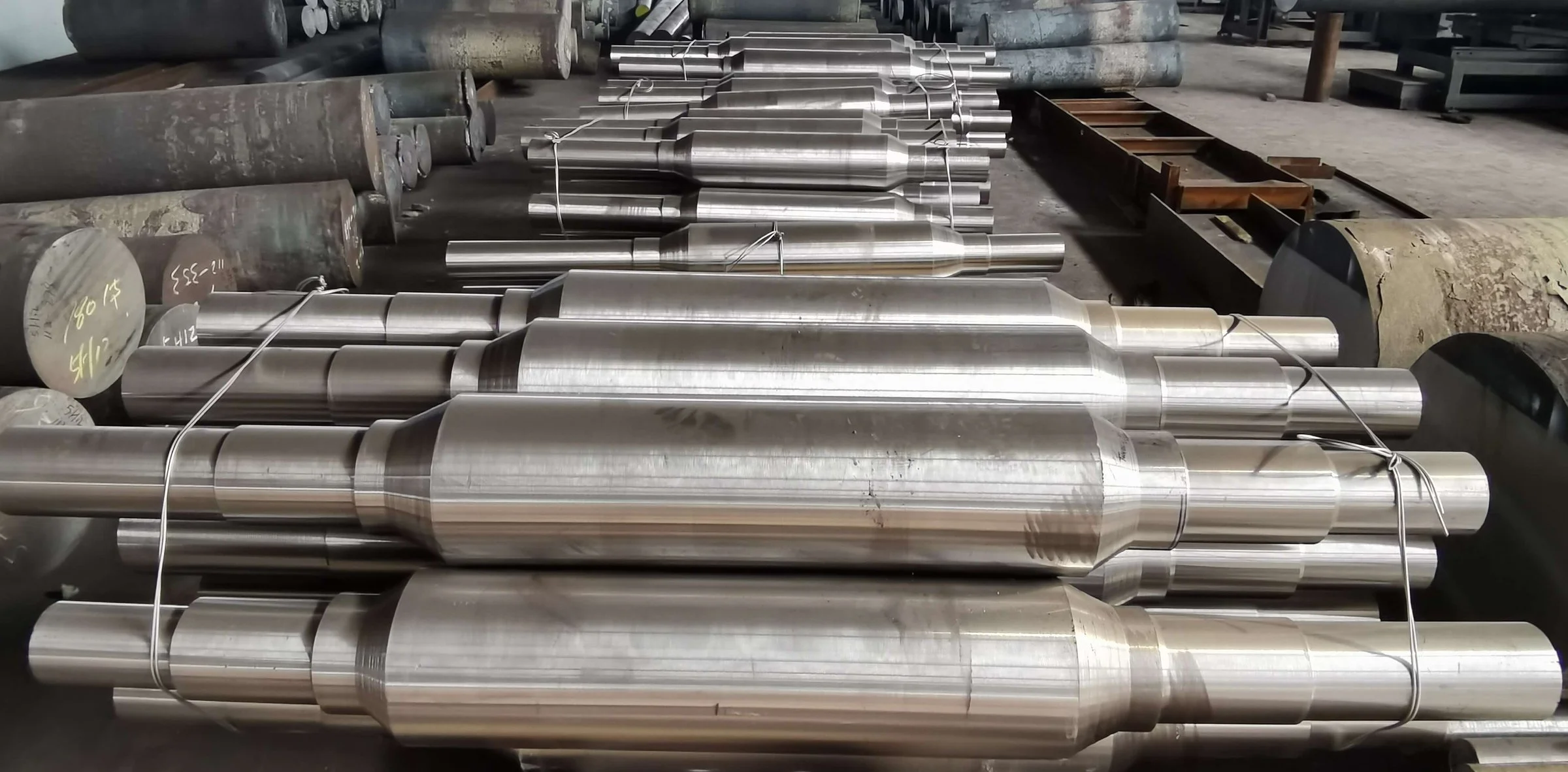
ESR 1.2379 for work rolls and intermediate rolls in 20-high and Z-high cold rolling mills. Forged, spheroidize annealed and UT tested, with the heat number on every piece and the length cut to your drawing.
Also supplied: 1.2379 round bar · D2 tool steel · roll selection guide
Request price & delivery
Send the roll drawing, or the barrel diameter and length with quantity and destination port. We confirm price and delivery in one working day.
Where 1.2379 Carries a Roll in a Cold Mill
1.2379 works as a work roll in cluster mills and Sendzimir mills. A 12 percent chromium cold work steel suits that position because the roll runs almost entirely in compression, carrying the rolling force while taking wear and contact stress from the moving strip. The intermediate rolls around it hold the work roll against both vertical and horizontal deflection, so the high chromium steel never has to resist a bending load.
| Roll type | Working hardness | What limits its life |
|---|---|---|
| Cluster mill work roll | 58 to 62 HRC | Spalling and wear from contact fatigue |
| Cluster mill intermediate and drive roll | 58 to 62 HRC | Contact fatigue wear and spalling |
| Tube and pipe forming roll | 58 to 62 HRC | Wear and edge chipping |
Composition data is for general reference only. Actual values vary by standard, mill, and heat number. Confirm against the material test certificate (MTC) or contact Aobo Steel.
Where 1.2379 Is the Wrong Buy
Unsupported rolls in two-high and four-high stands carry heavy bending loads and deflect across the body, and a high chromium cold work steel has no toughness budget for that. Those stands run forged roll steel around 0.85 percent carbon and 1.75 percent chromium, or a hot work grade. And a cold mill grade does not belong in a hot rolling stand, where thermal cycling checks and spalls the surface within a few campaigns.
What Decides Roll Life
Hardness uniformity along the barrel sets gauge control and keeps stress from concentrating in one band. Retained austenite comes next. A quench leaves 6 to 18 percent of it, and the same sources put 25 percent as the ceiling for hardened steel, so a heavy section that is not tempered out moves in service and softens unevenly. Grinding burn matters as much as any of them, since a burnt layer of 0.02 to 0.03 mm turns into a soft patch and spalls on the first heavy pass. A generous fillet radius at the neck is what keeps fatigue cracking away from the journal. In service the order is micro-notches and pitting from cyclic contact, then crack growth, then a spall that ends the roll body.
Source: ASM Handbook, Volume 14, Forming and Forging, ASM International, 1988, and Tool Steels, ASM International, 1998.