
What Each Furnace Atmosphere Gas Does to the Steel Surface
Every gas in a furnace atmosphere has a defined chemical effect on the surface of the steel in front of it, and the effect on a plain iron surface is not the same as the effect on a surface that carries carbon. That difference is the whole basis of heat treating in a controlled atmosphere. It is why a wet gas can ruin a D2 tool steel and leave a low carbon steel untouched, why the same gas that carburises a case can decarburise it, and why the carbon potential of the atmosphere has to be measured rather than assumed. This page sets out the effect of each constituent, the carbon activity that governs it, the gas mixture that holds a given carbon content in equilibrium, and the three reactions that remove carbon from the surface.
The individual gases and their effect on the metal
The table below is the source’s summary of what each atmosphere constituent does to five surfaces. Read it as three groups of gases. Oxygen, carbon dioxide and water vapour are the oxidising gases, and they will scale a steel surface. Carbon monoxide and methane are the carburising gases, because both can give up carbon to the steel. Hydrogen and carbon dioxide are the decarburising gases, and this is where the carbon content of the steel changes the answer, because a gas that only oxidises a plain iron surface will strip carbon out of a steel. Nitrogen is listed against every metal as having no effect, which is the reason it is used as the inert purge gas in a heat treatment shop.
| Metal | O2 | CO2 | CO | H2 | CH4 | H2O | N2 |
|---|---|---|---|---|---|---|---|
| Iron | oxidising | oxidising | carburising | decarburising | carburising | oxidising | – |
| Steel | oxidising | oxidising, decarburising | carburising | decarburising | carburising | oxidising, decarburising | – |
| Aluminium | oxidising | oxidising | – | – | – | – | – |
| Copper | oxidising | oxidising | – | – | – | – | – |
| Iron oxide | – | – | reducing | reducing | reducing | – | – |
Chemical effect of individual atmosphere constituents, reproduced from the source. A dash means no effect. Carbon dioxide and water vapour oxidise iron and also decarburise steel, which is why the steel row differs from the iron row. The last row is iron oxide rather than a metal, and it shows the three gases that reduce an already scaled surface.
The last row earns its place in a tool room. Carbon monoxide, hydrogen and methane all reduce an iron oxide layer, and that is what makes a reducing atmosphere able to clean up a lightly rusty or slightly scaled part before the heat treatment proper starts. It is also the limit of the method, because the same gases will not reduce every oxide. Chromium oxide is named by the source as very difficult to reduce, which is why a reducing atmosphere does not give a satisfactory result on a high chromium grade and why those grades are run in dissociated ammonia, hydrogen or vacuum instead.
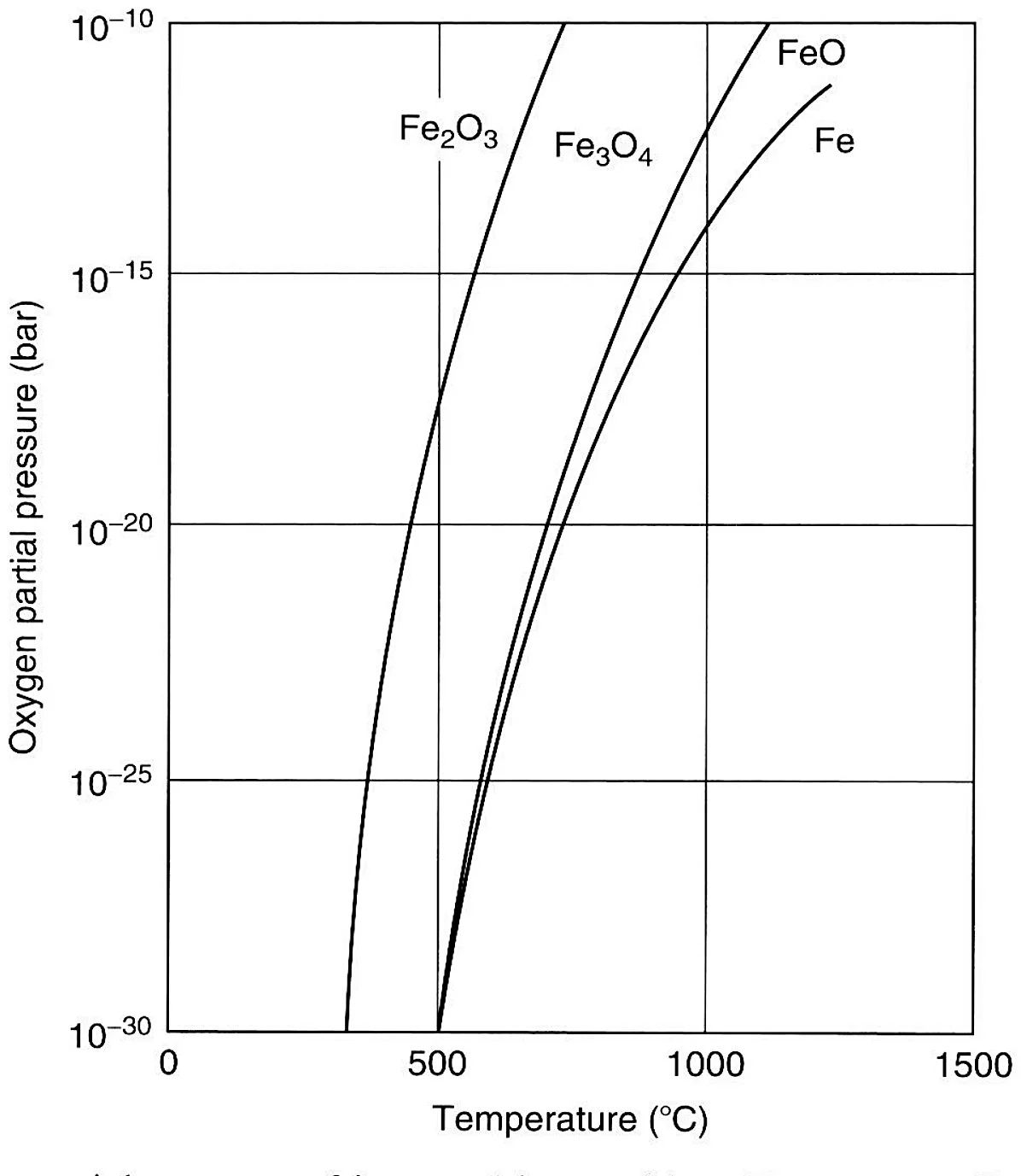
The oxygen side of the atmosphere is fixed by the iron oxide equilibria below.
Carbon activity in austenite
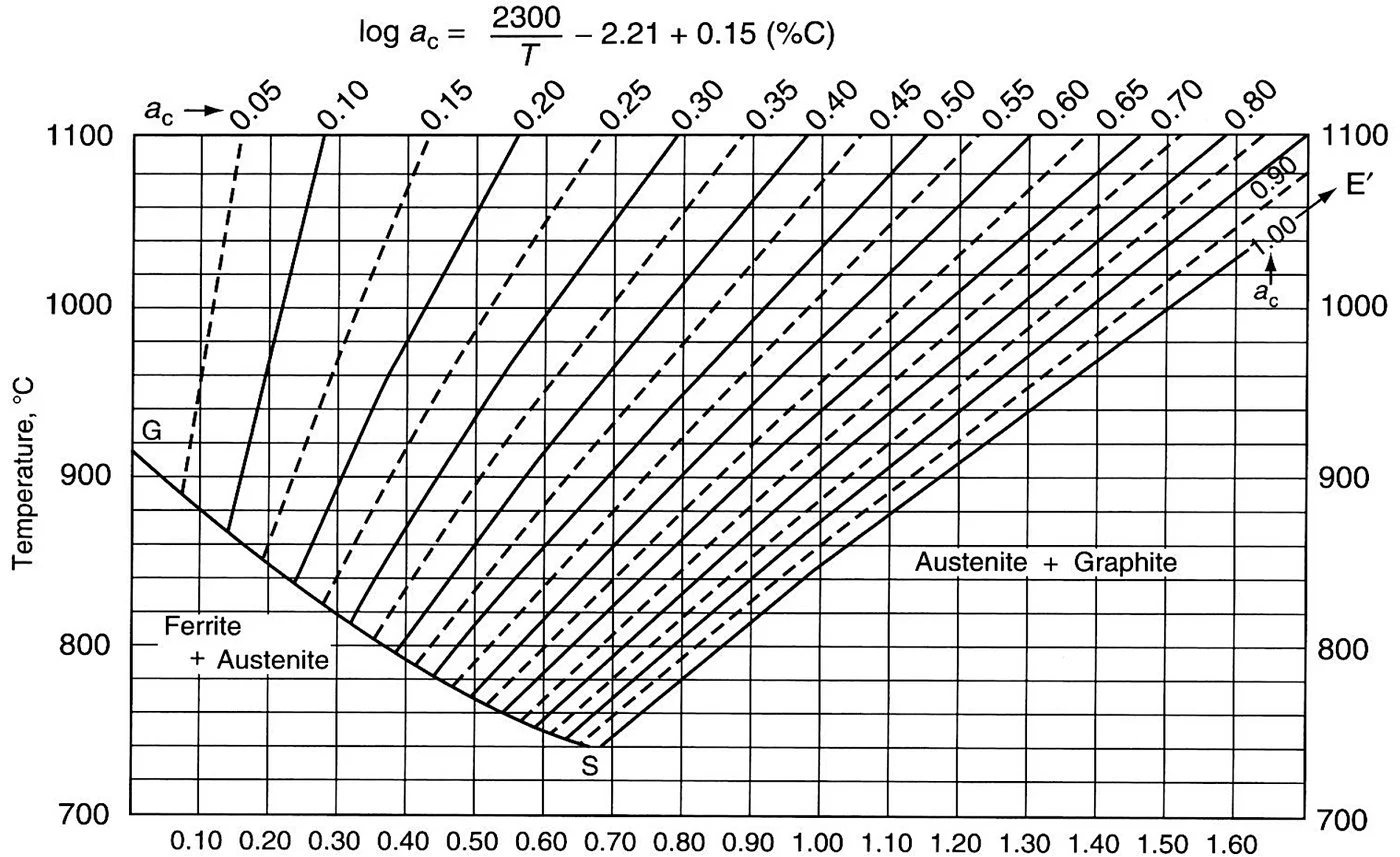
Whether a gas adds carbon to the steel or takes it away does not depend on the gas alone. It depends on the activity of the carbon already dissolved in the austenite, and that activity is a function of the carbon content and the temperature. The table below gives the activity of carbon in austenite relative to pure graphite for five plain carbon contents over five temperatures.
| Carbon content, % | 760 °C | 800 °C | 850 °C | 900 °C | 950 °C |
|---|---|---|---|---|---|
| 0.05 | – | – | 0.03 | 0.03 | 0.02 |
| 0.1 | – | – | 0.06 | 0.06 | 0.05 |
| 0.2 | – | 0.15 | 0.13 | 0.13 | 0.11 |
| 0.4 | – | 0.33 | 0.27 | 0.27 | 0.21 |
| 0.8 | 1.0 | 0.90 | 0.61 | 0.61 | 0.51 |
Activity of carbon in austenite at various carbon contents and selected temperatures, relative to pure graphite. A dash means the source lists no value. The figure falls as the temperature rises at a fixed carbon content, and rises with the carbon content at a fixed temperature.
Two readings follow from the table and both matter in practice. At a fixed carbon content, a higher temperature lowers the carbon activity, so the same atmosphere is more strongly carburising to a steel held at a lower temperature. And at a fixed temperature, a higher carbon content raises the activity, so a high carbon tool steel needs a gas of higher carbon potential before it will hold its surface carbon. The activity of carbon in pure graphite is taken as 1.0, which is the reference the whole table is measured against.
Carbon activity in austenite is the quantity behind the table above, and it is mapped against temperature and carbon content here.
The gas mixture that holds a carbon content in equilibrium
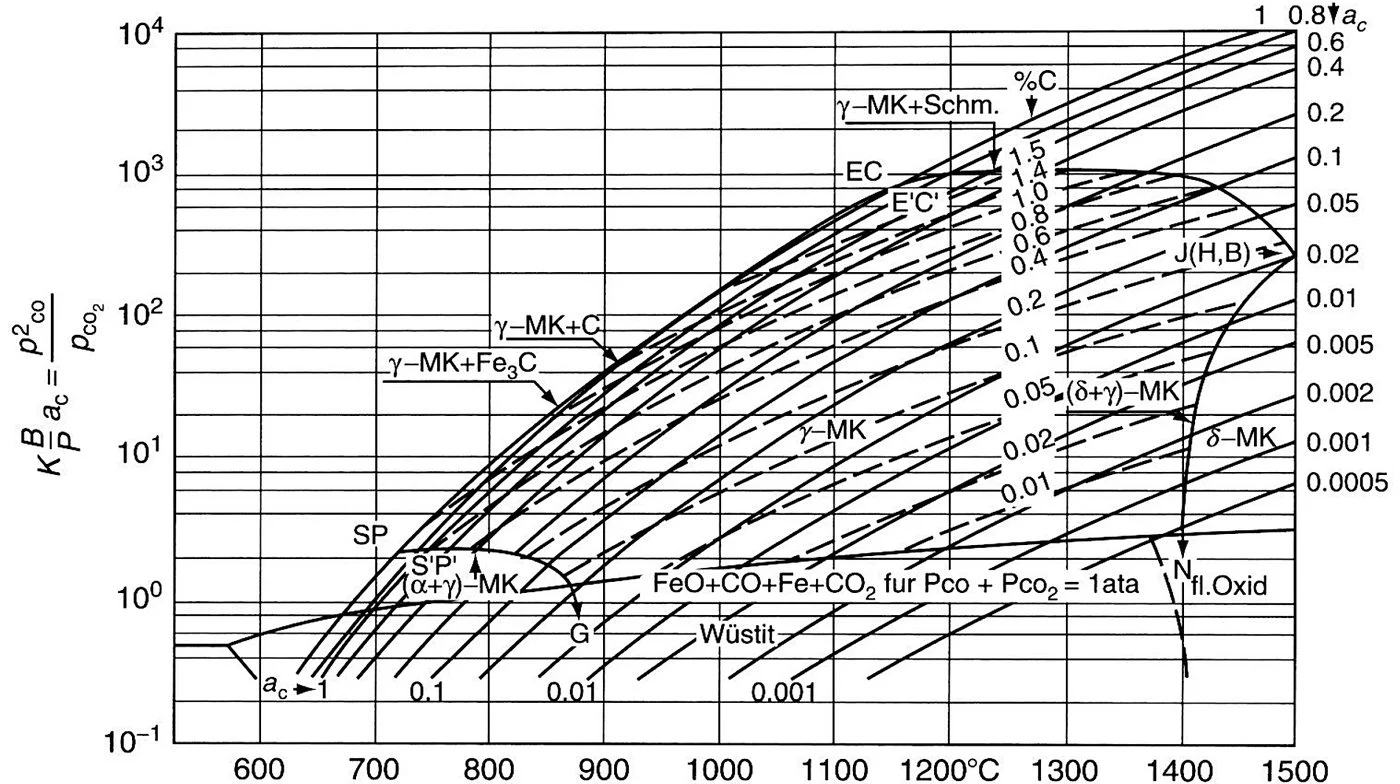
The practical consequence of the previous section is that each carbon content has its own equilibrium gas composition, and a mixture that is neutral to one steel is carburising to another. At 900 °C the source gives the figures below for two steels, and the gap between them is the point. A 0.05% carbon steel is in equilibrium with a gas of 70% carbon monoxide and 30% carbon dioxide, while a 0.8% carbon steel needs 95% carbon monoxide and only 5% carbon dioxide. Run the same 70/30 gas over the 0.8% carbon steel and it takes carbon out of the surface.
| Carbon content of steel, % | CO, % | CO2, % |
|---|---|---|
| 0.05 | 70 | 30 |
| 0.8 | 95 | 5 |
Composition of carbon monoxide and carbon dioxide atmospheres in equilibrium with steels of two different carbon contents at 900 °C. The higher the temperature and the higher the carbon content of the steel, the greater the carbon monoxide content needed to hold the surface in equilibrium.
The direction of the temperature effect is worth stating because it is easy to get backwards. A given carbon monoxide and carbon dioxide mixture has a more carburising effect if the temperature is lowered, so an atmosphere that is neutral at the austenitising temperature becomes carburising as the load cools. That is one of the reasons a controlled atmosphere furnace is not simply switched off at the end of a cycle.
The equilibrium that decides the gas mixture is the Boudouard reaction against the steel surface itself.
Furnace gas reactions with steel, printable PDF
The chemical effect of each furnace gas on iron, steel, aluminium and copper, the carbon activity of austenite at five temperatures, the carbon monoxide and carbon dioxide mixture that holds two carbon contents in equilibrium, and the three decarburising reactions, in one reference sheet with our contact details.
The three decarburising reactions
Carbon leaves the surface of a steel by three routes, and the source writes each of them with the carbon on the left. Hydrogen removes it as methane, carbon dioxide removes it as carbon monoxide, and water vapour removes it as carbon monoxide and hydrogen. Each reaction is reversible and each has an equilibrium constant written from the partial pressures of the gases in it and the activity of carbon in the austenite, so which way it runs at a given moment is decided by the gas composition and the temperature.
| Reaction | Running to the right | Running to the left |
|---|---|---|
| C + 2H2 = CH4 | hydrogen removes carbon as methane | methane deposits carbon on the steel |
| C + CO2 = 2CO | carbon dioxide removes carbon as carbon monoxide | carbon monoxide deposits carbon on the steel |
| C + H2O = CO + H2 | water vapour removes carbon as carbon monoxide | the reverse adds carbon |
The three decarburising reactions, written with carbon on the left as in the source. Running to the right removes carbon from the steel, running to the left deposits it.
Decarburisation matters out of proportion to its depth because it lowers the carbon content of the surface, and the surface is where a tool does its work. The source names components that operate at high stress as the place the effect is most serious, and springs as the example. On a tool steel the same effect shows up as a soft skin over a hard core, which is a scrap part rather than a reject that can be reworked.
Which direction each element moves
The table below reduces the whole subject to one sheet, because every heat treatment carried out in a controlled atmosphere can be classified by which element moves and in which direction. Where the movement is out of the steel the process is oxidation, decarburisation or denitriding. Where it is into the steel the process is scale reduction, carburisation, nitriding or nitrocarburisation. Where there is no net movement the process is bright annealing or decarburisation-free annealing and hardening.
| Process | Element | Reacting gases | Direction of interchange |
|---|---|---|---|
| Oxidation | O2 | H2 | atmosphere to metal |
| Scale reduction | CO & CO2 | atmosphere from metal | |
| Bright annealing | – | no interchange | |
| Carburisation | C | CO & CO2, CH4 & H2 | atmosphere to metal |
| Decarburisation | CO & CO2, CH4 & H2 | atmosphere from metal | |
| Decarburisation-free annealing or hardening | CO & CO2, CH4 & H2 | no interchange | |
| Nitriding | N2 | NH3 & H2 | atmosphere to metal |
| Denitriding | NH3 & H2 | atmosphere from metal | |
| Nitrocarburisation | C + N2 | CO & CO2, CH4 & H2, NH3 & H2 | atmosphere to metal |
| Decarburisation or denitriding | CO & CO2, CH4 & H2, NH3 & H2 | atmosphere from metal |
Examples of heat treatment processes involving the interchange of elements, reproduced from the source. The direction is written out here where the source prints an arrow. The reacting gas shown against oxidation is reproduced as printed in the source.
The carbon family is the one that governs tool steel work, and the source sets out how the two directions meet. When a mixture of carbon monoxide and carbon dioxide, or of methane and hydrogen, reacts in the direction that deposits carbon, carburisation is taking place. When the same mixture runs the other way, decarburisation is taking place. When there is no net movement in either direction, the treatment is decarburisation-free annealing or hardening, which is exactly what a tool steel cycle is trying to achieve.
What this means for a tool steel cycle
The alloy content of the grade decides how much the oxygen-bearing gases have to be held down, and the carbon content decides how high the carbon potential has to be set. A high chromium cold work steel is the case where both pressures are strongest, because chromium has a strong affinity for oxygen and the carbon content is high, so the gas has to be dry and its carbon potential has to match the steel. That is why the selection rule and the chemistry rule give the same answer on a D2 or a DC53, and why the answer changes on a plain carbon tool steel. An endothermic atmosphere can hold a plain carbon tool steel without decarburising it, and the same atmosphere can be wrong for a grade whose chromium content sits above two per cent.
The choice of atmosphere by alloy content is set out on the protective atmosphere selection page. The vacuum alternative, with the dew point each vacuum level actually reaches, is on the vacuum heat treatment page. Decarburisation as a defect and how much stock has to come off to clear it is on the decarburisation and stock removal page, and the carbon profile that a carburising atmosphere produces through a case is on the gas carburising carbon penetration page.
Before you use these values
This page is a reference summary of published practice and it is not an Aobo Steel specification. The gas effects, activities and equilibrium compositions are reproduced from the source, and what a particular furnace produces depends on the generator, the control system and the load. The values are read at the temperatures stated in each table. Final selection is confirmed on the job.
Source: Controlled Atmospheres for Heat Treatment, R. Nemenyi and G. H. J. Bennett, Pergamon Press, 1984.