
Packing Compounds for Annealing Tool Steel
When a tool is annealed inside a pack, the material packed around it decides whether the surface of the steel keeps its carbon, holds it, or loses it. This page gives the temperature range over which each of the common packing compounds carburizes, stays neutral or decarburizes tool steel, and the conditions that move those ranges.
Why tool steel is packed for annealing
In a box furnace or a roller hearth furnace the surface of the work has to be protected in one of two ways. One is a proprietary coating that resists decarburization. The other is to pack the workpieces in pipes and surround them with a material that does not decarburize steel, such as spent charcoal, mica or cast iron chips. Atmosphere furnaces, salt baths and vacuum furnaces do the same job from the other direction, by controlling or removing the gas around the load.
The aim of the packing itself is to keep decarburizing gases away from the steel. Excluding oxygen needs a tight pack and a perfect seal, because at annealing temperature most gases diffuse through ordinary seals at a rate that is surprisingly fast. A material that contains carbonaceous matter does better under those conditions. Where scale is already on the bars as they are charged, decarburization follows unless a carbonaceous material is present, and moisture in the packing is not tolerable, because decarburization takes place very readily once it is there.
How a packing compound behaves
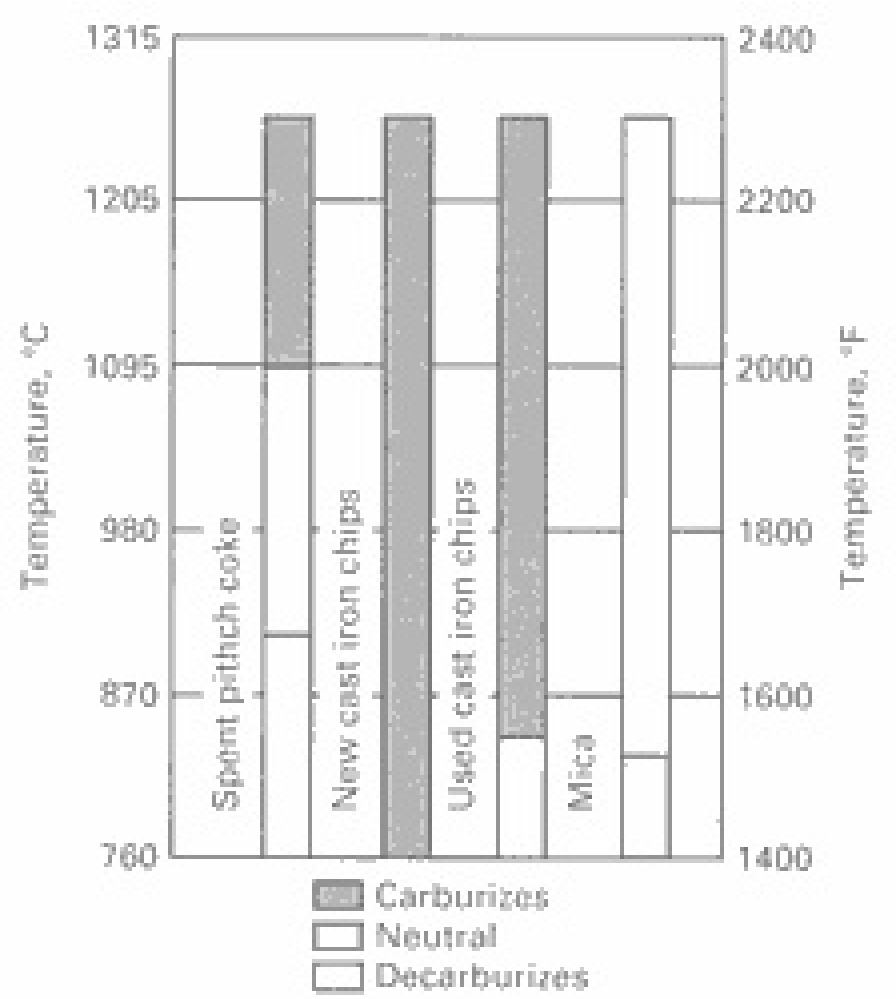
A packing material can carburize the steel, decarburize it or be neutral to it, and which of the three applies depends on the heating temperature, the carbon content of the steel, and the density and particle size of the packing. The chart below gives the range of usefulness of four compounds that are commonly used in the shop. They are spent pitch coke, new cast iron chips, used cast iron chips and mica. Each bar is split into the temperature band in which that compound carburizes, the band in which it stays neutral, and the band in which it decarburizes.
What shifts the range
The source is explicit that the chart is a guide only. Scale on the bars as charged, the age of the packing compound, its moisture content and the carbon content of the steel all change the range appreciably. The temperature at which a material changes from neutral to decarburizing is not as definite as the bars suggest, and the effect of carbon content is not included in the chart at all. It applies particularly to high carbon steels.
Reading it as a band rather than a line is the safe habit. Spent pitch coke and new cast iron chips hold a neutral range that sits above the annealing temperatures used for most cold work grades, so the compound stays neutral in service. Used cast iron chips have the narrowest neutral band, which is the reason spent material is renewed rather than topped up.
Where the pack sits in the annealing sequence
Full annealing heats the steel slowly and uniformly to a temperature above the transformation range, holds it there for one to four hours and then cools it at a controlled rate followed by air cooling. A packed container is charged and cooled with the furnace, so it follows that same schedule. Cracking from thermal shock is limited by charging the furnace at a low temperature so the load heats up with it, and by cooling the work and its container in the furnace at 8 to 22 °C/h (15 to 40 °F/h) down to 540 °C (1000 °F) or lower. Below that temperature the cooling rate stops being critical for most tool steels.
The temperatures each grade is annealed at are collected on the tool steel annealing and normalizing temperature chart. Where a liquid bath or a small furnace is available, the two-hold version of the same treatment is set out on the cycle annealing page, and the condition the steel is delivered in is described on the annealed condition page. The cold work grades that are packed most often are D2 tool steel and O1 tool steel.
Before you use this chart
This page is a reference summary of published practice and it is not an Aobo Steel specification. The ranges are the published figures for the compounds named, and a different furnace, packing density or steel carbon content will move them. The choice of packing and the annealing cycle remain the responsibility of the heat treater.
Source: ASM Handbook, Volume 4, Heat Treating, ASM International, 1991.