
Choosing Between H13 and 1.2714 (L6) Tool Steel for Forging Dies
Buyers sourcing hot work tool steel often assume that any grade used in hot metal forming can serve interchangeably across forging processes. H13 and 1.2714 (L6, close to ASTM 6F3) are frequently mentioned in the same breath because both operate in high-temperature, high-stress environments. In practice, the two steels are built around opposite priorities, and choosing the wrong one leads to premature die failure, either through heat checking or through outright cracking under impact. Understanding why the two grades diverge starts with their chemical composition. See how H13 compares across other tool steel grades.
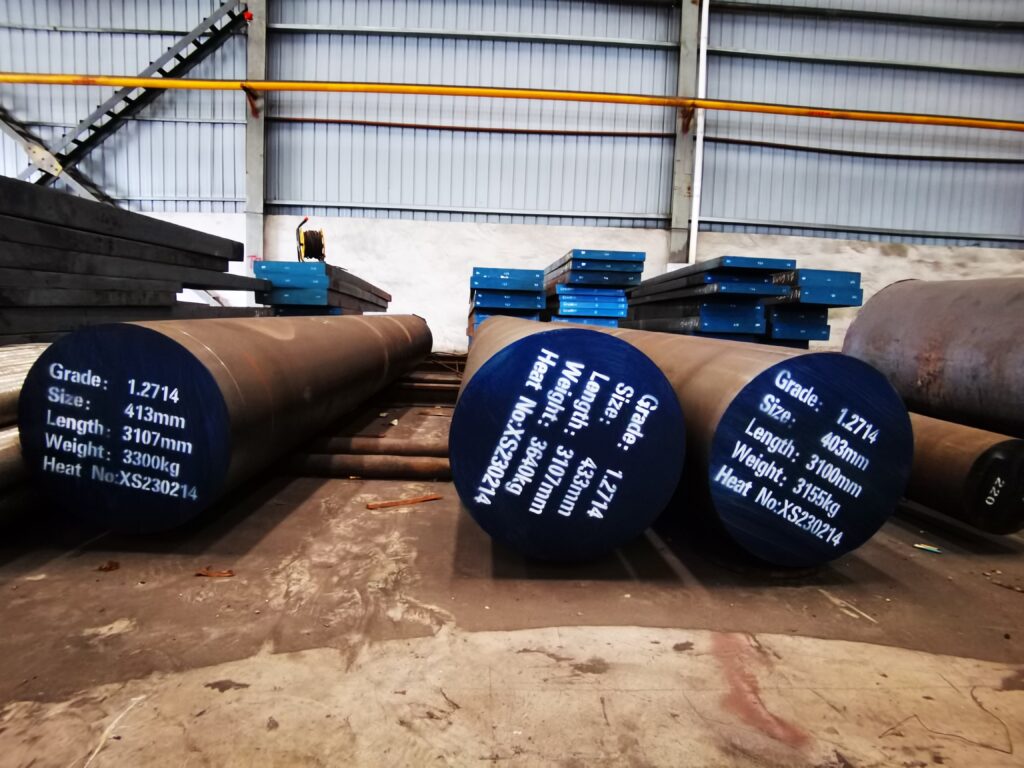
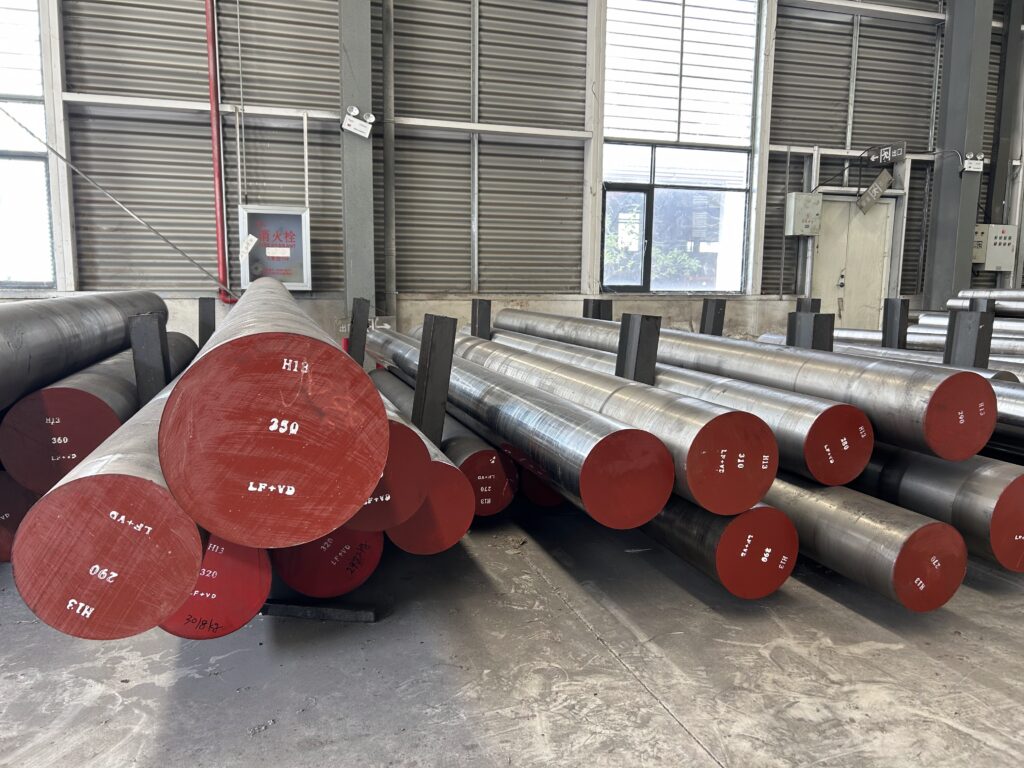
Composition drives two different design philosophies
| Element | H13 (UNS T20813 / DIN 1.2344) | AISI L6 | DIN 1.2714 (55NiCrMoV7) |
|---|---|---|---|
| Carbon | 0.32% to 0.45% | 0.65% to 0.75% | 0.50% to 0.60% |
| Chromium | 4.75% to 5.50% | 0.60% to 1.20% | 0.90% to 1.20% |
| Nickel | 0.30% max | 1.25% to 2.00% | 1.50% to 1.80% |
| Vanadium | 0.80% to 1.20% | 0.20% to 0.30% | 0.07% to 0.12% |
| Molybdenum | 1.10% to 1.75% | 0.50% max | 0.35% to 0.55% |
L6 and 1.2714 are treated as commercially equivalent grades because they share the same nickel-chromium-molybdenum alloy design and serve the same shock-resisting die applications, but the two standards do not target identical chemistries; L6 generally runs a higher carbon range than 1.2714. The ranges above reflect commonly published reference values for each standard. Composition can vary slightly by standard revision, mill, and heat, so treat these figures as a guide to how the two families differ rather than a substitute for the actual mill test certificate. For the performance discussion below, “1.2714 (L6)” refers to this family of low-alloy nickel-bearing hot work and shock-resisting steels as a group. If your project needs to match a specific standard or drawing callout, Aobo Steel can confirm the exact chemistry against the applicable spec before the order is placed.
H13 is built on high chromium, molybdenum, and vanadium content, forming stable alloy carbides that hold up under sustained heat. The 1.2714/L6 family takes the opposite route. A higher carbon base combined with nickel raises bulk toughness and delays crack initiation under sudden mechanical shock. It does so without the carbide-forming elements that give H13 its heat resistance. This single difference in alloy design explains almost every performance gap between the two steel families.
Where the performance actually diverges
The contact time between the die and the workpiece is the variable that separates the two applications, and it explains why the same composition trade-off produces such different field results.
When a die stays in contact with hot metal for an extended period, as in press forging or die casting, heat builds up inside the tool steel and pushes the material toward softening. H13 resists this through secondary hardening. Its carbide structure lets it hold around 50 HRC even after prolonged exposure at 500°C to 550°C. 1.2714 has no comparable mechanism. Once it sees sustained heat, it softens quickly because it lacks the molybdenum and vanadium needed for a secondary hardening response.
The same heat exposure also determines resistance to heat checking, the surface cracking pattern caused by repeated thermal expansion and contraction. H13 is the standard choice for water-cooled die casting dies precisely because it tolerates this cycling well. 1.2714 does not; repeated contact with liquid metal and rapid cooling brings on heat checking much faster.
Impact toughness reverses the comparison. Hammer forging delivers high-velocity blows with very short contact time, so the die surface absorbs less heat but takes far more mechanical shock. This is where 1.2714 performs better than H13. Working at a lower hardness, typically 35 to 40 HRC, and strengthened by its nickel content, 1.2714 resists quench embrittlement and holds up under repeated heavy impact in massive die blocks. H13 remains tough for a highly alloyed steel. Still, in very large sections it can be prone to carbide segregation at grain boundaries if the cooling rate during quenching is not tightly controlled, which raises the risk of cracking under the same impact conditions.
Wear resistance follows the same pattern. At elevated temperature, H13’s vanadium carbides give it a clear advantage, and nitriding pushes its surface hardness above 1000 HV for erosive service. 1.2714 wears reasonably well at lower temperatures because of its higher carbon content, but that advantage narrows sharply once temperatures rise. Nitriding can lift its working hardness to 55 to 60 HRC, useful for forging dies but not enough for severe extrusion wear.
Heat treatment reflects the same split
H13 requires austenitizing at 995°C to 1030°C to dissolve its alloy carbides, then double or triple tempering at 540°C to 650°C to convert retained austenite and activate secondary hardening. Because it hardens through in still air even in large sections, distortion and residual stress stay low, and working hardness typically lands between 40 and 53 HRC depending on service severity. See more details: H13 tool steel heat treatment guide
1.2714 austenitizes at a much lower 830°C to 880°C and is usually oil quenched, though larger sections are often air quenched to reduce cracking risk and small parts can go to water for a harder case. For hot work dies, it is commonly supplied pre-hardened in the 331 to 375 HB range, roughly 35 to 40 HRC, which simplifies die manufacturing and lowers tooling cost for the buyer.
Matching the grade to the process
The selection question comes down to which failure mode threatens the die more: softening and heat checking from sustained thermal load, or cracking from repeated mechanical shock.
H13 is the right choice for die casting dies, cores, ejector pins, and shot sleeves in aluminum, magnesium, and zinc casting, for hot extrusion tooling including dies, press liners, mandrels, and dummy blocks, and for press forging dies where extended contact time drives heat deep into the tool. See H13 limitations page.
1.2714 is the right choice for hammer forging dies and massive drop-forging blocks, where short, high-velocity impact makes fracture toughness the priority. It also performs well in cold work tooling such as blanking dies, punches, shear blades, and trimmer dies, and in machinery parts exposed to severe shock loads, including arbors, clutch parts, spindles, cams, chucks, and pawls. In large hammer die blocks, 1.2714 often outlasts H13 simply because it resists breaking under heavy, repeated blows.
Neither grade is a universal hot work solution. The right choice depends on whether the die’s dominant stress is thermal or mechanical, and matching that stress profile to the alloy’s design intent is what determines service life.