
A36 Steel vs Tool Steel
A36 is a low-carbon structural steel for buildings, bridges, and general fabrication. Tool steels are high-carbon, high-alloy steels for cutting, forming, and molding.
The two are not interchangeable: A36 cannot reach tool hardness, holds no meaningful wear resistance, and should never be specified in place of a tool steel grade. This page covers the composition and hardness gap, and which grade to use when A36 will not do.
Tool Steel Available from Aobo Steel
Aobo Steel supplies tool and mold steels for dies, molds, cutting tools, forming tools, and wear-critical industrial parts. A36 is discussed here as a comparison material, not as a tool steel substitute.
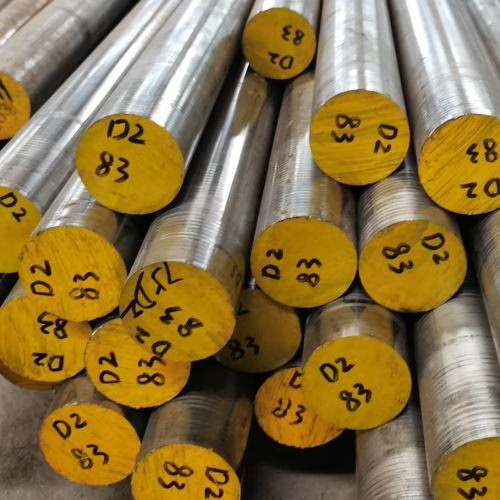
D2, A2, O1, S7, H13, P20 and More
Cold work, hot work, mold, stainless tool steel, and high-speed steel grades supplied in annealed condition with mill certificates for industrial tooling orders.
What Is A36 Steel?
A36, specified as ASTM A36, is the most common structural steel grade in North America. It is a low-carbon steel made for welded construction, including building frames, bridges, base plates, and general structural members.
Its defining trait is low carbon, typically around 0.20-0.25 percent, with no meaningful alloy content. That gives A36 excellent weldability, good ductility, low cost, and wide availability. The same low carbon sets a hard ceiling on performance.
A36 cannot be hardened much beyond 160-180 HB, has little wear resistance, and loses strength quickly above about 200°C. It was never designed for tooling.
Chemical Composition: A36 vs D2 Tool Steel
| Element | A36 | D2 Tool Steel |
|---|---|---|
| Carbon (C) | 0.25-0.29% max | 1.40-1.60% |
| Silicon (Si) | 0.40% max | 0.10-0.60% |
| Manganese (Mn) | 0.80-1.20% | 0.20-0.60% |
| Chromium (Cr) | None | 11.0-13.0% |
| Molybdenum (Mo) | None | 0.70-1.20% |
| Vanadium (V) | None | 0.50-1.10% |
| Phosphorus (P) | 0.040% max | 0.030% max |
| Sulfur (S) | 0.050% max | 0.030% max |
A36 carries no chromium, molybdenum, or vanadium, the elements that form hard carbides and give tool steel its wear resistance and hardenability. Its carbon level is also far too low to form the hard martensite on which tool steel performance depends.
D2, by comparison, holds roughly six times the carbon and is heavily alloyed with chromium. That is why it can work as a cutting, shearing, and wear-resistant cold-work tool steel while A36 cannot.
Why A36 Cannot Be Used for Dies and Cutting Tools
It cannot reach tool-level hardness
A36’s carbon content is too low to harden by quenching. At its hardest, it sits around 160-180 HB, below the bottom of the HRC range used for tooling.
No carbides, no wear resistance
Tool steels contain chromium and vanadium carbides that resist abrasion. A36 contains none, so it wears rapidly under sliding or abrasive contact.
No hot hardness
Hot-work grades such as H13 retain hardness at elevated temperature through secondary hardening. A36 has no such alloying and softens fast under heat.
Structural grain, not tool grain
A36 is rolled for weldability and ductility. Tool steels are processed for fine, uniform grain that supports edge retention, hardness, and toughness.
Cutting and forming tools commonly need 58-64 HRC. No heat treatment can close that gap for A36 because the carbon required to form hard martensite is simply not present.
The Hardness Gap
Every tool steel grade outranks A36 by a wide margin, even before heat treatment.
| Material | Typical As-Used Hardness |
|---|---|
| A36 | 120-180 HB, about 70-89 HRB |
| 4140, quenched and tempered | 28-45 HRC |
| H13, quenched and tempered | 44-52 HRC |
| A2 | 57-62 HRC |
| D2 | 58-60 HRC |
| M2 high-speed steel | 62-65 HRC |
A36 in its hardest practical condition is softer than many tool steels in their annealed, soft condition. Annealed D2, at about 230 HB, is already harder than A36 will ever reach.
When A36 Is the Right Choice
A36 is the correct and economical material for structural work: building frames and structural members, welded fabrications, base plates, mounting brackets, and die holders or die shoes that carry load but do not require cutting or forming. In these roles, its weldability and low cost are genuine advantages.
It is the wrong material for any cutting edge or shear blade, any die, punch, or forming tool, wear plate, hot-work tool, or any part that needs 40 HRC or more.
If You Are Considering A36 for Tooling: What to Use Instead
| Intended Application | Avoid | Use Instead |
|---|---|---|
| Blanking die, prototype | A36 | O1 or A2 |
| Blanking die, production | A36 | D2 |
| Bending or forming die | A36 | A2 or O1 |
| Cold shear blade | A36 | D2 |
| Die casting die | A36 | H13 |
| Hot forging die | A36 | H13 |
If cost is the reason A36 is on the table, the math usually reverses once tooling is involved. Using the wrong material in a die or blade results in scrap parts, unplanned downtime, and frequent replacements, which cost far more than specifying the correct tool steel from the start.
Supply Note from Aobo Steel
Aobo Steel supplies tool and mold steels: cold work grades D2, D3, A2, O1, O2, and S7; hot work grades H13 and H11; mold steels P20 and P20+Ni; and stainless tool steels 440C and 420.
If your application involves dies, molds, or cutting and forming tools, we can supply the correct grade in annealed condition with mill certificates.
Need the right tool steel instead of A36?
Send your application, tooling type, size, hardness target, and expected production volume. Aobo Steel can help match D2, A2, O1, S7, H13, P20, or another grade to the actual failure mode.
Email [email protected] · Tel and WhatsApp +86 180 6294 5370
Related pages
Tool steel comparisons: D2 vs A2 · D2 vs S7 · H13 vs A2 · D2 vs 4140 · D2 vs 440C
Reference pages: What is tool steel · Tool steel selection by application · Tool steel equivalent grades
Grade families: Hot-work tool steels · Tool steel material finder
A36 figures follow ASTM A36; tool steel hardness ranges are typical published values. Confirm the exact range against the mill certificate for the delivered lot.