
420 Stainless Steel Heat Treatment Guide
To heat treat 420 stainless steel, preheat to about 650°C / 1200°F, then austenitize at 954–1010°C / 1750–1850°F, followed by air or oil quenching. After quenching, temper immediately according to the required hardness, toughness, and corrosion resistance.
For high-hardness applications, 420 stainless steel is usually tempered at lower temperatures. Typical reference points are about 150°C / 300°F for around 52 HRC minimum, 204°C / 400°F for around 50 HRC minimum, and 316°C / 600°F for around 48 HRC minimum.
The tempering range of 427–566°C / 800–1050°F should generally be avoided, as it may reduce impact strength and corrosion resistance.
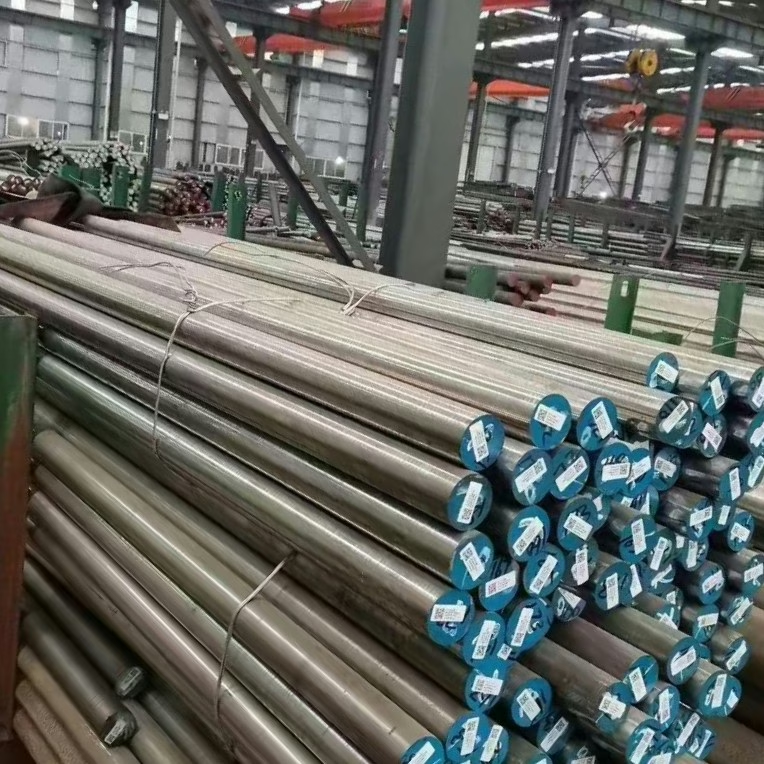
Need 420 stainless steel for heat-treated parts?
Aobo Steel supplies 420 stainless steel for molds, blades, shafts, wear parts, and precision components. Send your required size, quantity, and surface condition for bulk supply support.
420 stainless steel is a hardenable martensitic stainless steel. After proper heat treatment, it typically reaches 46–52 HRC in working applications while maintaining useful wear resistance, polishability, and moderate corrosion resistance. Final performance depends on section size, quenching method, tempering temperature, furnace atmosphere, and the required application.
This guide explains the practical heat-treatment process for 420 stainless steel, including preheating, austenitizing, quenching, a tempering chart, expected hardness, common mistakes, and application-based heat-treatment directions.
420 Stainless Steel Heat Treatment Process at a Glance
The final heat-treatment results for 420 stainless steel depend on heating temperature, soaking time, quenching method, tempering temperature, surface protection, and part geometry.
| Process Stage | Typical Range or Method | Purpose | Practical Note |
|---|---|---|---|
| Cleaning | Before heating | Remove oil, grease, and residues | Dirty surfaces may damage corrosion resistance and surface quality |
| Protective atmosphere | Vacuum, neutral atmosphere, or neutral salt bath | Reduce oxidation and decarburization | Important for polished parts, molds, and corrosion-resistant applications |
| Preheating | About 650°C / 1200°F | Reduce thermal shock | Especially useful for large, complex, or precision parts |
| Austenitizing | About 954–1010°C / 1750–1850°F | Prepare the steel for hardening | Higher end may be used for maximum hardness and corrosion resistance |
| Soaking | About 30 minutes per inch of greatest section thickness | Heat the section uniformly | Avoid unnecessary over-soaking |
| Quenching | Air or oil | Form hardened martensite | Choose by part size, shape, and hardness requirement |
| Tempering | Depends on required properties | Adjust hardness, toughness, and stability | Temper immediately after quenching |
| Double tempering | Often used for critical parts | Improve stress relief and stability | Cool to room temperature between tempers |
Annealing is not part of the main hardening cycle. It is used when the material needs to be softened before machining, forming, or re-hardening. For 420 stainless steel, subcritical annealing may be carried out around 675–760°C / 1245–1400°F, while full annealing may be carried out around 830–885°C / 1525–1625°F, followed by controlled cooling.
Step-by-Step Heat Treatment of 420 Stainless Steel
The main hardening cycle for 420 stainless steel consists of three steps: preheating, austenitizing and quenching, and tempering. Cleaning and atmosphere control should be completed before heating, but the heat treatment results are mainly determined by these three stages.
Step 1: Preheat 420 Stainless Steel
Preheating reduces thermal shock before the steel reaches the austenitizing temperature. This is important because stainless steels conduct heat more slowly than many carbon and low-alloy steels. Fast heating can create temperature differences between the surface and the core, increasing the risk of distortion or cracking.
A common preheating temperature for 420 stainless steel is about 650°C (1200°F).
| Part Condition | Reason Preheating Matters |
|---|---|
| Large sections | Reduces temperature difference between surface and core |
| Thin or uneven sections | Reduces distortion risk |
| Sharp corners or complex shapes | Reduces cracking risk |
| Precision mold parts | Improves dimensional stability |
| Previously hardened parts | Reduces thermal shock during re-hardening |
Before preheating, the surface should be clean. Oil, grease, and carbon-rich residues should be removed. For parts requiring good polishability or corrosion resistance, heating should be carried out in a vacuum, a neutral atmosphere, or a neutral salt bath.
Step 2: Austenitize and Quench 420 Stainless Steel
After preheating, heat 420 steel to the common hardening temperature 954–1010°C / 1750–1850°F.
The exact temperature should be selected based on section size, furnace condition, steelmaker data, and the required final hardness. The higher end of the range may be used when maximum hardness and corrosion resistance are required, but overheating should be avoided, as it can increase grain growth, distortion, and the risk of cracking.
A typical soaking guideline is about 30 minutes per inch of the greatest cross-sectional thickness. The goal is uniform heating through the section. Excessive soaking does not improve the result and may make the part less stable during quenching.
After soaking, the part should be quenched.
| Quenching Method | Best Used For | Advantage | Caution |
|---|---|---|---|
| Air quenching | Complex, irregular, or precision parts | Lower distortion and cracking risk | May be too slow for some heavy sections |
| Oil quenching | Heavier sections or parts needing stronger hardening response | Faster cooling and higher hardening response | Higher distortion and cracking risk |
Air quenching is often safer for complex shapes. Oil quenching may be used when higher hardness is required, and the part geometry can tolerate a more severe quench.
Cooling must be fast enough through the critical range to avoid harmful carbide precipitation at grain boundaries. Slow cooling can reduce corrosion resistance. After quenching, the part should be tempered as soon as practical.
Step 3: Temper 420 Stainless Steel
For high hardness, wear resistance, polishability, and corrosion resistance, lower tempering temperatures are usually preferred.
| Tempering Temperature | Approximate Hardness | Practical Meaning |
|---|---|---|
| 150°C / 300°F | About 52 HRC minimum | High hardness and edge retention |
| 204°C / 400°F | About 50 HRC minimum | Common low-temperature temper for general hardened parts |
| 250°C / 480°F | Often above 50 HRC | Often used when polishability and corrosion resistance matter |
| 316°C / 600°F | About 48 HRC minimum | Lower hardness with improved toughness |
| 593°C / 1100°F and above | Lower hardness | Used when toughness is more important than hardness |
Double tempering is often used for critical 420 stainless steel parts. The part should cool to room temperature between tempering cycles. This helps relieve internal stress and improve dimensional stability.
The range around 427–566°C / 800–1050°F should generally be avoided. Tempering in this range can reduce impact strength and corrosion resistance. If a softer, tougher condition is required, the tempering temperature is usually raised to about 593°C / 1100°F or higher, with a clear acceptance of lower hardness.
420 Stainless Steel Tempering Chart
The work-hardness of heat-treated 420 stainless steel is typically around 46–52 HRC. Final hardness depends on austenitizing temperature, quenching speed, tempering temperature, section size, and steel condition.
The chart below should be used as a practical reference, not as a guaranteed final hardness value.
| Tempering Temperature | Approximate Hardness | Typical Direction | Main Caution |
|---|---|---|---|
| 150°C / 300°F | About 52 HRC minimum | High hardness, edge retention, wear resistance | Lower toughness |
| 204°C / 400°F | About 50 HRC minimum | General high-hardness applications | Requires proper quenching |
| 250°C / 480°F | Often above 50 HRC | Plastic molds, polished parts, corrosion-resistant hardened parts | Final hardness depends on prior hardening |
| 316°C / 600°F | About 48 HRC minimum | Moderate hardness with better toughness | Hardness begins to drop |
| 400–450°C / 750–840°F | Around 450 HB or about 47 HRC in some spring tempers | Special spring or property requirements | Should not be used as a general tempering range |
| 427–566°C / 800–1050°F | Generally avoided | Not recommended for most applications | May reduce impact strength and corrosion resistance |
| 593°C / 1100°F and above | Lower hardness | Higher toughness applications | Significant hardness loss |
For applications requiring hardness above 50 HRC and good corrosion resistance, low-temperature tempering is usually the safer choice. This is common for plastic molds, cutting tools, wear parts, polished components, and corrosion-exposed parts.
Common Heat Treatment Mistakes with 420 Stainless Steel
Most heat-treatment problems with 420 stainless steel stem from poor process control. The most common failures are distortion, cracking, insufficient hardness, poor surface quality, reduced corrosion resistance, and loss of toughness.
| Mistake | Result | Better Practice |
|---|---|---|
| No clear property target | Wrong tempering direction | Define whether the priority is hardness, toughness, corrosion resistance, polishability, or dimensional stability |
| Poor surface cleaning | Surface damage or reduced corrosion resistance | Clean oil, grease, and residues before heating |
| No protective atmosphere | Scaling or decarburization | Use vacuum, neutral atmosphere, or neutral salt bath when surface quality matters |
| Skipping preheating | Higher risk of distortion or cracking | Preheat around 650°C / 1200°F before austenitizing |
| Wrong quenching method | Cracking, distortion, or insufficient hardness | Select air or oil by section size and geometry |
| Cooling too slowly | Reduced corrosion resistance | Control cooling through the critical range |
| Delaying tempering | Quench cracking risk | Temper soon after quenching |
| Tempering in the danger range | Lower impact strength and corrosion resistance | Avoid about 427–566°C / 800–1050°F unless a qualified procedure requires it |
| Single temper on critical parts | Lower stress relief and stability | Use double tempering for precision or critical parts |
| Chasing maximum hardness only | Brittle parts or reduced corrosion performance | Match tempering temperature to the application |
One serious mistake is using oil quenching for every part. Oil quenching can improve the hardening response, but it also increases the risk of distortion and cracking. For complex or irregular parts, air quenching is often the safer choice.
Another common mistake is using a high tempering temperature to improve toughness without considering corrosion resistance. For 420 stainless steel, high-temperature tempering can reduce hardness and may reduce corrosion performance. When high hardness and corrosion resistance are required, low-temperature tempering is usually preferred.
The most important risk zone is 427–566°C (800–1050°F). This range should not be used casually. If the part needs higher toughness, the process should be designed around 593°C / 1100°F or above, with the understanding that hardness will drop.
420 Stainless Steel Heat Treatment Direction by Application
The basic hardening process for 420 stainless steel is similar across many applications, but the tempering temperature should be adjusted based on the required performance.
| Application | Main Requirement | Heat Treatment Direction | Practical Note |
|---|---|---|---|
| Cutlery and blades | Hardness and edge retention | Austenitize properly, quench, then use low-temperature tempering | Avoid excessive tempering temperature if sharpness is required |
| Surgical and dental instruments | Hardness, polishability, corrosion resistance | Use low-temperature tempering and good surface protection | Surface quality is critical |
| Plastic molds | Polishability, hardness, corrosion resistance | Low-temperature tempering, often around 204–250°C / 400–480°F | Avoid high-temperature tempering if corrosion resistance matters |
| Wear parts | Hardness and abrasion resistance | Harden fully and temper in a lower range | Do not reduce hardness unless toughness is required |
| Shafts, gears, and rollers | Strength and toughness balance | Use an application-specific tempering temperature | Maximum hardness is not always the best target |
| Springs or tougher components | Toughness over peak hardness | Higher tempering temperature may be used | Hardness will be lower |
| Complex precision parts | Dimensional stability | Preheat carefully, consider air quenching, and use double tempering | Avoid severe quenching when cracking risk is high |
For plastic molds, 420 stainless steel is often chosen for its combination of hardness, polishability, and corrosion resistance. In this case, low-temperature tempering is usually preferred. High-temperature tempering may still produce usable mechanical properties, but it can reduce corrosion resistance.
For blades and wear parts, hardness and edge retention are usually the main targets. Lower tempering temperatures are commonly used. If the part chips or cracks in service, the solution is not simply to increase hardness. The quenching method, tempering temperature, part design, and service load should be reviewed.
For shafts, gears, rollers, and loaded mechanical parts, maximum hardness may not be the best target. These parts may need a more balanced hardness-toughness balance. The heat treatment should match the actual load condition, not only the highest possible HRC value.
Aobo Steel does not provide final hardening or heat treatment processing. We supply 420 stainless steel material for machining and subsequent heat treatment by the customer or a qualified heat-treatment provider.
The heat treatment data in this guide is provided as a technical reference for customers, toolmakers, and heat treatment professionals.
Need 420 stainless steel for hardened parts?
Aobo Steel supplies 420 stainless steel for molds, blades, shafts, wear parts, and precision components. Send us your required size, quantity, and surface condition for bulk supply support. The supply capability page lists the size range, tolerances, minimum order and lead times.