
D2 vs A2 Tool Steel: Practical Selection Guide
D2 tool steel and A2 tool steel are both air-hardening cold-work tool steels, but they solve different tooling problems.
D2 is the better choice when abrasive wear, edge retention, and long production life matter most. A2 is the better choice when chipping resistance, cracking resistance, easier machining, and lower fabrication difficulty matter more.
D2 and A2 Tool Steel Available from Aobo Steel
Aobo Steel supplies D2 and A2 air-hardening cold-work tool steels for dies, punches, blades, forming tools, gauges, and precision tooling applications.
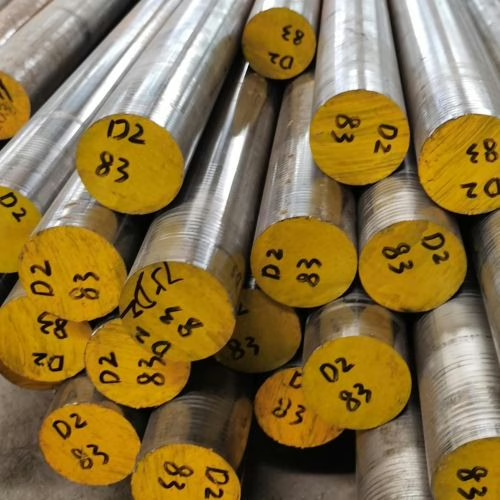
D2 | 1.2379 | SKD11
High-carbon, high-chromium cold-work tool steel for abrasive wear, edge retention, long production runs, and wear-dominated tooling.
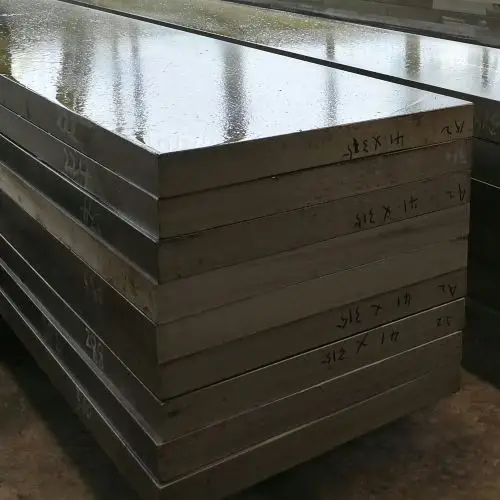
A2 | 1.2363 | SKD12
Air-hardening cold-work tool steel for better toughness, easier machining, easier grinding, and complex or chipping-sensitive tools.
The difference mainly comes from the carbide volume. D2 has higher carbon and chromium content, which form harder carbides for improved wear resistance. A2 has fewer large carbides, so it gives better toughness and easier processing.
Quick Selection Table
| Tooling Requirement | Better Choice | Why |
|---|---|---|
| Abrasive wear resistance | D2 | Higher carbide volume. |
| Edge retention | D2 | Better resistance to edge rounding. |
| Long production runs | D2 | Longer time between resharpening. |
| Chipping resistance | A2 | Better edge toughness. |
| Cracking resistance | A2 | Less sensitive to sharp corners and stress concentration. |
| Moderate impact loading | A2 | Safer than D2 under interrupted loading. |
| Easier machining | A2 | Lower carbide interference during cutting. |
| Easier grinding | A2 | Lower risk of grinding difficulty and surface damage. |
| Lower fabrication cost | A2 | Shorter machining and finishing time. |
| Maximum wear life in abrasive service | D2 | Better long-run wear performance. |
Chemical Composition Comparison
| Element | D2 Tool Steel | A2 Tool Steel |
|---|---|---|
| Carbon | 1.40% to 1.60% | 0.95% to 1.05% |
| Chromium | 11.00% to 13.50% | 4.75% to 5.50% |
| Molybdenum | 0.70% to 1.20% | 0.90% to 1.40% |
| Vanadium | 0.50% to 1.10% | 0.15% to 0.50% |
| Manganese | 0.20% to 0.60% | 0.40% to 1.00% |
| Silicon | 0.10% to 0.60% | 0.10% to 0.60% |
Equivalent Grades of D2 and A2 Tool Steel
| Standard / Region | D2 Tool Steel | A2 Tool Steel |
|---|---|---|
| AISI / ASTM | D2 | A2 |
| UNS | T30402 | T30102 |
| EN / ISO | X153CrMoV12 / X160CrMoV12-1 | X100CrMoV5 / X100CrMoV5-1 |
| DIN / W-Nr. | 1.2379 | 1.2363 |
| JIS | SKD11 | SKD12 |
| BS | BD2 | BA2 |
| AFNOR | Z160CDV12 / X160CrMoV12 | Z100CDV5 |
| GB | Cr12Mo1V1 | Cr5Mo1V |
| SS Sweden | 2310 | 2260 |
| UNI Italy | X155CrVMo12-1KU or similar listed variants | X100CrMoV5-1KU |
D2 is commonly matched with 1.2379 / X153CrMoV12 / SKD11. A2 is commonly matched with 1.2363 / X100CrMoV5 / SKD12.
Equivalent grades are useful for sourcing and quotation, but users should still confirm the exact standard, chemical composition, delivery condition, and heat-treatment requirement.
Hardness and Heat Treatment
D2 and A2 can achieve similar working hardness after heat treatment, so HRC alone should not be used to judge performance.
| Factor | D2 Tool Steel | A2 Tool Steel |
|---|---|---|
| As-quenched hardness | About 61 to 65 HRC | About 62 to 65 HRC |
| Common working hardness | About 58 to 60 HRC | About 58 to 60 HRC |
| Higher wear range | About 60 to 62 HRC | Possible in selected applications |
| Toughness-focused range | About 56 to 58 HRC | About 56 to 58 HRC |
| Austenitizing temperature | Commonly around 1850 F / 1010 C | Commonly around 1775 F / 968 C |
| Retained austenite concern | Higher | Lower |
| Grinding sensitivity | Higher | Lower |
| Dimensional stability | Excellent with proper control | Excellent and generally predictable |
D2 requires tighter control during hardening, tempering, and grinding due to its higher alloy content and the risk of retained austenite.
A2 is generally more forgiving in heat treatment and finishing. This is one reason it is often used for tools with more complex geometry or tighter manufacturing control requirements.
Machinability, Grinding, and Fabrication Cost
A2 is easier to manufacture into a finished tool. This matters when the tool has complex profiles, sharp internal corners, thin sections, or frequent regrinding requirements.
| Processing Factor | D2 Tool Steel | A2 Tool Steel |
|---|---|---|
| Machinability in annealed condition | Lower | Better |
| Typical machinability rating | Around 45% | Around 60% |
| Cutting tool wear | Higher | Lower |
| Grinding difficulty | High | Moderate |
| Resharpening cost | Higher | Lower |
| Risk of grinding burn or cracks | Higher | Lower, but still requires control |
| Best economic use | Long-run abrasive production | Short- to medium-run tooling or complex tools |
D2 can justify its higher processing cost when abrasive wear is the main cause of downtime.
A2 is often more economical when the tool does not need D2-level wear resistance, especially in short- to medium-run production.
Selection by Failure Mode
| Failure Mode | What It Looks Like | Better Choice | Practical Note |
|---|---|---|---|
| Abrasive wear | Surface wear, edge dulling, loss of tolerance | D2 | Strongest reason to choose D2 |
| Edge rounding | Cutting edge gradually loses sharpness | D2 | D2 holds the edge longer |
| Frequent regrinding | Tool wears too quickly | D2 | Useful for abrasive long-run work |
| Chipping | Small flakes break from the edge | A2 | D2 may be too brittle |
| Cracking | Tool breaks at corners, holes, or thin sections | A2 | Check geometry and stress concentration |
| Moderate impact | Interrupted loading or edge shock | A2 | Severe impact may require S-series steel |
| Grinding damage | Cracks or burns after finishing | A2 | A2 is easier to grind safely |
| Plastic deformation | Tool bends, mushrooms, or loses shape | Check hardness first | The issue may be heat treatment or tool support |
For plastic deformation, changing from A2 to D2 is not always the answer. First check hardness, heat treatment, load support, section size, and tool design. Consider whether failure is due to overloading, improper die clearance, or insufficient support before changing materials.
For tools that fail due to chipping, examine edge geometry, surface finish, and shock loading. For tools showing rapid wear, confirm lubrication and alignment conditions, as well as steel selection.
When D2 or A2 Is Not the Right Choice
| Situation | Avoid | Better Direction |
|---|---|---|
| Severe shock or battering | D2 and sometimes A2 | S7 or other shock-resisting tool steels |
| True hot-work service | D2 and A2 | H13, H11, or other hot-work tool steels |
| High-speed cutting | D2 and A2 | High-speed steel |
| Maximum abrasive wear required | A2 | D2 or higher-wear cold-work grades |
| Complex tool with chipping history | D2 | A2 or a tougher grade |
| Frequent welding repair expected | D2 | More weldable steel or tool redesign |
| Mirror polishing required | D2 | Lower-carbide steel may polish better |
| Low-duty simple component | D2 or A2 may be excessive | O1, 4140, or lower-cost steel may be enough |
Choose D2 for wear-dominated tooling
D2 is the stronger choice when abrasive wear, edge retention, and longer production life are the main requirements.
Choose A2 for tougher, easier tools
A2 is the safer choice when chipping resistance, cracking resistance, easier machining, and lower fabrication difficulty matter more.
Need D2 or A2 tool steel for cold-work tooling?
Aobo Steel supplies D2 and A2 tool steel for dies, punches, blades, forming tools, gauges, and precision tooling. Share your application, size, quantity, and tolerance for a practical supply suggestion.
Email [email protected] · Tel and WhatsApp +86 180 6294 5370
Related pages
D2 comparisons: D2 vs M2 · D2 vs 4140 · D2 vs O1 · D2 vs DC53 · D2 vs D3 · D2 vs 440C · D2 vs S7
Reference pages: Tool steel heat treatment guide · Tool steel machining allowance chart
Grade families: Tool steel grades · D-series tool steels · Tool steel material finder
Composition ranges, hardness figures and hardenability data are typical published values for D2 / 1.2379 / SKD11 and A2 / 1.2363. Confirm the exact range against the mill certificate for the delivered lot.