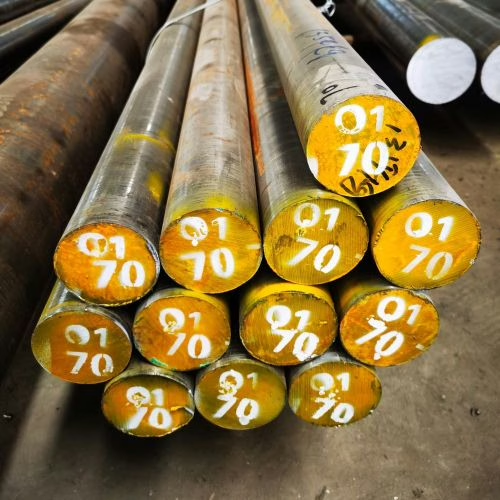
O1 Steel Hardness: Annealed, Quenched and Tempered HRC Range
O1 tool steel is usually supplied in the annealed condition, with a hardness typically not exceeding about 217 HBW. After oil quenching, O1 can reach about 64–65 HRC in the as-quenched condition. For practical use, O1 steel is hardened and tempered. Its typical hardness is about 58–60 HRC, with a broader practical range of 56–62 HRC.

Aobo Steel supplies O1 / 1.2510 / SKS3 tool steel round bar and flat bar in annealed condition for bulk industrial orders. Send your required size, quantity, tolerance, and application.
O1 Steel Hardness Quick Data
| 상태 | 일반적인 경도 | 실질적인 의미 |
|---|---|---|
| 어닐링 조건 | ≤ 217 HBW | Supplied condition for machining before hardening |
| As-quenched after oil quenching | about 64–65 HRC | Maximum hardness before tempering, not suitable for direct use |
| Common working hardness after tempering | 58–60 HRC | Standard range for many O1 cold-work tools |
| Practical hardened range | 56–62 HRC | Selected according to wear, shock, section size, and tool design |
| Higher-hardness tooling range | 60–62 HRC | Used where edge holding and wear resistance are more important |
| Lower-hardness tooling range | 56~58 HRC | Used where toughness and crack resistance are more important |
O1 Steel Hardness by Application
| 애플리케이션 | 권장 경도 | 공학적 이유 |
|---|---|---|
| Blanking dies and punches | 58–60 HRC | Good edge retention with lower chipping risk |
| Trimming punches | 58–60 HRC | Stable cutting performance in general cold-work use |
| Counterpunches and ejectors | 60–62 HRC | Higher hardness for surface pressure and wear |
| 벤딩 다이 | 58–60 HRC | Balanced hardness for forming pressure and toughness |
| 드로잉 다이 | 58–62 HRC | Selected according to sliding wear and tool support |
| Forward cold extrusion punches | 60–62 HRC | Higher hardness for compressive load and wear resistance |
| Punch shanks and mandrels | 56~58 HRC | Lower hardness improves toughness under load |
| Cutoff blades for cold heading | 60–64 HRC | Higher hardness improves cutting edge retention when shock is controlled |
| 엠보싱 다이 | 58–61 HRC | Balances surface definition, wear resistance, and crack resistance |
| 주화 제작용 주형 | 58–60 HRC | Practical balance between hardness and fracture resistance |
| Small cold rolls | 60–62 HRC | Suitable where the section can be hardened effectively in oil |
| 정밀 게이지 및 측정 도구 | 58–62 HRC | High hardness with good dimensional control |
| Sliding components, bushings, cams | 50–58 HRC | Depends on load, wear, and toughness requirements |
| Pressure plates requiring about 1700 MPa strength | 58–61 HRC | High strength and surface resistance |
| Pressure plates requiring about 1400 MPa strength | 50–54 HRC | Lower hardness for better load absorption |
| Pressure plates requiring about 1100 MPa strength | 40–44 HRC | Used where toughness is more important than cutting hardness |
For uncertain cold-work applications, 58–60 HRC is usually the most practical starting point. Hardness above 62 HRC should be used with caution, as O1 becomes more prone to chipping and cracking.
O1 Steel Tempering Hardness Chart
After oil quenching, O1 must be tempered to reduce internal stress and adjust final hardness. O1 does not have the same secondary hardening behavior as D2. As tempering temperature increases, O1 generally softens.
| 템퍼링 온도 | 대략적인 경도 |
|---|---|
| 갈증이 해소된 것처럼 | 64–65 HRC |
| 300°F / 150°C | about 63 HRC |
| 350°F / 177°C | 62–63 HRC |
| 400°F / 204°C | about 62 HRC |
| 500°F / 260°C | about 60 HRC |
| 600°F / 316°C | about 57 HRC |
| 700°F / 371°C | about 53 HRC |
| 800°F / 427°C | about 50 HRC |
| 900°F / 482°C | about 47 HRC |
For most O1 tooling, the common tempering range is about 150–260°C (300–500°F). This range keeps O1 in a useful high-hardness condition for cold-work tools. Higher tempering temperatures improve toughness but reduce hardness and wear resistance. For detailed information, see how to heat treat O1 tool steel.
Annealed Hardness of O1 Steel and Machining Behavior
O1 steel is normally supplied in the annealed condition, with hardness typically not exceeding about 217 HBW. This condition is used for machining, drilling, milling, turning, and grinding preparation before hardening.
Compared with D2, O1 is easier to machine because it has a lower volume fraction of alloy carbide. This is one reason O1 is widely used for general-purpose tools, gauges, fixtures, punches, and smaller dies.
Major machining should be completed before hardening. After O1 is hardened, conventional machining becomes difficult, and finishing is usually limited to grinding, polishing, EDM, or other post-hardening operations.
Failure Risks Related to O1 Steel Hardness
O1 failure is often related to excessive hardness, poor heat-treatment control, stress concentrations, or surface damage after hardening.
| 실패 위험 | Common Cause | 실질적인 결과 |
|---|---|---|
| 모서리 깨짐 | Hardness too high, impact loading, poor support | Cutting edge breaks before normal wear |
| 담금질 균열 | Sharp corners, uneven section thickness, delayed tempering | Tool cracks before or shortly after service |
| Brittle fracture | High hardness combined with shock or bending stress | Sudden tool failure |
| 차원 변화 | Unstable structure or poor heat treatment control | Tool size changes after hardening or during use |
| 균열을 갈아내다 | Overheating during grinding on hardened O1 | Microcracks grow under working load |
| Soft spots | Uneven hardening or excessive tempering heat | Local wear or deformation |
To reduce these risks, O1 tools should have smooth transitions, proper radii, controlled heat treatment, immediate tempering after quenching, and careful grinding after hardening.
O1 vs A2 vs D2 Hardness Comparison
O1, A2, and D2 can all work in similar HRC ranges, but they do not perform the same way. Hardness alone cannot explain tool life. Their differences come from hardenability, carbide volume, wear resistance, toughness, and machinability.
| 강철 등급 | Common Working Hardness | Hardening Type | 내마모성 | 강인함 | 가공성 |
|---|---|---|---|---|---|
| 오1 | 58–60 HRC | Oil-hardening | 좋은 | Good for general cold-work use | 좋은 |
| A2 | 57–60 HRC | 공기 경화 | Higher than O1 | Better balance than D2 | 보통의 |
| 디2 | 58–60 HRC | 공기 경화 | 매우 높음 | 낮추다 | 가난한 |
O1 is usually selected when machinability, simple heat treatment, and general-purpose cold-work performance are important. It is suitable for small- and medium-sized tools where oil quenching can provide sufficient hardness.
A2 is better when dimensional stability, higher hardenability, and better resistance to chipping are needed. D2 is better when abrasive wear resistance is the main requirement, but it is more difficult to machine and less forgiving under impact.
The selection should not be based only on HRC. O1, A2, and D2 may all be used at around 58–60 HRC, but their performance will differ under wear, impact, sliding, and cracking conditions.
Request Annealed O1 Steel Quote
Aobo Steel supplies annealed O1 tool steel for machining and further heat treatment. For available sizes, supply conditions, and bulk order details, please visit our O1 tool steel product page.
자주 묻는 질문
Annealed O1 steel is usually supplied at not more than about 217 HBW. This is the soft condition used for machining before hardening.
After proper oil quenching, O1 steel can reach about 64–65 HRC in the as-quenched condition. However, it must be tempered before use with tools.
The typical hardness of O1 tool steel is about 58–60 HRC after hardening and tempering. The broader practical range is about 56–62 HRC.
Not always. An HRC of 60–62 can be suitable for tools that require better edge retention and wear resistance. For tools exposed to impact, poor support, or cracking risk, a slightly lower hardness may be safer.
O1 loses hardness during tempering because the hard martensite formed during quenching becomes tempered martensite. As tempering temperature increases, hardness decreases and toughness improves.
No. O1 has good wear resistance for general cold-work tools, but D2 has much higher abrasive wear resistance because of its high carbon and high chromium carbide content.