
D2 vs M2 Tool Steel: Key Differences, Hardness, Applications, and Selection Guide
D2 tool steel and M2 are both high-hardness tool steels, but they are used for different tooling problems. D2 is mainly selected for cold-work wear resistance in dies, punches, forming tools, slitter knives, and blanking tools. M2 is mainly selected for high-speed cutting tools that must maintain hardness and edge strength under frictional heat. Although both steels can reach high hardness, D2 and M2 should not be treated as direct substitutes.
Choose D2 when the tool operates near room temperature and fails primarily due to abrasive wear. Choose M2 when the tool must cut at speed and resist softening at elevated cutting temperatures.
D2 and M2 Tool Steel Available from Aobo Steel
Aobo Steel supplies D2 cold-work tool steel and M2 high-speed steel for dies, punches, cutting tools, knives, broaches, thread-rolling dies, and severe wear applications.
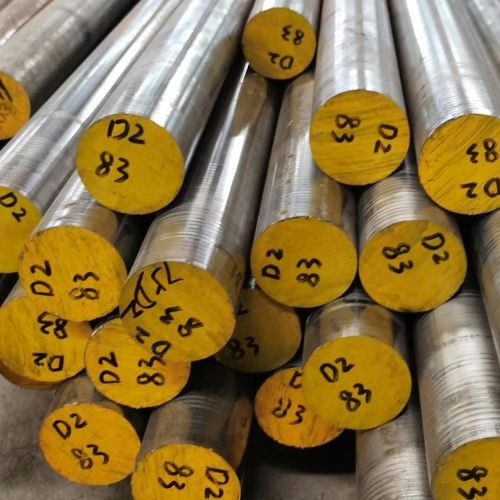
D2 | 1.2379 | SKD11
High-carbon, high-chromium cold-work tool steel for abrasive wear, edge retention, blanking dies, forming tools, punches, and slitter knives.
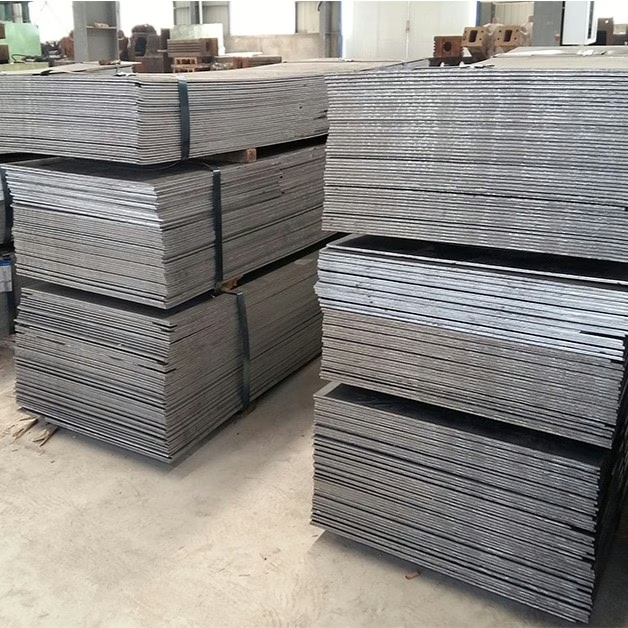
M2 | 1.3343 | SKH51
Molybdenum-tungsten high-speed steel for drills, taps, end mills, broaches, hobs, saw blades, cutters, and heat-generating cutting service.
D2 vs M2 Tool Steel: Quick Comparison
| Factor | D2 Tool Steel | M2 Tool Steel |
|---|---|---|
| Steel type | Cold-work tool steel | High-speed tool steel |
| Main alloy system | High carbon and high chromium | Molybdenum, tungsten, chromium, and vanadium |
| Main strength | Cold-work abrasive wear resistance | Hot hardness and cutting edge retention |
| Typical working hardness | About 58–62 HRC | About 62–65 HRC |
| Heat resistance | Limited compared with high-speed steel | Strong resistance to softening under cutting heat |
| Toughness | Moderate to low | Slightly better than D2, but not a shock-resisting steel |
| Typical applications | Dies, punches, blanking tools, forming tools, slitter knives | Drills, taps, end mills, broaches, saws, milling cutters |
| Cost level | Usually lower | Usually higher |
| Best selection logic | Wear resistance in cold work | Edge retention under speed and heat |
The key difference is not only hardness. D2 is selected for wear at lower working temperatures. M2 is selected when heat, speed, and cutting-edge stability are considered in controlling tool life.
What Is D2 Tool Steel?
D2 tool steel is a high-carbon, high-chromium cold-work tool steel. Its main value is strong abrasive-wear resistance, combined with good dimensional stability after proper heat treatment.
D2 is widely used for blanking dies, forming dies, drawing dies, punches, slitter knives, shear blades, chipper knives, thread-rolling dies, coining tools, wear plates, and gauges. In industrial cutting and shearing tools such as slitter knives, shear blades, and chipper knives, the main failure mode is abrasive edge wear at near room temperature rather than heat softening, which is exactly where D2 performs well. It holds its edge and dimension under cold shearing wear at a reasonable cost.
The same carbide structure that gives D2 strong wear resistance also limits its toughness. For heavy impact, severe shock, or tools with sharp stress concentration, D2 may chip or crack. In those cases, a tougher grade such as S7, H11, or another suitable tool steel may be safer.
What Is M2 Tool Steel?
M2 tool steel is a molybdenum-tungsten high-speed steel. Its main value is the ability to maintain hardness and cutting-edge strength under the heat generated by high-speed machining.
M2 is commonly used for twist drills, taps, reamers, end mills, milling cutters, broaches, hobs, saw blades, threading dies, lathe tools, and other cutting tools. It can also be used in some severe cold-work applications when D2 is not sufficiently resistant to chipping, edge breakdown, or demanding wear conditions.
M2 is not simply a “harder version” of D2. It uses a different alloy system and is more demanding in heat treatment. It is also usually more expensive, so the performance improvement must justify the cost.
D2 vs M2 Equivalent Grades
| Steel Grade | AISI / SAE | UNS | DIN / EN | JIS | GB / China | Common Description |
|---|---|---|---|---|---|---|
| D2 Tool Steel | D2 | T30402 | 1.2379 / X153CrMoV12 | SKD11 | Cr12Mo1V1 | High-carbon, high-chromium cold-work tool steel |
| M2 Tool Steel | M2 | T11302 | 1.3343 / HS6-5-2C | SKH51 | W6Mo5Cr4V2 | Molybdenum-tungsten high-speed steel |
In international purchasing, D2 may be requested as 1.2379, SKD11, or Cr12Mo1V1. M2 may be requested as M2, 1.3343, SKH51, or W6Mo5Cr4V2. Before placing an order, buyers should confirm the required standard, chemical composition, delivery conditions, size tolerances, inspection requirements, and application.
D2 vs M2 Chemical Composition
D2 depends mainly on high carbon and high chromium for cold-work wear resistance. M2 depends on molybdenum, tungsten, and vanadium for secondary hardening, hot hardness, and cutting performance.
| Element | D2 Tool Steel | M2 Tool Steel | Practical Meaning |
|---|---|---|---|
| Carbon | About 1.40–1.60% | About 0.78–0.90% in standard M2 | Supports hardness and carbide formation |
| Chromium | About 11.00–13.00% | About 3.75–4.50% | D2 forms more chromium-rich carbides for abrasive wear resistance |
| Molybdenum | About 0.70–1.20% | About 4.50–5.50% | M2 gains stronger secondary hardening and hot hardness |
| Tungsten | Not a main alloying element | About 5.50–6.75% | Supports red hardness and cutting performance |
| Vanadium | About 0.70–1.10% | About 1.75–2.20% | Improves wear resistance and edge stability |
| Cobalt | Normally absent | Normally absent in standard M2 | Cobalt is more relevant to grades such as M35 and M42 |
D2 has much higher chromium and carbon, so it forms a large amount of wear-resistant carbides. This is useful for cold-work dies and punches, but it also makes the steel less tough and more difficult to machine.
M2 has much higher molybdenum, tungsten, and vanadium. These elements help the steel retain its hardness after high-temperature tempering and during cutting service. That is why M2 is preferred for high-speed tools, while D2 is preferred for cold-work tooling.
D2 vs M2 Hardness
D2 and M2 can both reach high hardness, but their hardness serves different purposes.
| Steel | Typical Working Hardness | Main Purpose |
|---|---|---|
| D2 Tool Steel | About 58–62 HRC | Wear resistance in cold-work dies, punches, and shearing tools |
| M2 Tool Steel | About 62–65 HRC | Cutting edge retention and hot hardness in high-speed tools |
D2 hardness supports wear resistance in cold forming, blanking, stamping, and shearing. It can achieve high hardness, but it does not retain it as well as M2 when the working edge becomes hot.
M2 usually works at a higher hardness range and has much better resistance to softening under cutting heat. Its secondary hardening response is one of the main reasons it performs well in drills, taps, milling cutters, and broaches.
For cold-work dies, higher hardness is not always better. If a D2 tool chips or cracks, simply increasing the hardness may make the problem worse. The correct hardness depends on the tool design, section size, heat treatment, work material, and failure mode.
D2 vs M2 Heat Treatment Difference
Heat treatment is a major difference between D2 and M2 because the two steels are designed for different service conditions. D2 heat treatment focuses on cold-work wear resistance, dimensional stability, and controlled toughness. M2 heat treatment focuses on secondary hardening, hot hardness, and cutting-edge retention.
| Heat Treatment Factor | D2 Tool Steel | M2 Tool Steel |
|---|---|---|
| Main purpose | Wear resistance and dimensional stability in cold-work tooling | Hot hardness and cutting edge retention in high-speed cutting tools |
| Preheating | Usually preheated slowly around 1200–1300°F / 650–705°C | Often uses double preheating before final hardening |
| Austenitizing temperature | Commonly around 1850°F / 1010°C | Commonly around 2200–2225°F / 1200–1220°C |
| Soaking control | Needs enough soak to prepare for hardening without overheating | Needs very short, tightly controlled soaking |
| Atmosphere control | Surface protection is important | More sensitive to oxidation and decarburization |
| Quenching | Known for air-hardening and good dimensional stability | Can be quenched in air, oil, or salt bath depending on process |
| Tempering | Used to balance hardness, wear resistance, toughness, and size stability | Double tempering is required; triple tempering is often used |
| Main risk | Cracking, brittleness, retained austenite, or dimensional change | Decarburization, overheating, grain growth, or incipient melting |
D2 is generally more forgiving than M2, but improper heat treatment can still cause cracking, excessive brittleness, retained austenite, or dimensional change. Its heat treatment should not be driven solely by hardness; the final result must match the tool’s wear conditions, section size, and chipping risk.
M2 is more demanding because it is hardened at a much higher temperature and depends strongly on high-temperature tempering. The process must carefully control the furnace atmosphere, soak time, and tempering cycles. Otherwise, the tool may lose surface carbon, become brittle, or fail to reach the expected hot hardness.
For selection, this means M2 is not only a more expensive steel grade but also requires stricter heat-treatment control. If the application does not require hot hardness or high-speed cutting performance, D2 is often the more practical choice. If the tool edge must keep hardness under cutting heat, M2 is the safer selection.
See detailed heat treatment information: how to heat treat D2 tool steel and how to heat treat M2 tool steel.
D2 vs M2 Machinability
Neither D2 nor M2 is an easy steel to machine. Both are alloy-rich, carbide-bearing grades, and both must be machined in the annealed condition before hardening. The hard final part is produced by grinding, not by cutting the hardened steel.
D2 is demanding because its high chromium and carbon form a large volume of hard chromium carbides. These carbides are abrasive and wear cutting tools quickly, so machining D2 usually means slower feeds, sharp carbide tooling, and allowance for tool wear. M2 in the annealed condition is also limited, but its carbide structure is generally less abrasive to machine than D2, so many shops find annealed M2 slightly easier to cut than annealed D2.
For purchasing and production planning, the practical points are simple. Order both grades in the annealed condition for machining. Leave grinding stock for the final dimensions, because the part is sized by grinding after heat treatment. Do not plan to machine either grade in the hardened state. If a project depends heavily on fast, low-cost machining, neither D2 nor M2 is the right starting point, and a more machinable tool steel or pre-hardened grade should be considered.
D2 vs M2: Wear Resistance, Toughness, and Heat Resistance
D2 and M2 are both wear-resistant steels, but they are not equally strong in the same conditions.
| Property | Better Choice | Reason |
|---|---|---|
| Cold-work abrasive wear | D2 | High carbon and high chromium create strong wear-resistant carbide volume |
| Cutting edge retention | M2 | Molybdenum, tungsten, and vanadium support hot hardness and edge stability |
| Hot hardness | M2 | M2 resists softening better at elevated cutting temperatures |
| Toughness | M2, slightly | M2 is usually tougher than D2, but neither grade is ideal for heavy shock |
| Dimensional stability in cold-work tooling | D2 | D2 is widely used where wear resistance and dimensional control are required |
| Severe impact resistance | Neither | Use a tougher grade such as S7 or H11 |
D2 usually has the advantage in cold-work abrasive wear. It is suitable for tools that primarily experience sliding wear, edge wear, or abrasion at lower working temperatures.
M2 has an advantage when heat is a failure mode. Cutting tools need to maintain hardness even as their edges heat up. D2 cannot match M2 in this area.
In terms of toughness, M2 is usually better than D2, but the difference is limited. Both steels are high-hardness, carbide-rich grades. If the tool fails due to cracking, impact breakage, or shock loading, a tougher tool steel may be a better solution than either D2 or M2.
D2 vs M2 Applications
| Application | Better Choice | Reason |
|---|---|---|
| Blanking dies | D2 | Strong cold-work wear resistance |
| Forming dies | D2 | Suitable for wear-resistant cold forming |
| Drawing dies | D2 | Good wear resistance and dimensional stability |
| Punches | D2 or M2 | D2 for general cold-work wear; M2 for more severe edge chipping or demanding service |
| Slitter knives | D2 or M2 | D2 for cold shearing wear; M2 for higher speed or more severe cutting conditions |
| Thread-rolling dies | D2 or M2 | D2 is common; M2 may be used for heavier-duty work |
| Twist drills | M2 | Requires hot hardness and cutting edge retention |
| Taps and reamers | M2 | Requires stable cutting performance under frictional heat |
| End mills and milling cutters | M2 | D2 is not designed for high-speed cutting |
| Broaches and hobs | M2 | Requires edge strength, wear resistance, and hot hardness |
| Severe impact tools | Neither | Consider shock-resisting or tougher grades |
D2 is usually selected when the tool operates under cold-working conditions and requires wear resistance at a reasonable cost. M2 is selected when the tool cuts material at speed and must resist edge softening under heat.
M2 can be used as a premium upgrade in some severe-cold-work tools, but it should not be chosen solely because it is harder. The additional cost must be justified by longer tool life, reduced downtime, or better performance in a specific failure mode.
For most cold shearing and chipping tools, D2 is the practical choice because the working edge stays cool and failures are mainly due to wear. M2 becomes worth its higher cost only when the same knives run at higher speed, see more frictional heat, or fail from edge chipping that D2 cannot resist, in which case the gain in edge stability has to justify the price.
Can D2 Replace M2?
D2 usually cannot replace M2 in high-speed cutting applications. It does not have the same red hardness, secondary hardening response, or resistance to softening under cutting heat.
For drills, taps, milling cutters, broaches, hobs, saws, and other cutting tools, M2 is normally the safer choice. D2 may be wear-resistant at room temperature, but that does not make it suitable for high-speed cutting.
D2 should be considered only when the application is more about cold shearing, forming, or wear resistance than true high-speed machining. If the tool edge becomes hot during service, M2 is usually the better option.
Can M2 Replace D2?
M2 can replace D2 in some cold-work applications, but it is not always necessary. It may be useful when D2 fails from edge chipping, galling, insufficient edge strength, or short tool life in severe service.
Common examples include heavy-duty punches, cold-heading inserts, thread-rolling dies, severe blanking tools, and some cutting or shearing applications where D2 does not provide enough performance.
The trade-off is cost and heat-treatment difficulty. M2 is more expensive and more sensitive to decarburization. It normally requires controlled atmosphere, vacuum, or salt-bath heat treatment to achieve reliable results.
If the application is a standard cold-work die, and D2 already provides acceptable tool life, M2 may not be economical. M2 should replace D2 only when the performance gain is clear.
When Not to Use D2 or M2
D2 and M2 are not universal tool steels. Both are high-hardness grades and have limitations in impact resistance, weldability, and in highly stressed tool designs.
| Situation | Avoid | Better Direction |
|---|---|---|
| Severe impact or shock loading | D2 and M2 | Consider S7, H11, or another tougher grade |
| Hot die casting or hot extrusion | D2 and M2 | Consider H13, H11, or other hot-work tool steels |
| General plastic mold plate | D2 and M2 | Consider P20, 1.2311, or 1.2738 |
| Low-cost structural parts | D2 and M2 | Consider alloy steels such as 4140 / 42CrMo |
| High-speed cutting tools | D2 | Use M2 or another high-speed steel |
| Standard cold-work dies with cost pressure | M2 may be unnecessary | D2 is usually more practical |
| Tools requiring welding | D2 and M2 | Redesign the tool or choose a more weldable material |
| Sharp-cornered designs with severe stress concentration | D2 and M2 | Improve tool design or use a tougher steel |
Do not use D2 as a high-speed cutting steel. Do not use M2 simply because it is harder or more expensive. The correct choice depends on working temperature, wear type, impact load, production volume, and heat-treatment capability.
Choose D2 for cold-work abrasive wear
D2 is the practical choice when the tool works near room temperature and failure is mainly wear, edge rounding, or loss of dimensional control.
Choose M2 for speed, heat, and edge retention
M2 is the better choice when a cutting edge must keep hardness and strength under frictional heat or demanding high-speed service.
Need D2 or M2 tool steel for industrial tooling?
Aobo Steel supplies D2 and M2 tool steel for dies, punches, cutting tools, knives, broaches, thread-rolling dies, and severe wear applications. Share your grade, size, quantity, and use case for a practical material suggestion.
Email [email protected] · Tel and WhatsApp +86 180 6294 5370
Related pages
D2 comparisons: D2 vs 4140 · D2 vs O1 · D2 vs A2 · D2 vs DC53 · D2 vs D3 · D2 vs 440C · D2 vs S7
Reference pages: Hardness conversion calculator · Tool steel hot hardness chart · Annealing and normalizing chart
Grade families: Tool steel grades · D-series tool steels · High-speed steels · Tool steel material finder
Composition, hardness and heat-treatment figures are typical published values for D2 / 1.2379 / SKD11 and M2 / 1.3343 / SKH51. Confirm the exact range against the mill certificate for the delivered lot.