
4140 vs H13 Tool Steel: Hot Work or Mechanical Parts?
4140 is a chromium-molybdenum structural alloy steel for machinery components that run at room to moderate temperature. H13 is a hot work tool steel for dies and tooling that operate hot, often above 500°C.
Whether one can replace the other in a given part turns almost entirely on operating temperature. Use H13 when hot hardness, thermal fatigue resistance, and molten-metal erosion resistance matter. Use 4140 for shafts, holders, fixtures, and structural machine parts that do not work hot. Plain structural grades such as A36 carry far less carbon and alloy, and the comparison against tool steel is in the A36 vs tool steel page.
Selection rule: if the working surface sees sustained heat above about 350-400°C, choose H13. If the part is a structural support or mechanical component operating at room to moderate temperature, 4140 is usually enough.
Source H13 Tool Steel from Aobo Steel
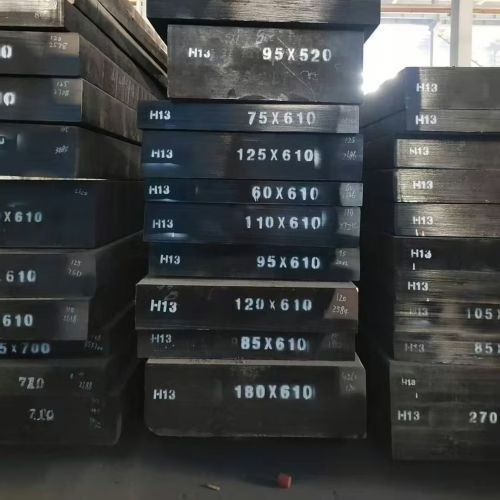
If your application runs hot, H13 is the grade to specify. Aobo Steel supplies H13 in forged and rolled form, annealed condition, as round bar, flat bar, and forged block. H13 ESR is available for premium die casting and high-polish work.
H13 | 1.2344 | SKD61
Hot work tool steel for aluminum die casting dies, hot forging dies, hot extrusion tooling, hot shear blades, mandrels, inserts, and tooling that must resist heat checking.
Quick Answer: 4140 vs H13
4140 and H13 can reach similar peak hardness in thin sections, but they are not used for the same job. 4140 is a strong structural alloy steel. H13 is designed to keep hardness, strength, and surface integrity during repeated high-temperature service.
| Decision Factor | 4140 Alloy Steel | H13 Tool Steel |
|---|---|---|
| Steel type | Chromium-molybdenum structural alloy steel | Chromium hot work tool steel |
| Main role | Load-bearing machine and structural components | Hot dies, inserts, tools, and high-temperature tooling |
| Typical working hardness | 28-32 HRC, sometimes 30-45 HRC after quench and temper | 44-52 HRC for many hot work tools |
| High-temperature service | Softens quickly as temperature rises | Maintains useful hot hardness and strength |
| Thermal fatigue resistance | Poor for hot-cold cycling | Excellent for heat checking resistance |
| Best use | Shafts, gears, axles, bolts, fixtures, holders, base plates | Die casting dies, forging dies, extrusion dies, hot shear blades |
| Cost | Lower material cost | Higher material cost, but longer life in hot work |
Chemical Composition
| Element | 4140 | H13 |
|---|---|---|
| Carbon (C) | 0.38-0.43% | 0.35-0.42% |
| Silicon (Si) | 0.15-0.35% | 0.80-1.20% |
| Manganese (Mn) | 0.75-1.00% | 0.25-0.50% |
| Chromium (Cr) | 0.80-1.10% | 4.80-5.50% |
| Molybdenum (Mo) | 0.15-0.25% | 1.20-1.50% |
| Vanadium (V) | None | 0.80-1.20% |
Both grades carry similar carbon, so their peak as-quenched hardness is close. The decisive difference is alloy content. H13 holds roughly five times the chromium, six times the molybdenum, and a deliberate vanadium addition. These elements form stable alloy carbides and drive secondary hardening, which lets H13 keep its hardness when hot.
4140 carries far less alloy because it was never meant to work hot. Its chemistry is built for strength, toughness, hardenability, and machinability in structural service.
Key Property Differences
| Property | 4140 | H13 |
|---|---|---|
| Steel type | Alloy structural steel | Hot work tool steel |
| Typical working hardness | 28-32 HRC | 44-52 HRC |
| Max attainable hardness | About 55 HRC | About 54 HRC |
| Hot hardness at 500°C | Softens quickly | Holds hardness |
| Thermal fatigue resistance | Poor | Excellent |
| Wear resistance, room temperature | Low | Moderate |
| Wear resistance, hot | Poor | Good |
| Toughness | Good | Good |
| Machinability, annealed | Excellent | Good |
| Cost per kg | Lower | Higher |
| Weldability | Easier with preheat | More difficult |
4140 can be quenched as hard as H13, or slightly harder, because of its carbon. Peak hardness is not what separates the two grades, and 4140 is rarely run above about 45 HRC anyway because toughness falls off. The gap that matters opens under heat: 4140 loses hardness, while H13 keeps it.
When to Choose H13 Over 4140
The part runs hot
Above roughly 350-400°C, 4140 loses strength quickly because it has no secondary hardening to fall back on. H13 keeps useful hardness and strength to around 600°C.
The part cycles hot and cold
Repeated heating and cooling drives heat checking. H13 resists this fine surface cracking much better than 4140.
Wear must hold up at temperature
4140 can wear acceptably at room temperature, but it softens and wears rapidly once hot. H13’s alloy carbides and secondary hardening improve hot wear resistance.
The surface faces molten metal
In die casting, molten aluminum around 680°C or zinc around 420°C can erode the die face. H13 resists washout far better than 4140.
Typical H13 applications include aluminum die casting dies, hot forging dies, hot extrusion tooling, hot stamping dies, hot shear blades, core pins, mandrels, and hot work inserts.
When 4140 Is Enough
4140 is often the right call when the part is not a hot working tool:
- Service stays at room temperature or below about 250°C, such as shafts, machine parts, fasteners, and structural components.
- The part is a holder, bolster, or base plate that supports tooling but never contacts hot metal directly.
- Good toughness at moderate hardness, commonly 30-40 HRC, covers the requirement.
- Welding or weld repair matters, since 4140 tolerates it better than H13.
- Material cost is the main constraint and the duty is light.
Quick Application Guide
| Application | Recommended | Why |
|---|---|---|
| Aluminum die casting die | H13 | Hot hardness, thermal fatigue resistance, and erosion resistance are all essential. |
| Hot forging die | H13 | Sustained heat plus impact require hot work tool steel. |
| Aluminum extrusion die | H13 | Hot wear and thermal fatigue resistance are needed. |
| Hot shear blade | H13 or H10 | Hot hardness and wear resistance control blade life. |
| Die holder or bolster plate | 4140 or P20 | The part provides structural support and is not directly heated. |
| Machine shaft at ambient temperature | 4140 | Good strength and toughness at lower cost. |
| Cold work production die | D2 or A2 | Dedicated cold work steels provide better wear life. |
Why Cheaper Material Often Costs More
H13 costs more per kilogram than 4140 because of its higher alloy content and more demanding processing. In a hot work application, though, the figure that matters is cost per part produced.
- H13 dies last far longer, which means fewer die changes and less downtime.
- Fewer parts are scrapped as the die degrades.
- H13 tolerates aggressive cooling and thermal cycling without early cracking, which supports faster and more stable production.
Specifying 4140 in a hot work tool to save on material is usually false economy. The shorter die life and lost production time can cost far more than the material ever saved.
Aobo Steel Supply
Aobo Steel supplies H13 tool steel (1.2344 / SKD61 / 4Cr5MoSiV1) in forged and rolled form, mainly in annealed condition for bulk export. H13 is one of our core grades, stocked as round bar, flat bar, and forged block. H13 ESR is available for premium die casting and high-polish applications.
For 4140, please inquire. Aobo Steel specializes in tool steel and mold steel rather than general engineering alloys, so 4140 availability is confirmed per order. Where the part allows, a tool steel alternative often delivers better long-term value.
Need H13 for hot work tooling?
Send your grade, size, quantity, delivery requirement, and application. Aobo Steel can confirm H13 forged or rolled supply, annealed condition, ESR option, and mill certificate requirements.
Email [email protected] · Tel and WhatsApp +86 180 6294 5370
Related pages
H13 comparisons: H13 vs H11 · H13 vs A2 · H13 vs P20 · H13 vs H21 · H13 vs SKD61
Reference pages: Thermal fatigue resistant tool steels · Tool steel heat treatment guide · H13 steel properties
Grade families: H-series tool steels · Tool steel grades · Tool steel material finder
Composition, hardness and heat-treatment figures are typical published values for 4140 / 42CrMo4 and H13 / 1.2344 / SKD61. Confirm the exact range against the mill certificate for the delivered lot.