
Aobo Steel | Global Tool Steel Supplier in China
D2 Tool Steel (1.2379 / SKD11) Selection & Bulk Supply Guide | Aobo Steel
Stable Supply for Distributors & Stockists
MOQ 5 Tons | Mill Length 2–5.5m | MTC per Order
Most failures in D2 tool steel applications originate from incomplete specifications rather than material defects. When hardness, delivery condition, surface condition, or tolerance are not clearly defined, the result is unstable tool life, premature cracking, excessive wear, or unnecessary machining cost.
In bulk purchasing, these problems are not detected at the order stage. They appear later in production, where correction becomes costly and difficult.
This guide structures the key specification decisions into a practical framework, helping buyers align application requirements, material conditions, and supply constraints before placing an order.
How to Specify D2 Based on Application
The specification must begin with service conditions, not with the material name.
D2 performs reliably in applications dominated by abrasive wear and compressive loading. Under these conditions, it provides stable wear resistance and long service life. However, in applications involving repeated impact, edge shock, or intermittent loading, D2 becomes prone to chipping and cracking. In such cases, failure is caused by incorrect material selection, not material quality.
Delivery conditions must also be defined at this stage. D2 is typically supplied in the annealed condition to allow machining before heat treatment. If this is not specified, downstream processing becomes unpredictable.
Tolerance should only be tightened on functional dimensions. Applying tight tolerances across all dimensions increases machining cost without improving performance.
Read more: How to Specify D2 for Wear-Resistant Applications
Hardness Selection Logic
Hardness must match the application, not be maximized.
Higher hardness improves abrasion resistance but reduces the ability to absorb stress. When hardness exceeds the application’s tolerance, failure shifts from gradual wear to sudden damage such as edge chipping or cracking. These failures occur early and unpredictably.
If hardness is too low, wear accelerates and increases local stress, which can also lead to instability.
The correct approach is to match hardness to load conditions. Abrasive-wear applications benefit from higher hardness, while operations involving impact or load variation require greater toughness.
For many wear-resistant applications, a range around 58–60 HRC provides a practical balance. Hardness must also be defined together with the testing location and application context to avoid inconsistent results.
Read more: Choosing the Right Hardness: Avoid Premature Failure
Surface Condition Decision (Black vs Machined)
Surface condition determines whether machining risk is controlled before or after delivery.
Black surface material retains scale and a decarburized layer, both of which must be completely removed. It offers a lower purchase cost but requires sufficient machining allowance and stable rough machining capability.
Machined surface material has this layer removed in advance. It arrives dimensionally controlled, reducing variability in machining and heat treatment.
If the decarburized layer is not fully removed, the surface cannot reach the required hardness. This leads to immediate performance failure after heat treatment.
Most failures occur when black material is ordered too close to the final size, leaving insufficient allowance for proper cleanup.
The decision must be based on machining capability and allowance, not price alone.
Read more: Black vs Machined Surface: Cost vs Performance Trade-off
Bulk Supply Considerations
Bulk supply follows fixed production and logistics rules. Ignoring these constraints leads to failed quotations or increased cost. Round bar form and supply for 1.2379 are covered on the 1.2379 round bar page.
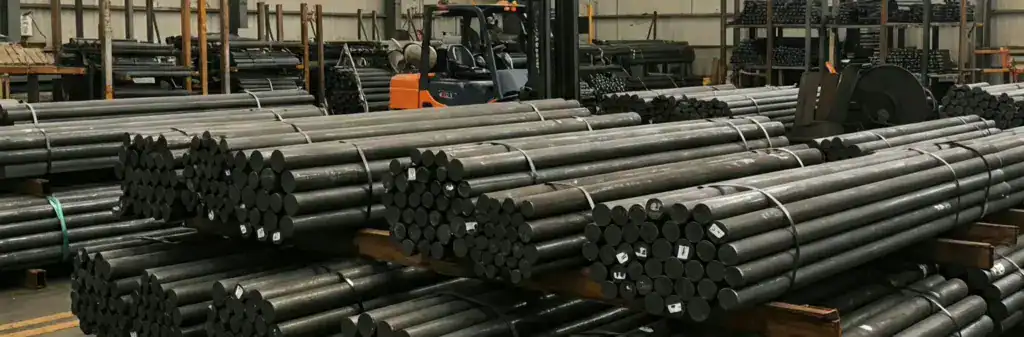
D2 is supplied in mill lengths (approximately 2–5.5 meters), optimized for container loading. Fixed cut lengths are not part of the standard bulk supply and should be arranged after delivery.
Tolerance is defined by surface condition. Black material typically follows 0 / +5 mm, while machined material can achieve 0 / +1 mm. Requesting tight tolerances on raw material increases cost without improving functional performance.
The minimum order quantity is 5 tons, with approximately 26 tons per 20GP container being the most efficient configuration.
Size availability must be confirmed within standard ranges before quotation.
Most quotation failures result from:
- Requesting fixed lengths instead of mill length
- Expecting machining-level tolerances on raw material
- Ordering below the MOQ
- Requesting non-standard sizes
For distributors and stockists, selecting standard sizes, mill length, and black surface improves supply stability and cost efficiency.
Read more: Bulk Order Checklist: Length, Tolerance, MOQ Explained
Practical Decision Flow
A correct specification follows a fixed sequence. Defining parameters independently leads to a mismatch and unstable results.
Step 1: Application Assessment
Confirm that abrasive wear and compressive loading dominate. If impact is significant, reconsider D2.
Step 2: Hardness Definition
Define a hardness range based on service conditions. Avoid specifying maximum hardness without considering fracture risk.
Step 3: Surface Condition Selection
Select surface condition based on machining capability and allowance. Ensure the decarburized layer can be fully removed if black material is used.
Step 4: Supply Specification Alignment
Align the order with bulk supply conditions. Define mill length, realistic tolerances, MOQ, and delivery conditions.
A usable order specification should include:
- Grade
- Condition
- Size
- Tolerance
- Surface
- Length
- Quantity
Only when these parameters are aligned can the specification be executed reliably in production.
Ready to Source D2 Tool Steel in Bulk?
Tell us your required size and quantity.
We will confirm availability, delivery conditions, and pricing.