
S Series Tool Steel
S series tool steel is the shock-resisting group in the AISI tool steel classification system. The “S” designation refers to shock resistance, which makes these steels suitable for tools exposed to repeated impact, sudden load, chipping, cracking, or breakage.
S Series Tool Steels Available from Aobo Steel
Aobo Steel supplies S series shock-resisting tool steel in bulk round bar and flat bar for industrial tooling buyers, distributors, stockists, and machining companies.
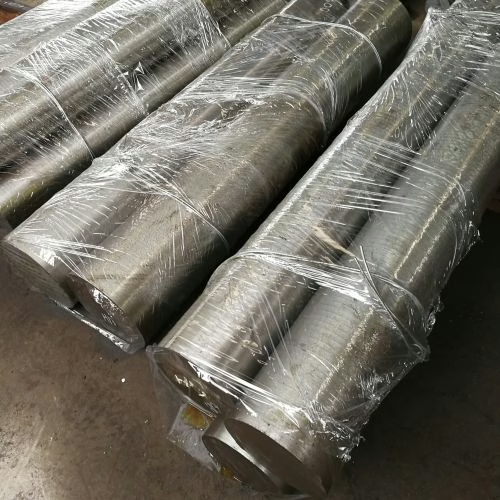
S1 | 1.2550
Shock-resisting tool steel for applications that may need impact resistance, moderate hot hardness, or surface hardening options.

S7 | 1.2355
Widely used shock-resisting tool steel with air-hardening behavior, good hardenability, and better dimensional stability.
S series tool steel is the shock-resisting group in the AISI tool steel classification system. The “S” designation refers to shock resistance, which makes these steels suitable for tools exposed to repeated impact, sudden load, chipping, cracking, or breakage.
Unlike high-carbon cold-work tool steels, S-series steels are not primarily designed for maximum abrasive wear resistance. They usually use a lower-carbon range and a tougher, heat-treated matrix, allowing the tool to absorb impact energy rather than fail suddenly.
Most S series steels contain combinations of silicon, manganese, chromium, molybdenum, tungsten, or vanadium. These alloying elements control hardenability, tempering response, strength, toughness, and heat resistance. Because the alloy design differs by grade, S1, S2, S5, and S7 can behave very differently during heat treatment and service.
Among common S series grades, S7 is widely used because it combines high shock resistance, air-hardening behavior, and better dimensional stability. S5 is often used for heavy impact tools. S1 can be selected when shock resistance and moderate hot hardness are needed. S2 is more suitable for specific tools that need a hard case and tough core.
Typical applications include chisels, punches, shear blades, rivet tools, concrete breakers, forming tools, and selected moderate hot-work tooling.
Why S Series Tool Steel Is Used for Shock Resistance
The shock resistance of the S series tool steel comes from its chemistry and heat-treated microstructure.
The carbon content is commonly around 0.40% to 0.65%. This range allows the steel to develop high strength after hardening and tempering while limiting the formation of large, brittle carbides. Large carbides improve abrasion resistance, but they can also become crack initiation points under impact loading.
Alloying elements then adjust the steel’s response. Silicon improves tempering resistance. Chromium, molybdenum, manganese, tungsten, and vanadium can improve hardenability, strength, hot hardness, or wear resistance depending on the grade.
After proper heat treatment, S series steels form a tough martensitic structure with fine carbides. This structure is better suited to absorbing repeated blows than a highly carbide-rich structure. That is the metallurgical reason S-series steels are used for impact-loaded tooling.
Key Properties of S Series Tool Steel
| Property | S Series Tool Steel Characteristics |
|---|---|
| Toughness | High to very high. This is the defining property of the group. |
| Hardness | Selected according to tool load, grade, and heat treatment condition. |
| Wear resistance | Low to medium compared with high-carbon cold work tool steels. |
| Hardenability | Varies by grade. S2 is shallow-hardening; S7 has much deeper hardenability. |
| Dimensional stability | Strongly affected by the quenching method. Air-hardening grades are usually more stable. |
| Heat resistance | Some grades can work in moderate hot-work conditions up to about 1000°F to 1050°F, or 540°C to 565°C. |
| Machinability | Generally moderate in annealed condition. |
S Series Tool Steel vs D Series Tool Steel
The main difference in the selection is the failure mode.
| Comparison Item | S Series Tool Steel | D Series Tool Steel |
|---|---|---|
| Tool steel type | Shock-resisting tool steel | High-carbon, high-chromium cold work tool steel |
| Main purpose | Toughness under impact | Wear resistance and edge retention |
| Carbon direction | Lower carbon than D series | High carbon |
| Carbide structure | Fewer coarse carbides | High volume of hard chromium-rich carbides |
| Toughness | Higher | Lower |
| Abrasive wear resistance | Lower | Higher |
| Heat treatment behavior | Depends strongly on grade: water, oil, or air hardening | Many grades are air-hardening, except grades such as D3 |
| Typical use | Chisels, punches, shear blades, impact tools | Blanking dies, slitting knives, forming dies, wear tooling |
| Better choice when | The tool breaks, chips, or cracks | The tool mainly wears out |
Heat Treatment of S Series Tool Steel
Heat treatment of S series tool steel must control four risks: surface decarburization, graphitization, quench cracking, and excessive brittleness.
Many S series steels contain silicon. During heating, a poor furnace atmosphere can cause surface decarburization. A decarburized surface loses carbon and becomes weaker than the core. This can reduce fatigue strength, edge strength, and service life.
High-silicon grades can also undergo graphitization if overheated or held at high temperatures for too long. This damages the steel structure and reduces service reliability. Controlled-atmosphere, vacuum, or neutral salt-bath heating is preferred when surface quality is important.
The usual heat treatment route is shown below.
| Heat Treatment Stage | Purpose |
|---|---|
| Annealing | Produces a soft, uniform structure for machining. |
| Preheating | Reduces thermal shock before austenitizing. |
| Austenitizing | Prepares the steel for hardening. |
| Quenching | Hardens the steel according to grade and section size. |
| Tempering | Reduces brittleness and sets the final hardness-toughness balance. |
| Double tempering | Often used for grades such as S5 and S7 to improve stability and toughness. |
The quenching method is one of the biggest differences between S grades.
| Quenching Method | Typical Meaning |
|---|---|
| Water quenching | Fast cooling, high hardening effect, higher risk of cracking and distortion. |
| Oil quenching | Safer than water quenching and common for medium-hardenability grades. |
| Air hardening | Improved dimensional stability and reduced risk of quench cracking in suitable section sizes. |
The following ranges should be treated as typical reference values, not as a replacement for the steelmaker’s heat treatment datasheet. Final practice should consider tool size, furnace type, surface protection, section thickness, and required working hardness.
| Grade | Typical Preheating | Austenitizing Range | Quenching Method | Typical Tempering / Hardness Direction |
|---|---|---|---|---|
| S1 | ~1200°F / 650°C | 1650–1750°F / 900–955°C | Oil quench | Temper at 400–1200°F / 205–650°C. Working hardness may range from about 58 HRC to 40 HRC depending on tempering temperature. |
| S5 | ~1400°F / 760°C | 1600–1695°F / 870–925°C | Oil quench | Double tempering is recommended. About 40–44 HRC is typical for maximum shock applications. |
| S7 | 1200–1300°F / 650–705°C | 1695–1750°F / 925–955°C | Air quench in suitable sections | Double tempering at 900–960°F / 482–516°C is commonly used. Final hardness is about 58–60 HRC in this range. |
S7 is commonly treated as an air-hardening shock-resisting tool steel. It is often preferred for tools that need better dimensional stability or have more complex shapes. S5 is commonly oil-quenched. S2 usually has a higher heat treatment risk because it is associated with faster quenching.
Tempering should follow quenching promptly. Shock-resisting tool steels should not remain in the as-quenched condition. Across S series grades and applications, final working hardness often falls within a broad range of about 40-60 HRC.
Applications of S Series Tool Steel
| Application Area | Typical Tools | Main Failure Risk | Suitable S Series Direction |
|---|---|---|---|
| Battering and percussion tools | Hand chisels, pneumatic chisels, rivet sets, concrete breakers | Impact fracture, mushrooming, breakage | S5, S7, S2 |
| Heavy-duty punching | Cold punches, header punches, knock-out pins | Punch cracking, edge chipping, sudden load | S7, S5 |
| Shearing tools | Shear blades, cold cutters, pipe cutters | Edge chipping and impact load | S7, S5 |
| Forming and pressing tools | Bending dies, coining dies, forming dies | Local stress, cracking, repeated load | S7, S5 |
| Moderate hot work | Hot punches, hot shearing blades, forging inserts | Softening, cracking, thermal-mechanical stress | S1, S7 |
| Plastic molding and tooling support | Mold components, master hobs, tooling inserts | Strength, polish, and dimensional stability | S7 |
How to Choose S Series Tool Steel
After deciding that an S series steel is suitable, the next step is to choose the right grade direction. The choice depends on dimensional stability, quenching method, section size, working temperature, and required surface performance.
| Selection Need | Better Grade Direction | Reason |
|---|---|---|
| Best dimensional stability | S7 | Air-hardening behavior reduces distortion risk in suitable sections. |
| Complex tool shape or sharp corners | S7 | Safer hardening than water-quenched grades. |
| General heavy impact tooling | S5 or S7 | Both are used for shock-loaded tools; S7 offers stronger hardening safety. |
| Oil-hardening impact tools | S5 | Suitable where oil quenching and economy are important. |
| Moderate hot-work shock applications | S1 or S7 | These grades offer better resistance to softening at elevated temperatures. |
| Better surface wear with tough core | S1 | S1 can be considered where carburizing or surface hardening is useful. |
| Simple tools needing a hard case and a tough core | S2 | More suitable for simple shapes, as faster quenching increases heat-treatment risk. |
| Large cross-section tools | S7 or deep-hardening grades | Hardenability must be sufficient through the section. |
For most general shock-resisting tooling, S7 is often the first grade to evaluate because it combines toughness, hardenability, and dimensional stability. S5 remains useful for heavy-duty impact tools where oil hardening is acceptable. S1 is suitable for applications that require shock resistance, with moderate hot hardness or surface hardening options. S2 should be used more carefully because its quenching requirements limit the complexity of tool designs.
Need Bulk S Series Tool Steel Supply?
Aobo Steel supplies S1, S7 and other shock-resisting tool steel round bar and flat bar for bulk industrial orders. Send your required grade, size, quantity, and application.