
Oil-Hardening Tool Steel: Grades, Properties, Heat Treatment and Applications
Oil-hardening tool steel is a family of cold-work tool steels that harden by quenching in oil after austenitizing. In the AISI classification, these steels belong to the Group O series. The main oil-hardening tool steel grades are O1, O2, O6, and O7.
Oil-Hardening Tool Steel Grades Available from Aobo Steel
Aobo Steel supplies oil-hardening tool steel in bulk round bar and flat bar for cold work dies, punches, gauges, cutting tools, and precision tooling applications.
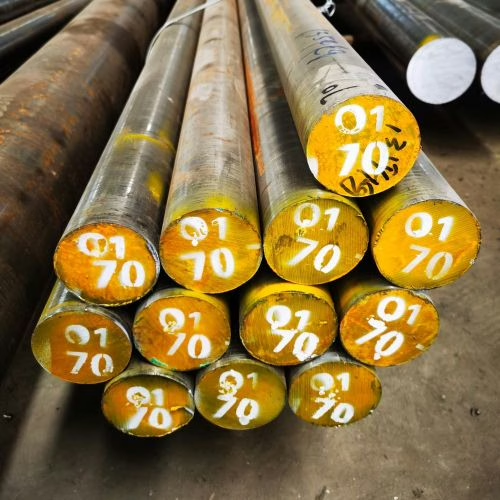
O1 | 1.2510 | SKS3
General-purpose oil-hardening tool steel for cold work dies, punches, gauges, and cutting tools.
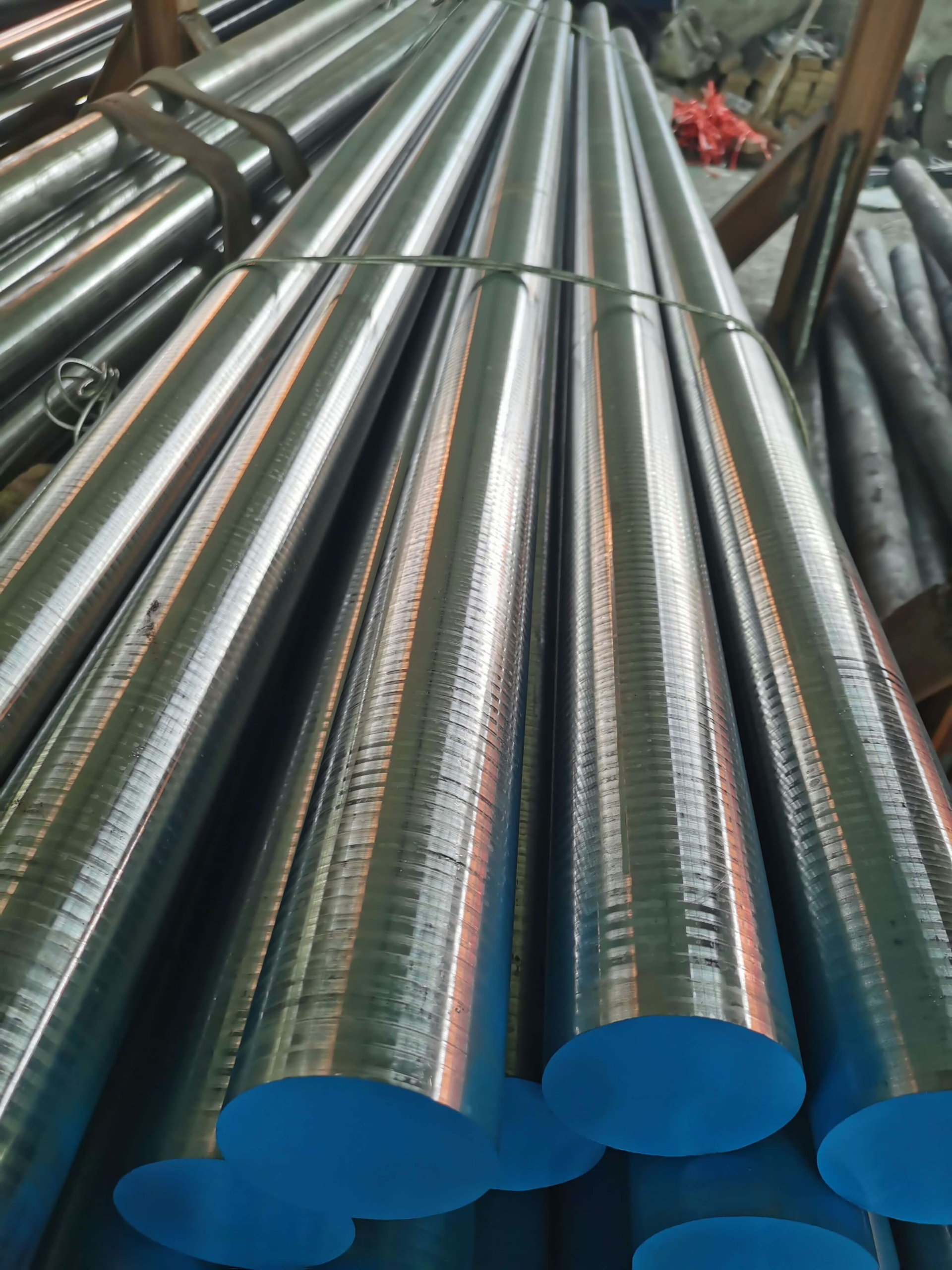
O2 | 1.2842 | 90MnCrV8
Oil-hardening tool steel used where dimensional control and heat-treatment safety are important.
These steels usually contain about 0.85% to 1.55% carbon, with moderate additions of manganese, chromium, tungsten, molybdenum, or silicon. This alloy design gives them higher hardenability than plain water-hardening tool steels. As a result, they can achieve higher hardness with oil quenching rather than water quenching.
Oil-hardening tool steels sit between water-hardening steels and air-hardening steels. They are safer to harden than water-hardening steels because oil quenching reduces cracking and distortion. Compared with air-hardening steels, they are usually easier to machine and more economical, but they typically offer lower dimensional stability and wear resistance under severe tooling conditions.
Their best use is in cold-work tooling that requires balanced hardness, wear resistance, machinability, heat-treatment safety, and cost-effectiveness. Their main limitation is poor resistance to softening at elevated temperatures. For hot-work dies, die-casting tools, or high-speed cutting tools, hot-work steels or high-speed steels are more suitable.
Oil-Hardening Tool Steel vs Water-Hardening and Air-Hardening Steel
Oil-hardening tool steel is best understood by comparing it with the two neighboring cold work tool steel groups: water-hardening and air-hardening steels.
| Item | Water-Hardening Tool Steel | Oil-Hardening Tool Steel | Air-Hardening Tool Steel |
|---|---|---|---|
| Typical grades | W1, W2 | O1, O2, O6, O7 | A2, A6, A7, A10 |
| Quenching method | Water or brine | Oil | Air or controlled cooling |
| Alloy content | Low | Moderate | Higher |
| Hardenability | Low | Medium | High |
| Distortion risk | High | Medium | Low |
| Cracking risk | High | Lower than W-series | Usually the lowest among these groups |
| Machinability | Very good | Good | Usually lower |
| Wear resistance | Moderate | Good | Usually higher |
| Cost | Usually lowest | Economical | Usually higher |
| Best use | Simple tools and low-cost applications | General cold work tools needing safer hardening | Complex tools, long runs and tighter dimensional control |
Water-hardening steels are simple and low-cost, but their severe quench makes them risky for intricate tools. Oil-hardening steels reduce that risk while keeping good machinability and reasonable cost.
Air-hardening steels provide better dimensional stability because they cool more slowly and contain more alloying elements. They are better suited to complex dies, large sections, and long production runs, but they usually cost more and are harder to machine.
Main Oil-Hardening Tool Steel Grades
The O-series is not a large family. The most important grades are O1, O2, O6, and O7. Each grade has a different role in cold-work tooling.
| Grade | Main Alloying Direction | Key Character | Typical Applications |
|---|---|---|---|
| O1 | Manganese, chromium, tungsten | General-purpose oil-hardening tool steel with balanced hardness, toughness, machinability and wear resistance | Blanking dies, forming dies, punches, taps, reamers, broaches, gauges |
| O2 | Mainly manganese | Lower hardening temperature and good dimensional control during heat treatment | Intricate dies, thread rolling dies, fixed gauges, bushings, precision tools |
| O6 | Silicon, manganese, molybdenum, free graphite | Graphitic oil-hardening steel with excellent machinability and anti-galling behavior | Deep drawing dies, forming rolls, wear plates, machine ways, tool shanks |
| O7 | Higher carbon and tungsten | Highest wear resistance and edge retention in the O-series | Paper knives, woodworking tools, cutting edges, wear-critical cold work tools |
Key Properties of Oil-Hardening Tool Steel
Oil-hardening tool steels are valued for their balanced performance in cold-work applications. They do not provide the highest wear resistance or the best dimensional stability among all tool steels, but they give a practical combination of properties at a reasonable cost.
| Property | Practical Meaning |
|---|---|
| Hardenability | Better than water-hardening steels because moderate alloying supports deeper hardening |
| Working hardness | Commonly about 57 to 62 HRC after quenching and tempering |
| Possible hardness range | About 56 to 64 HRC depending on grade, section size and tempering temperature |
| Wear resistance | Good for general cold work tooling, but usually lower than D2 in severe abrasion |
| Dimensional stability | Better than water-hardening steels, but usually lower than air-hardening steels |
| Toughness | Moderate; suitable for many cold work tools, but not ideal for heavy shock loading |
| Machinability | Generally good; O6 is especially machinable because of free graphite |
| Hot hardness | Low; not suitable for repeated high-temperature service |
Oil-hardening steels can harden to a greater depth than plain water-hardening steels. This helps tools that need repeated grinding or resharpening, because the hardness is not limited to only a shallow outer layer.
Their wear resistance comes mainly from high carbon and the hardened martensitic structure. O7 improves wear resistance further through higher carbon and tungsten content. However, O-series steels do not contain the large carbide volume found in D-series cold work steels or high-speed steels.
O6 is the special grade in this group. During annealing, part of its carbon forms free nodular graphite. This graphite improves machinability and reduces galling during sliding contact, making O6 useful for drawing dies, forming rolls, and machine components at risk of friction.
The main weakness is heat resistance. Oil-hardening tool steels soften if exposed to elevated temperatures for long periods. They should normally remain in cold-work service, especially where operating temperatures do not repeatedly exceed about 205 to 260 °C (400 to 500 °F).
Common Applications of Oil-Hardening Tool Steel
Oil-hardening tool steels are mainly used for tools that operate at room temperature or relatively low temperatures. They suit short- to medium-run production tools, precision tools, and general cold work tooling.
| Application Area | Typical Tools | Suitable Grades |
|---|---|---|
| Blanking and trimming | Blanking dies, trimming dies, punches | O1, O2, O7 |
| Forming and drawing | Forming dies, drawing dies, flanging dies, coining dies | O1, O2, O6 |
| Cutting and piercing | Taps, reamers, broaches, drills, slitting cutters, piercing tools | O1, O7 |
| Precision measurement | Plug gauges, ring gauges, snap gauges, templates, master tools | O2 preferred, O1 |
| Sliding machine parts | Bushings, arbors, guides, collets, chuck jaws, feed rolls | O1, O6 |
| Plastic molding tools | Low-temperature molds and short- to medium-run molds | O1, O2 |
O-series steels are not high-speed cutting steels. They can work in low- to medium-speed cutting tools, but high-speed steels are better when cutting heat becomes a major issue.
Heat Treatment Basics of Oil-Hardening Tool Steel
Oil-hardening tool steels are usually supplied in an annealed condition for machining. After machining, the tool is hardened by heating, oil quenching, and tempering.
| Step | Purpose | Typical Range or Note |
|---|---|---|
| Preheating | Reduce thermal shock before hardening | Often around 650 °C, or 1200 °F, especially for larger or more complex tools |
| Austenitizing | Prepare the steel for hardening | Commonly about 790 to 885 °C, or 1450 to 1625 °F, depending on grade |
| Oil quenching | Form the hardened structure | Warm oil is commonly used, often around 32 to 70 °C, or 90 to 160 °F |
| Removal from oil | Reduce quench stress before tempering | Often removed at about 50 to 66 °C, or 120 to 150 °F |
| Tempering | Reduce brittleness and adjust hardness | Commonly about 150 to 260 °C, or 300 to 500 °F, for high-hardness cold work tools |
| Higher tempering | Improve toughness when needed | About 288 to 315 °C, or 550 to 600 °F, may be used when impact resistance is more important |
O1 commonly uses a higher austenitizing range than O2. O2 can harden at a relatively low temperature, which helps reduce heat-treatment movement. O7 needs closer quenching control because its higher carbon and tungsten improve wear resistance but reduce hardenability in thicker sections. In thicker O7 tools, oil temperature, agitation, and transfer time become more critical.
Oil agitation matters during quenching. Without sufficient oil movement, vapor can form around the hot tool, and cooling can slow and become uneven. This may cause soft spots or uneven hardness.
Tempering should follow quenching promptly. As-quenched steel is hard but brittle, and tempering imparts usable toughness to the tool. For many O-series cold-work tools, the final hardness is typically around 58 to 62 HRC, but the required hardness should be determined by the tool design and service conditions.
How to Choose the Right Oil-Hardening Tool Steel Grade
Grade selection should start from the tool’s main working problem.
| Main Requirement | Recommended Grade | Reason |
|---|---|---|
| General-purpose cold work tooling | O1 | Balanced properties and wide commercial availability |
| Minimum distortion during hardening | O2 | Lower austenitizing temperature reduces heat-treatment stress |
| High machinability and anti-galling | O6 | Free graphite acts as a solid lubricant, improving cutting and preventing seizing |
| Maximum wear resistance and edge retention | O7 | Higher carbon and tungsten content form hard, abrasion-resistant carbides |
| Strict-tolerance tools and precision gauges | O2 | Better dimensional control for close-tolerance designs |
For most general tooling, O1 is the starting point. For precision or low-distortion tools, O2 is more suitable. For drawing, forming, or sliding-wear applications with a risk of galling, O6 has a clear advantage. For cutting edges and wear-critical tools, O7 is the strongest oil-hardening option.
If the tool will be exposed to high heat, use hot-work steel or high-speed steel instead. If the tool will face heavy impacts, consider shock-resistant steel. If the tool needs very high abrasion resistance, D2 or another high-carbon high-chromium steel may be more suitable. If the tool needs maximum dimensional stability in a large or complex shape, air-hardening steel is usually a better choice.
Need Bulk Oil-Hardening Tool Steel Supply?
Aobo Steel supplies O1, O2 and other tool steel round bar and flat bar for bulk industrial orders. Send your required grade, size, quantity, and application.