
P20 Tool Steel in Plastic Molds and Die Casting Applications
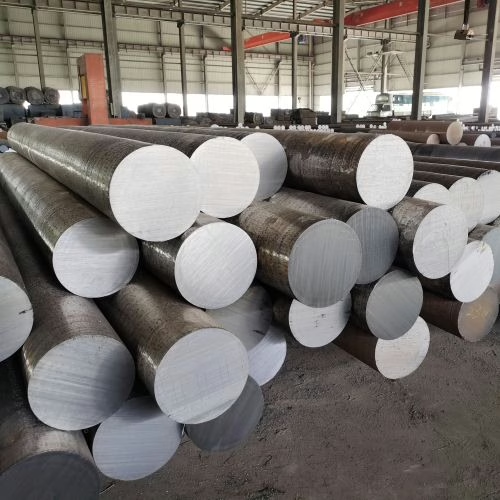
P20 tool steel is widely used in mold manufacturing and die casting. This low-alloy steel is typically supplied in a pre-hardened state (hardness approximately 30-40 HRC), enabling direct machining into complex molds without additional high-temperature heat treatment, thereby minimizing deformation and dimensional changes. It offers excellent machinability, polishability, and wear resistance. Primary applications include plastic injection mold cavities and various tooling components, as well as zinc alloy and other low-melting-point alloy die-casting molds. This article provides a comprehensive analysis of P20 tool steel, detailing its metallurgical properties, core advantages, and practical applications in plastic forming and die casting.
P20 Tool Steel: An Overview
P20 steel’s typical chemical composition (mass fractions) includes: Carbon (C): 0.28% to 0.40%. Sulfur (S): ≤ 0.030% Silicon (Si): 0.20% to 0.80%. Manganese (Mn): 0.60% to 1.00%. Chromium (Cr): 1.40% to 2.00%. Molybdenum (Mo): 0.30% to 0.55%. Phosphorus (P): ≤ 0.030%.
P20 steel is typically supplied in a pre-hardened condition, with a hardness range of 30-40 HRC. It is one of the most easily machined mold steels. Its machinability rating is approximately 65% when compared to annealed water-hardening tool steel W1, which is rated at 100%. P20 steel also offers excellent polishing properties and is weldable for repair or modification, making it a suitable choice for plastic mold and die-casting applications.
P20 Tool Steel in Plastic Injection Molds
P20 tool steel is a cornerstone material in the plastic injection molding industry, highly favored for its balance of cost-effectiveness, durability, and processing characteristics.
Why P20 is the Go-To Choice
- Cost-Effectiveness for a Wide Range of Applications. These steels are typically supplied in a prehardened condition, typically around 32 HRC (approximately 300 HB), allowing direct machining of mold cavities without subsequent high-temperature heat treatment. This eliminates potential distortion and costly post-heat-treatment finishing operations, such as grinding, thereby significantly reducing overall manufacturing expenses. The relatively lean alloy design of P20 types results in lower material costs, typically accounting for only 10-20% of the total mold cost, with the bulk of the expenditure attributed to machining and other manufacturing steps.
- Durability and Mold Life. P20 offers sufficient durability for intermediate-length production runs. Its wear resistance can be further improved through various post-treatment processes. Nitriding or flame hardening of localized wear or indentation areas can enhance the wear resistance of P20. For applications requiring higher surface hardness and wear resistance, P20 molds can undergo carburizing treatment, achieving surface hardness exceeding 55 HRC.
- Dimensional Stability. Another advantage of P20 material is its dimensional stability during mold manufacturing. Since it is supplied in a prehardened state, extensive high-temperature heat treatment is avoided after machining the mold cavities, thereby minimizing distortion and unwanted size changes. This inherent stability, coupled with a uniform structure, is vital for achieving predictable, accurate dimensions in the final mold, which directly affects the quality of the molded plastic parts.
Ideal Applications in Plastic Molding
P20 is a highly versatile material suitable for a broad spectrum of plastic molding applications, including general-purpose injection and compression molds, even for large tools. It also finds use in zinc die-casting dies and as holder blocks. While P20 is not typically specified for extreme wear or highly polished optical components, its modified grades currently account for the largest volume of plastic mold steels utilized in the industry. For molds with high machining content where surfaces will not be polished, such as male components contacting non-appearing regions of parts, P20 is also a practical choice.
P20 vs. Aluminum
Aluminum molds are primarily chosen for low-volume production, prototyping, or when the lowest possible tooling costs are the main driver. They are easy to machine and offer rapid prototyping benefits, but their lower hardness makes them prone to scratching, denting, and overall shorter longevity. While some specialized aluminum tooling can produce up to 50,000 plastic parts, P20 significantly surpasses aluminum in strength and wear resistance. This makes P20 a far more robust choice for longer production runs, where consistent part quality and reduced mold maintenance are critical over the mold’s lifespan.
P20 Tool Steel in Die Casting Applications
P20 tool steel is a highly regarded material in the mold manufacturing industry, with its balanced properties and machining advantages making it widely used in die casting applications. Its selection is often based on the metal’s melting point and the specific demands of the production run.
Suitability for Zinc Die Casting
P20 is an ideal choice for die casting low-melting-point alloys such as zinc alloys, which typically have melting points around 400°C (750°F). Molds for low-melting-point metals rarely fail due to thermal fatigue. P20 is typically supplied in a pre-hardened state with a hardness of approximately 300 HB (Rockwell C 32). This allows mold cavities to be machined directly without subsequent high-temperature heat treatment. This eliminates the need for costly heat-treatment finishing operations while reducing the risk of distortion during heat treatment.
Limitations in Die Casting
- Not for High-Temperature Alloys. Despite its numerous advantages, P20 tool steel is generally unsuitable for high-temperature alloys such as die-cast aluminum, magnesium, or brass. These metals have melting points significantly higher than that of zinc. The intense thermal cycling inherent in high-temperature alloys often leads to thermal fatigue cracking on mold surfaces, known as “hot cracking.” P20 steel exhibits poor resistance to softening at elevated temperatures, making it vulnerable to such conditions. This susceptibility can result in rapid deterioration and shortened mold life.
- Comparison with H13 Steel. For demanding die casting applications involving aluminum, magnesium, or brass, H13 hot-work tool steel is the preferred material. H13 is a 5% chromium hot-work tool steel specifically designed for high-temperature applications, offering excellent resistance to heat, wear, and thermal mechanical fatigue. Unlike P20, H13 maintains high hardness and strength at elevated temperatures and possesses good temper resistance. Its higher vanadium content results in greater dispersion of hard vanadium carbides, thereby contributing to superior wear resistance. H13 also exhibits high hardenability, allowing it to be air-hardened, resulting in minimal residual stresses and reduced distortion. These properties make H13 much better suited to withstand the severe thermal and mechanical stresses encountered when casting higher-melting-point alloys, where consistent performance and extended tool life are critical. The North American Die Casting Association (NADCA) even provides specific recommendations for the use of H13 tool steel in premium-quality die casting applications.
Working with P20 Tool Steel: Practical Guidelines
P20 tool steel is widely used in applications like plastic injection molds and zinc die-casting dies due to its balanced properties. Effective utilization of P20 requires adherence to best practices in machining, heat treatment, welding, and polishing to ensure optimal performance and tool life.
Machining P20 Tool Steel
P20 exhibits excellent machinability, typically achieving a hardness of 300 HB or 32 HRC in its pre-hardened state. This allows direct machining of cavities, meeting basic hardness requirements without additional heat treatment. Its machining method involves high rotational speed combined with low feed rates.
Heat Treatment (When Necessary)
While P20 is frequently utilized in its pre-hardened state (around 36-38 HRC after typical heat treatment), additional surface treatments can enhance its properties for specific demanding applications.
- Carburizing: Carburizing is commonly applied to P20 molds in plastic molding applications, significantly enhancing surface hardness and wear resistance. This process involves heating the steel in a carbon-rich atmosphere, typically maintained at 870 to 925°C (1600 to 1700°F) for 2 to 24 hours, with the duration determined by the required carburizing depth. Carburized P20 molds exhibit superior wear resistance, toughness, and polishability. However, note that carburizing temperatures exceeding 870°C (1600°F) may adversely affect polishability.
- Nitriding: Another beneficial surface treatment process for P20 steel enhances surface hardness, improves corrosion resistance, and reduces friction and galling.
- Stress-relieving: After subsequent processing, P20 must undergo stress-relief treatment.
Polishing Techniques
P20 steel exhibits excellent polishability, particularly in the carburized condition, which is a critical property for plastic molds. However, excessive carburizing temperatures (above 870 °C / 1600 °F) can be detrimental to achieving a good polished finish. When polishing, care must be taken to avoid excessive pressure, which can cause localized plastic deformation known as “orange peel” or pitting if the pressure exceeds the steel’s yield strength. High-quality P20 materials, often produced via remelting processes,
Common Challenges and How to Overcome Them
Molds made from P20 tool steel are prone to wear and surface defects.
Mold wear is a significant concern, often arising from the abrasive action of hard particles or fibers added to plastic mixtures. High contact pressures and friction between the mold and flowing material can cause adhesive and abrasive wear. Chemical reactions with aggressive plastics also contribute to material degradation. Inadequate or improper lubrication further exacerbates wear.
Surface defects on molds, such as scratches, pitting, and inconsistent finishes, directly translate to flaws on the molded parts. Over-polishing can lead to “orange peel,” which negatively affects surface quality. Electrical Discharge Machining (EDM), if not executed correctly, can leave brittle white layers and microcracks that compromise polishability and the final product’s appearance.
To mitigate these issues, a combination of strategies is essential. Proper maintenance involves routine cleaning and re-lubrication to prevent material buildup and reduce friction. Regular stress-relieving or re-tempering can extend tool life by alleviating internal stresses. Correct operational parameters are crucial, including optimizing injection speeds, mold temperatures, and pressures to minimize localized heating and mechanical stress on mold surfaces. Regular inspection is vital for identifying and addressing wear or defects early. Additionally, selecting high-quality tool steels with superior homogeneity and applying appropriate surface treatments, such as nitriding or chrome plating, can significantly enhance wear resistance and polishability.