
H13 Tool Steel Applications
H13 tool steel is used for hot-work tooling: aluminum die-casting dies, extrusion dies, hot-forging dies, hot shear blades, die inserts, core pins, ejector pins, slides, moving cores, and mold components.
It is selected when tooling must resist repeated heating and cooling, impact loading, hot wear, surface cracking, and dimensional stress. H13 is rarely chosen for one property alone; it is used because it balances toughness, hot hardness, thermal-fatigue resistance, and thermal-shock resistance.
H13 Tool Steel Available from Aobo Steel
Aobo Steel supplies H13 (1.2344 / SKD61 / 4Cr5MoSiV1) in forged and rolled form, annealed condition, as round bar, flat bar, and forged block. H13 ESR is available for premium die casting, high-cycle tooling, and high-polish mold work.
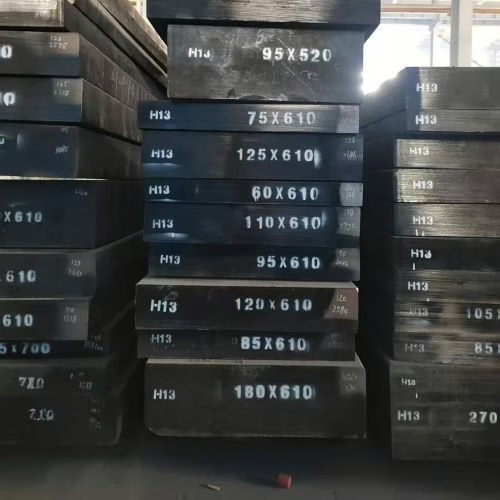
H13 | 1.2344 | SKD61
Balanced chromium hot-work tool steel for die casting dies, extrusion tooling, hot forging dies, hot shear blades, die inserts, core pins, and stressed mold components.
Quick Application Selection Guide for H13 Tool Steel
| Application | Why H13 Is Used | Typical Working Hardness | Main Failure Risk |
|---|---|---|---|
| Aluminum die-casting dies | Resists heat checking, washout, and cracking | 42-48 HRC | Thermal fatigue, molten-metal erosion |
| Magnesium die-casting dies | Handles rapid thermal cycling and impact | 42-48 HRC | Heat checking, cracking |
| Zinc die-casting dies | Allows higher hardness because service temperature is lower | 48-52 HRC | Wear, surface damage |
| Aluminum extrusion dies | Resists hot wear, pressure, and thermal cycling | 44-50 HRC | Wear, deformation, thermal fatigue |
| Extrusion mandrels | Supports wear resistance under high pressure | 46-52 HRC | Wear, cracking, bending stress |
| Hot-forging dies | Balances impact toughness and heat resistance | 40-50 HRC | Impact cracking, overheating, wear |
| Hot shear blades | Maintains edge strength during hot cutting | 45-52 HRC | Edge cracking, chipping, softening |
| Die inserts | Provides local heat and wear resistance | 44-52 HRC | Local cracking, wear, heat damage |
| Core pins and ejector pins | Combines surface wear resistance with a tough core | 40-52 HRC | Galling, wear, cracking |
| Plastic mold inserts | Used when P20 is not enough for wear, polishability, or heat resistance | 48-52 HRC | Abrasion, polishing defects, distortion |
The hardness values above are typical service ranges, not fixed limits. Large tools, heavy-impact conditions, and severe thermal cycling call for greater toughness and lower hardness. Smaller inserts, pins, mandrels, and wear-focused parts are usually run nearer the top of the range.
As a practical ceiling, hardened and tempered H13 holds useful hot-work properties up to about 52-54 HRC. Values above this are not realistic for tempered hot-work service.
H13 for Die-Casting Dies
H13 is one of the most common tool steels for aluminum, magnesium, and zinc die-casting dies. These dies must withstand high-speed molten metal, repeated thermal cycling, casting pressure, cooling stress, and surface wear.
The main reason for using H13 in die casting is its resistance to heat checking. During each cycle the die surface heats rapidly on contact with molten metal and cools quickly during spraying or internal cooling. This repeated expansion and contraction creates fine surface cracks. As these cracks grow, they degrade casting surface quality, make ejection harder, and shorten die life.
H13 suits aluminum die casting because the die must resist both thermal fatigue and molten-metal washout. In magnesium die casting, the same need for thermal-shock resistance and crack control makes it a practical choice. In zinc die casting the service temperature is lower, so H13 can be run at higher hardness for better wear resistance.
For brass die casting, H13 is limited to less severe conditions or shorter runs. Brass melts hotter, so when the die must hold up at high temperature for extended periods, higher-alloy hot-work steels are safer.
H13 for Extrusion Dies and Tooling
H13 handles the pressure, hot wear, and repeated thermal cycling of extrusion while keeping useful toughness. In extrusion the billet is forced through the die under high load, so the tooling must resist deformation, cracking, and surface wear.
For aluminum and magnesium extrusion, H13 is used for dies, mandrels, dummy blocks, backers, bolsters, die rings, rams, and liners. Active dies and mandrels need higher wear resistance, while support tooling needs greater toughness and load-bearing strength.
For copper, brass, and steel extrusion, H13 still serves in support tooling, mandrels, containers, and surrounding components. Where the active die area exceeds the practical service temperature of H13, higher-alloy hot-work steels are required.
H13 for Hot-Forging Dies
H13 is used for hot-forging dies, punches, and inserts. Forging tools must resist impact, compressive load, contact with hot metal, surface wear, and repeated heating and cooling.
In hammer forging the impact load is severe, so H13 is run at lower hardness to reduce the risk of brittle fracture. In press forging the load is applied more gradually, so higher hardness can be used. Press forging also creates longer contact time between the hot workpiece and the die, so overheating and thermal fatigue still have to be controlled.
H13 for Hot Shear Blades and Die Inserts
H13 is used for hot shear blades because it keeps edge strength at elevated temperature while resisting impact and thermal shock. These blades cut heated billets, bars, and forged parts, so blade hardness has to match cutting severity.
Lighter hot shearing allows higher hardness for edge wear resistance. Heavy-duty shearing, thick sections, and strong impact call for lower hardness to reduce edge cracking and blade fracture.
H13 is also common in die inserts. Rather than machining a full die from hot-work steel, the active wear and heat zone is made from H13 while the holder, backup block, or retainer uses a more economical steel. In die-casting inserts H13 resists heat checking and molten-metal erosion. In forging inserts it resists wear, impact, and thermal fatigue. For high-cycle dies, precision inserts, or polished mold surfaces, ESR H13 improves steel cleanliness and fatigue performance.
H13 for Core Pins and Mold Components
H13 is used for core pins, ejector pins, slides, moving cores, mold inserts, and other stressed mold components. These parts see sliding wear, localized heat, repeated motion, and high contact pressure.
For die-casting core pins and ejector pins, H13 provides a tough core with a wear-resistant surface, which reduces galling, wear, and cracking over repeated cycles.
For plastic molds, P20 is more economical for general mold bases and large cavities. H13 is chosen when the mold needs higher wear resistance, heat resistance, polishability, or longer production life, as in abrasive resin molding, high-cycle plastic molds, and molds for visible or transparent parts.
For optical, transparent, or high-polish components, ESR H13 reduces polishing defects because cleaner steel carries fewer inclusions. This matters for clear lenses, cosmetic plastic parts, and high-quality visible surfaces.
Where H13 Fits Best
Die casting
Choose H13 when heat checking, molten-metal erosion, thermal shock, and casting pressure are the main risks.
Extrusion
Use H13 for aluminum and magnesium dies, mandrels, liners, and support tooling that must resist hot wear and pressure.
Forging
Choose lower hardness for hammer forging and higher hardness where press-forging wear is more important than impact risk.
Mold components
Use H13 when P20 cannot provide enough wear resistance, heat resistance, polishability, or service life.
When H13 Is Not the Right Tool Steel Choice
H13 performs well in balanced hot-work applications, but it is not the best choice when one requirement dominates the job.
| Service Condition | Why H13 May Not Be Best | Better Material Direction |
|---|---|---|
| Continuous service above about 540°C | H13 loses hardness and strength too quickly | H21, H24, H26, H42, or other high-alloy hot-work steels |
| Severe cold abrasion | H13 lacks the carbide volume for maximum cold-work wear resistance | D2, A2, M2, PM tool steels, or carbide |
| Corrosive plastic molding | H13 is not stainless and can rust or pit | 420 stainless, 15-5 PH, or 17-4 PH |
| Large plastic molds with cost pressure | H13 is harder to machine and needs heat treatment | P20 or other prehardened mold steels |
| Maximum fracture toughness | H13 is slightly less tough than H11 | H11 or modified H11 |
| Extremely thick die blocks | Core properties are hard to control without adequate quenching | Premium H13, insert design, or alternative block steels |
For continuous very-high-temperature service, tungsten hot-work steels outperform H13. For severe cold wear, D2 or A2 is more suitable. For corrosive plastic molding, stainless mold steels are safer. For large plastic molds where machining efficiency and cost matter more than hot-work performance, P20 is the better choice.
The selection rule is to choose H13 when the main risks are heat checking, hot cracking, thermal shock, impact, and hot wear.
Need H13 for Hot-Work Tooling?
Send your grade, size, quantity, application, hardness target, and quality requirement. Aobo Steel can confirm H13 forged or rolled supply, annealed condition, ESR option, and mill certificate details.
FAQ
H13 tool steel is primarily used for hot-work tooling, including aluminum die-casting dies, extrusion dies, hot-forging dies, hot shear blades, die inserts, core pins, ejector pins, and high-performance mold components.
H13 is used for die-casting dies because it resists heat checking, thermal shock, molten-metal erosion, and cracking. These are common failure risks in aluminum, magnesium, and zinc die casting.
Yes. H13 is widely used for aluminum extrusion dies, mandrels, dummy blocks, backers, bolsters, die rings, rams, and liners because it combines hot-work strength, toughness, and good response to surface treatment.
Yes. H13 is commonly used for hot-forging dies, punches, and inserts because it can withstand impact, heat, and repeated thermal cycling better than many general-purpose steels.
Yes. H13 is used for core pins, ejector pins, slides, moving cores, mold inserts, and high-performance plastic mold components, especially when wear resistance, heat resistance, or polishability must exceed those of standard P20.
H13 is preferable when the mold requires higher wear resistance, heat resistance, polishability, or a longer production life. P20 is usually better for general plastic molds where lower cost, easier machining, and availability of pre-hardened stock are more important.
H13 is not usually the best choice for severe cold-work wear. For cold stamping, blanking, deep drawing, and long-run abrasive wear, D2 or A2 is usually more suitable.