
O1 vs D2 Tool Steel: Which One Should You Choose?
D2 tool steel is the better choice when wear resistance, long tool life, and dimensional stability are the main requirements. O1 is the better choice when machinability, toughness, simpler heat treatment, and lower manufacturing cost are more important.
In simple terms, choose D2 for abrasive, high-volume, wear-dominated tooling. Choose O1 for general-purpose tooling, complex machined parts, short- to medium-run production, or applications where chipping risk is more important than maximum wear life.
O1 and D2 Tool Steel Available from Aobo Steel
Aobo Steel supplies O1 and D2 tool steel in round bar and flat bar for industrial tooling applications.
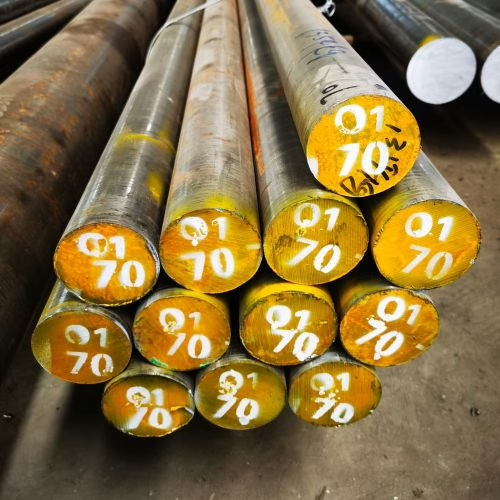
O1 | 1.2510 | SKS3
Oil-hardening cold-work tool steel for easier machining, better toughness than D2, and practical short- to medium-run tooling.
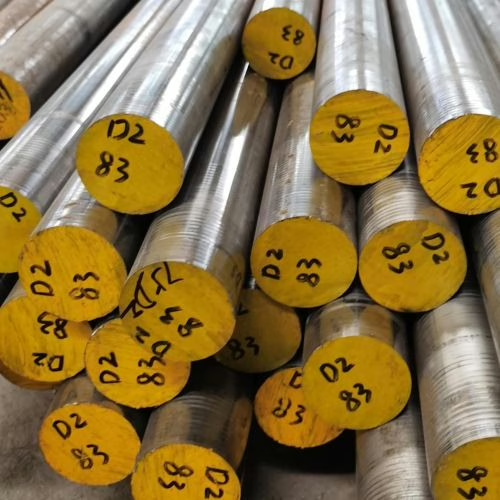
D2 | 1.2379 | SKD11
High-carbon, high-chromium cold-work tool steel for abrasive wear resistance, long tool life, and dimensional stability.
O1 vs D2 Tool Steel at a Glance
| Comparison Factor | O1 Tool Steel | D2 Tool Steel | Practical Meaning |
|---|---|---|---|
| Tool steel type | Oil-hardening cold-work steel | Air-hardening cold-work steel | Different hardening behavior and distortion control |
| Wear resistance | Moderate to good | High to very high | D2 lasts longer in abrasive service |
| Toughness | Better than D2 | Lower than O1 | O1 is safer where chipping or impact is a concern |
| Machinability | Good | Difficult | O1 usually reduces machining and grinding cost |
| Dimensional stability | Good | Excellent | D2 is better for precision tooling after hardening |
| Heat treatment | Simpler and more forgiving | More demanding but more stable | O1 is easier to process; D2 needs better control |
| Typical production volume | Short to medium runs | Long production runs | Production volume strongly affects the final choice |
| Cost logic | Lower upfront cost | Higher initial cost, longer tool life | O1 saves fabrication cost; D2 can reduce cost per part in high-volume production |
O1 vs D2 Tool Steel Chemical Composition Difference
The performance difference between O1 and D2 is mainly due to carbon, chromium, and carbide volume. D2 contains much higher carbon and chromium, so it forms a larger amount of hard chromium-rich carbides. This gives D2 much stronger wear resistance but reduces toughness and machinability.
O1 has lower alloy content, so it is easier to machine and generally tougher, but it cannot match D2 in abrasive wear conditions.
| Element | O1 Tool Steel (%) | D2 Tool Steel (%) |
|---|---|---|
| Carbon (C) | 0.85-1.00 | 1.40-1.60 |
| Chromium (Cr) | 0.40-0.60 | 11.00-13.00 |
| Manganese (Mn) | 1.00-1.40 | <=0.60 |
| Molybdenum (Mo) | – | 0.70-1.20 |
| Tungsten (W) | 0.40-0.60 | – |
| Vanadium (V) | <=0.30 | <=1.10 |
| Silicon (Si) | <=0.50 | <=0.60 |
| Cobalt (Co) | – | Optional in some variants |
O1 is a lower-alloy oil-hardening steel designed for practical general-purpose tooling. D2 is a high-carbon, high-chromium air-hardening steel designed for high wear resistance and better dimensional stability.
O1 vs D2 Tool Steel Equivalent Grades and Designations
When sourcing O1 or D2 tool steel internationally, equivalent grades help buyers compare materials across different standards. However, equivalent grades should not be treated as automatic substitutes without checking the exact chemical composition, delivery condition, and applicable standard.
| Grade | UNS | DIN / W.Nr. | GB / China | Common Trade Names or Designations |
|---|---|---|---|---|
| O1 Tool Steel | T31501 | 1.2510 | – | DF2, Crovaco 14, CS 13M, DS 200 |
| D2 Tool Steel | T30402 | 1.2379 | Cr12Mo1V1 | CRU-Die 2, CS 13M Extra, Diehard Standard, DOM VM, DS 144, SC 25 |
For D2, DIN 1.2379 is one of the most widely recognized international equivalents. In Chinese GB standards, Cr12Mo1V1 is commonly used as the corresponding grade. For O1, DIN 1.2510 is the standard European equivalent.
Wear Resistance: D2 Has the Clear Advantage
D2 tool steel provides significantly higher wear resistance than O1 in most industrial tooling applications. Its higher carbon and chromium content produce a larger volume of hard carbides, which helps the tool maintain edge integrity and surface stability under abrasive conditions.
O1 also exhibits useful wear resistance due to its high carbon content, but its carbide volume is much lower than that of D2. This makes O1 suitable for moderate wear conditions, but it wears faster when the tool is exposed to abrasive materials, high friction, or long production cycles.
| Wear Condition | Better Choice | Reason |
|---|---|---|
| Abrasive cutting or forming | D2 | Higher carbide volume and stronger abrasion resistance |
| Long production runs | D2 | Longer edge retention and less frequent regrinding |
| Moderate wear service | O1 | Adequate wear resistance with easier fabrication |
| Low-volume tooling | O1 | D2’s wear advantage may not justify the extra cost |
| High-friction forming | Usually D2 | Better surface stability under continuous contact |
D2 is usually selected when tool life and wear control are the main problems. O1 is more suitable when the wear demand is moderate and the buyer needs easier machining, lower cost, or faster tool production.
Toughness: O1 Is Safer Against Chipping
O1 tool steel generally provides better toughness and better resistance to chipping than D2. This difference matters in tooling applications involving impact, bending stress, interrupted contact, thin edges, or complex geometry.
D2’s wear resistance comes from its high carbide volume. Those carbides improve abrasion resistance but also make the steel more susceptible to brittle failure under shock or edge loading. When D2 is used under unstable contact conditions, chipping or cracking can pose a greater risk.
O1 has a lower carbide volume and a more forgiving structure, so it can better absorb localized stress. When both steels are hardened to typical working ranges, often around 58-62 HRC depending on the application and heat treatment, O1 is generally safer where toughness matters more than maximum wear resistance.
| Application Risk | Better Choice | Practical Reason |
|---|---|---|
| Shock loading | O1 | Better resistance to sudden impact |
| Interrupted cutting | O1 | Lower risk of edge chipping |
| Thin edges or sharp corners | Often O1 | Better tolerance to localized stress |
| Stable abrasive wear | D2 | Toughness is less critical than wear resistance |
| Heavy wear with low impact | D2 | Better long-term tool life |
Use O1 when the chipping risk is high. Use D2 when the application is stable and mainly controlled by abrasive wear.
O1 vs D2 Tool Steel Machinability and Grinding Cost
O1 is significantly easier to machine and grind than D2. This is one of the strongest practical reasons for choosing O1, especially for complex tooling, short production runs, or parts that require more machining time.
O1 allows more stable cutting, easier grinding, and lower tool consumption. It is more forgiving in standard machining setups and usually supports faster turnaround in toolmaking.
D2 is more difficult to machine because of its high carbon and chromium content and carbide-rich structure. It usually requires lower cutting speeds, more careful process control, stronger tooling, and more grinding effort. This increases fabrication cost and lead time.
| Processing Factor | O1 Tool Steel | D2 Tool Steel |
|---|---|---|
| Machining difficulty | Easier | More difficult |
| Grinding difficulty | Lower | Higher |
| Cutting tool wear | Lower | Higher |
| Fabrication speed | Faster | Slower |
| Processing cost | Lower | Higher |
| Best use case | Complex or economical tooling | Wear-critical tooling where cost is justified |
For buyers, this means O1 often wins on initial manufacturing cost. D2 only makes economic sense when its longer wear life offsets the extra machining and grinding costs.
O1 vs D2 Tool Steel Heat Treatment and Dimensional Stability
O1 is simpler and more forgiving, while D2 requires more controlled heat treatment but offers better dimensional stability after hardening.
O1 is oil-hardening. It normally uses lower austenitizing temperatures, commonly around 790-815°C, and can be hardened effectively by oil quenching. This makes the process relatively simple, but oil quenching introduces higher thermal stress than air cooling. As a result, O1 can show more distortion during hardening.
D2 is air-hardening. It typically requires higher austenitizing temperatures, commonly around 980-1025°C, and requires tighter control during heating, preheating, soaking, and tempering. However, because it hardens with slower cooling, D2 usually produces lower quench stress and better dimensional stability.
| Heat Treatment Factor | O1 Tool Steel | D2 Tool Steel |
|---|---|---|
| Austenitizing temperature | Lower, often around 790-815°C | Higher, often around 980-1025°C |
| Hardening method | Oil quench | Air hardening |
| Process difficulty | Simpler | More demanding |
| Quench stress | Higher than D2 | Lower than O1 |
| Distortion risk | Higher | Lower |
| Dimensional stability | Good | Excellent |
| Best choice when | Heat treatment simplicity matters | Precision after hardening matters |
D2 is preferred for precision dies, gauges, and components where post-heat-treatment size change must be minimized. O1 is suitable when simpler heat treatment, machining flexibility, and lower process cost are more important, and some post-hardening correction is acceptable.
For detailed heat treatment information, see our D2 heat treatment guide and O1 heat treatment guide.
O1 vs D2 Tool Steel: Typical Industrial Applications
The application difference between O1 and D2 is mainly driven by wear severity, production volume, tooling geometry, and failure risk.
O1 is used in general-purpose cold-work tooling where ease of machining, toughness, and cost control are more important than maximum wear resistance. D2 is used in high-wear, long-run tooling where edge retention, dimensional stability, and tool life are more important than ease of fabrication.
| Application | Better Choice | Reason |
|---|---|---|
| Short-run blanking dies | O1 | Lower cost and easier fabrication |
| Medium-duty forming dies | O1 | Good balance of toughness and wear resistance |
| General punches and tooling components | O1 | Easier machining and practical performance |
| Drill bushings and gauges | O1 or D2 | O1 for easier fabrication; D2 for higher wear and stability |
| Long-run blanking dies | D2 | Better edge retention |
| Stamping dies for abrasive materials | D2 | Higher wear resistance |
| Deep drawing dies | D2 | Better surface stability and tool life |
| Thread-rolling dies | D2 | High pressure and wear resistance required |
| Slitter knives and shear blades | D2 | Longer cutting edge life |
| Tools with high chipping risk | O1 | Better toughness |
D2 is not automatically better because it lasts longer in abrasive service. If the tool is complex, production volume is limited, or impact risk is high, O1 may be the more reliable and economical choice.
Cost and Tool Life: Which Is More Economical?
The economic choice between O1 and D2 is not decided only by the raw material price. It depends on total tooling cost, machining time, heat-treatment cost, maintenance frequency, downtime, and production volume.
O1 usually has the advantage in upfront cost. It is easier to machine and grind, and less demanding in heat treatment. For short- to medium-run tools, this can make O1 the more economical choice because the production volume may not be high enough to justify D2’s extra material and processing cost.
D2 usually becomes more economical at high production volumes. Although it costs more to buy, machine, grind, and heat treat, its higher wear resistance can reduce regrinding, tool replacement, and production downtime.
| Cost Factor | O1 Tool Steel | D2 Tool Steel |
|---|---|---|
| Raw material cost | Usually lower | Usually higher |
| Machining cost | Lower | Higher |
| Grinding cost | Lower | Higher |
| Heat treatment cost | Lower and simpler | Higher and more controlled |
| Tool life in abrasive service | Shorter | Longer |
| Maintenance frequency | Higher in wear-heavy service | Lower in wear-heavy service |
| Best economic case | Short to medium production runs | Long production runs |
| Main cost advantage | Lower upfront fabrication cost | Lower long-term cost per part |
For low production volume, O1 is usually more economical because the tool can be made faster and at a lower cost. For high production volumes, D2 can become more cost-effective because its longer tool life reduces shutdowns, regrinding, and replacements.
O1 vs D2 Selection Guide Based on Application
The final choice between O1 and D2 should be based on the tool’s actual failure mode. If the tool fails mainly due to wear, D2 is usually the stronger choice. If the tool fails mainly due to chipping, cracking, machining costs, or heat-treatment risk, O1 is often more practical.
| Selection Question | Choose O1 If | Choose D2 If |
|---|---|---|
| What is the main failure mode? | Chipping, impact, cracking, or machining difficulty | Abrasive wear, edge wear, or surface loss |
| What is the production volume? | Short to medium | Long run or continuous production |
| How important is machinability? | Very important | Less important than wear life |
| How important is dimensional stability? | Moderate requirement | Critical requirement |
| How severe is the wear condition? | Moderate | High or very high |
| How complex is the tool shape? | Complex geometry or heavy machining | Simpler geometry or wear-critical design |
| What cost matters most? | Lower initial tooling cost | Lower long-term cost per part |
O1 is the practical choice when machining efficiency, lower upfront cost, toughness, and easier heat treatment matter more than maximum wear resistance. It is well-suited for short- to medium-run tooling, complex machined components, and applications where chipping risk must be controlled.
D2 is the better choice when wear resistance, tool life, and dimensional stability are the limiting factors. It is better suited for high-volume production, abrasive working conditions, precision dies, and applications where downtime and regrinding must be minimized.
Need O1 or D2 tool steel for industrial tooling?
Send your required grade, size, quantity, tooling application, and failure condition. Aobo Steel can help compare O1 and D2 for machinability, toughness, wear resistance, dimensional stability, and total tooling cost.
Email [email protected] · Tel and WhatsApp +86 180 6294 5370
Related pages
Related comparisons: O1 vs O2 · D2 vs S7 · D2 vs D3 · D2 vs M2
Reference pages: Tool steel tempering chart · O1 steel hardness · Tool and die failure analysis
Grade families: Tool steel grades · D-series tool steels · Tool steel material finder
Composition, hardness and heat-treatment figures are typical published values for O1 / 1.2510 / SKS3 and D2 / 1.2379 / SKD11. Confirm the exact range against the mill certificate for the delivered lot.