M2 Tool Steel Hardness: HRC Range, Heat Treatment and Red Hardness
M2 tool steel typically reaches 60–66 HRC after hardening and tempering. For most cutting tools, the common working hardness is around 64–65 HRC. In the as-quenched condition, M2 can reach about 64–66 HRC, but this condition is too brittle for service and must be tempered immediately.
Before heat treatment, M2 is usually supplied in the annealed condition. Its typical annealed hardness is about 212–241 HB, which allows machining, cutting, drilling, grinding, and tool preparation before final hardening.
The practical value of M2 lies not only in its high hardness. It is selected because it can keep useful hardness and wear resistance under cutting heat. This red hardness is why M2 is widely used for drills, taps, milling cutters, saw blades, punches, and other high-speed or wear-resistant tooling.
M2 Tool Steel Hardness in Different Conditions
| Condition | Typical Hardness | Practical Meaning |
| Annealed condition | 212–241 HB | Suitable for machining before heat treatment |
| Cold-drawn or processed condition | About 248–255 HBW in some specifications | Depends on product form and processing route |
| Post-forging annealed limit | Up to about 285 HBS in some references | Related to forging and annealing practice |
| As-quenched condition | 64–66 HRC | Very hard but too brittle for service |
| Tempered working condition | 60–66 HRC | Practical final hardness range |
| Common cutting tool range | 64–65 HRC | Good wear resistance and red hardness |
| Toughness-focused range | 60–62 HRC | Lower risk of chipping and cracking |
M2 is normally supplied soft and machined first, then hardened and tempered to its final working hardness.
M2 Tool Steel Annealed Hardness Before Heat Treatment
M2 tool steel is normally supplied in an annealed condition because hardened M2 is too difficult to machine efficiently. The typical annealed hardness is about 212–241 HB.
Some references may list slightly different annealed hardness limits, such as 248 HBW, 255 HBW, or higher post-forging annealed limits. These values usually reflect differences in product form, processing condition, and annealing method. They do not change the main buying point: annealed M2 is supplied for machining before final heat treatment.
| Buyer Question | Direct Answer |
| Is M2 supplied at 60–66 HRC? | Usually no. It is commonly supplied annealed. |
| What is the typical annealed hardness? | About 212–241 HB. |
| Why does annealed hardness matter? | It affects machinability before hardening. |
| When does M2 reach 60–66 HRC? | After hardening and tempering. |
We supply M2 material in an annealed condition. Final hardening and tempering should be arranged by the customer or a qualified heat-treatment facility.
How Heat Treatment Controls M2 Tool Steel Hardness
M2 hardness is mainly controlled by austenitizing temperature, quenching method, tempering temperature, and tempering cycles.
| Heat Treatment Factor | Effect on Hardness |
| Austenitizing temperature | Controls carbide dissolution, hardenability, hot hardness, and toughness |
| Quenching method | Affects transformation to martensite and as-quenched hardness |
| Tempering temperature | Controls final hardness, toughness, and secondary hardening |
| Double or triple tempering | Stabilizes hardness and reduces brittle structure after quenching |
M2 is commonly austenitized at about 1190–1240°C (2175–2245°F). Higher austenitizing temperatures can improve hot hardness, but they may also reduce toughness and increase retained austenite. For this reason, heat treatment should not blindly chase maximum hardness.
After quenching, M2 can reach about 64–66 HRC, but this is not a usable final condition. The steel is highly stressed and brittle, so tempering is required.
M2 Tempering Hardness and Secondary Hardening
M2 is a high-speed steel, so its hardness response during tempering is different from that of many low-alloy steels. When tempered at higher temperatures, M2 can develop secondary hardness because fine alloy carbides form in the matrix.
The common tempering range for M2 is about 1000–1050°F (538–566 °C). In this range, M2 often reaches a strong combination of hardness, cutting ability, and toughness.
| Tempering Condition | Approximate Hardness | Meaning |
| As quenched | 64–66 HRC | Hard but brittle |
| 400°F / 204°C | About 63 HRC | Initial softening |
| 600°F / 316°C | About 62.5 HRC | Lower hardness before secondary hardening peak |
| 1000°F / 538°C | About 65.5 HRC | Secondary hardening develops |
| 1020°F / 550°C | Up to about 66 HRC | Near peak hardness in some tests |
| 1050°F / 566°C | About 63.5–64.5 HRC | Common practical tempering range |
| 1150°F / 621°C | About 60 HRC | Hardness starts to fall |
| 1200°F / 649°C | About 53–53.5 HRC | Over-tempered condition |
For demanding tools, M2 is typically double-tempered. Triple tempering may be used when better dimensional stability and microstructural stability are required.
M2 Red Hardness and Hot Hardness
Red hardness means the ability of M2 to retain useful hardness at elevated temperatures. This is one of the main reasons M2 is used for high-speed cutting tools.
During cutting, the tool edge is exposed to frictional heat. If the steel softens quickly, the edge wears, deforms, or fails. Properly heat-treated M2 resists this softening better than many lower-alloy tool steels.
| Requirement | Why M2 |
| Cutting-edge hardness | Maintains edge strength during cutting |
| Hot hardness | Resists softening under frictional heat |
| Wear resistance | Alloy carbides improve abrasion resistance |
| Practical toughness | Better general-purpose balance than more brittle high-speed grades |
M2 is not the hardest hot steel. Cobalt-bearing grades such as M42 can offer higher hot hardness, but they usually sacrifice toughness. For general-purpose cutting tools, M2 remains a widely used grade, offering a balanced combination of hardness, red hardness, wear resistance, and toughness.
M2 Hardness by Application
The best M2 hardness depends on how the tool fails in service. If the tool fails due to wear, higher hardness helps. If it fails by chipping or cracking, slightly lower hardness may give longer tool life.
| Application | Suggested Hardness Range | Reason |
| Drills, taps, reamers, milling cutters | 64–65 HRC | Good cutting-edge retention and red hardness |
| General cutting tools | 64–65 HRC | Strong wear resistance |
| Punches | 60–62 HRC | Better toughness and lower cracking risk |
| Shearing dies | 58–63 HRC | Balance of wear resistance and impact resistance |
| Saw blades | Slightly lower hardness | Better chipping resistance |
| Abrasive service with limited impact | 64–66 HRC | Maximum wear resistance |
If you are sourcing M2 tool steel for drills, punches, cutting tools, saw blades, or wear-resistant tooling, Aobo Steel can supply annealed M2 steel in bulk. Contact us with your required size, quantity, and destination port, and our team will help check the suitable supply form.
M2 Hardness vs Toughness
Higher M2 hardness improves wear resistance, but it reduces toughness. This trade-off is important in punches, dies, saw blades, interrupted cutting tools, and impact-loaded tools.
For continuous cutting, 64–65 HRC is often useful because wear resistance and hot hardness are critical. For impact-loaded tools, 60–62 HRC may perform better because it lowers the risk of chipping and cracking.
| Service Condition | Better Hardness Choice |
| Continuous cutting and abrasive wear | Higher hardness, often 64–65 HRC |
| Impact or edge chipping | Lower hardness, often 60–62 HRC |
| High cutting temperature | Maintain secondary hardening and red hardness |
| Severe shock loading | Consider whether M2 is the right grade |
M2 Surface Hardness After Nitriding or Boronizing
Surface treatments can increase surface hardness and wear resistance, but they do not replace proper hardening and tempering of the M2 core.
| Surface Treatment | Typical Surface Hardness | Practical Comment |
| Nitriding | Over 1000 HV, often around 1000–1450 HV | Practical for improving wear, galling, and seizure resistance |
| Boronizing | Often above 1600 HV, sometimes around 1800–2000 HV | Very high surface hardness, but less simple for M2 because of heat-treatment compatibility |
For M2, nitriding is usually the more practical commercial surface treatment. It can improve surface hardness while keeping the hardened core stable. Boronizing can produce a harder surface, but its high processing temperature may conflict with the heat treatment needed to maintain M2 core hardness.
Is M2 Tool Steel Hardness Suitable for Your Application?
M2 is suitable for applications requiring high hardness, good wear resistance, and red hardness. It is widely used for cutting tools, punches, dies, saw blades, and wear-resistant tooling.
However, M2 is not always the best choice. If the main failure is heavy impact cracking, severe shock, or repeated chipping, a tougher grade may be more suitable. If the main failure mode is abrasive wear and impact is limited, M2 can be used in a higher-hardness range.
| Main Failure Mode | M2 Hardness Direction |
| Wear | Use higher hardness |
| Heat softening | Use proper secondary hardening tempering |
| Chipping | Reduce hardness slightly |
| Cracking | Consider lower hardness or a tougher grade |
| Severe shock | M2 may not be the best choice |
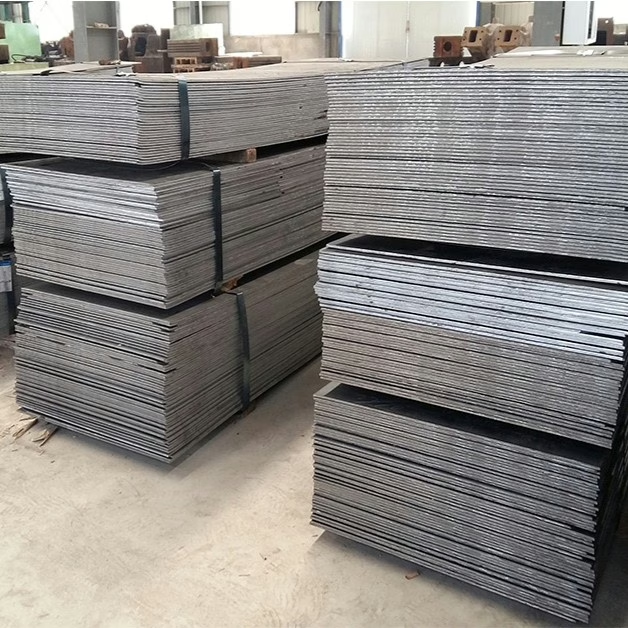
Aobo Steel supplies M2 high-speed tool steel in an annealed condition for bulk buyers, distributors, stockists, and tool manufacturers. We can supply M2 round bar, flat bar, and plate according to order requirements. Final hardness, such as 60–66 HRC, should be achieved by the customer’s heat-treatment process after machining.
For M2 tool steel supply, bulk orders, or technical discussion, visit our M2 tool steel product page or contact [email protected].

FAQ
M2 tool steel typically reaches 60–66 HRC after proper hardening and tempering. For many cutting tools, the common working hardness is around 64–65 HRC.
The typical annealed hardness of M2 tool steel is about 212–241 HB. This condition is used for machining before final heat treatment.
Yes. M2 can reach about 66 HRC with proper hardening and tempering. However, maximum hardness is not always the best choice for impact-loaded tools.
Many M2 cutting tools are heat-treated to about 64–65 HRC. This range provides strong wear resistance, cutting-edge retention, and red hardness.
Red hardness means M2 can retain useful hardness at elevated temperatures. This helps cutting tools resist softening when frictional heat builds up at the cutting edge.
No. Higher hardness improves wear resistance, but it can reduce toughness. For punches, shearing tools, saw blades, or impact-loaded tools, a lower range such as 60–62 HRC may give better service life.
Usually no. M2 tool steel is commonly supplied in the annealed condition for machining and later heat treatment. Final hardness is achieved after hardening and tempering.